Search Engine Marketing

AI Adoption Outpaced The PC & Internet: Dive Into The Stanford Report Data via @sejournal, @MattGSouthern

Stanford’s 2026 AI Index covers 400+ pages of data. Here’s what search professionals should take from the adoption numbers, reliability gaps, and transparency decline. The post AI Adoption Outpaced The PC & Internet: Dive Into The Stanford Report Data appeared first on Search Engine Journal.
AI Adoption Outpaced The PC & Internet: Dive Into The Stanford Report Data via @sejournal, @MattGSouthern Read More »

Advertisers are testing ChatGPT ads — but uncertainty remains high

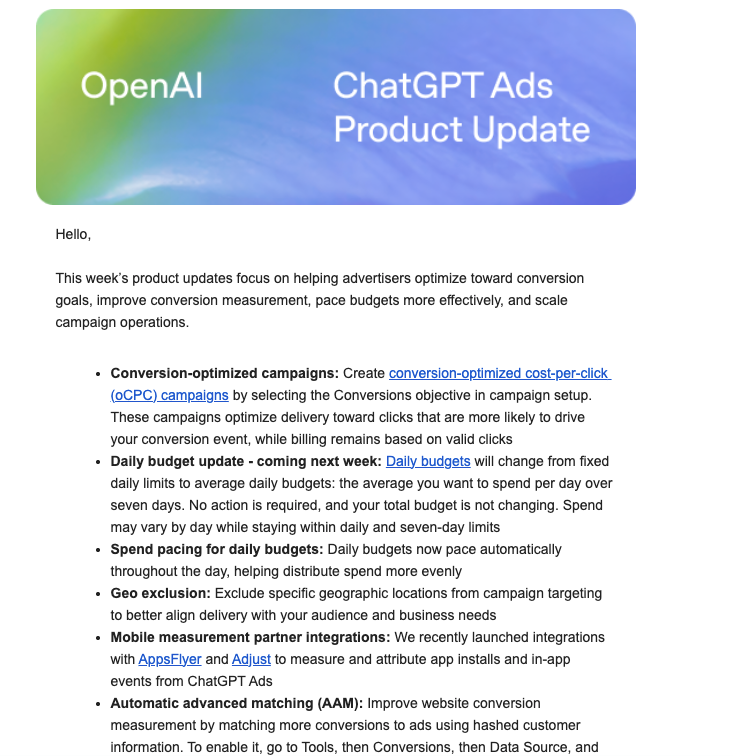
OpenAI is emerging as a new advertising channel, but early advertiser sentiment is mixed as brands grapple with limited data, unclear performance, and a rapidly evolving product. Driving the news. Two months after launching ads in ChatGPT, advertisers are experimenting — but still lack clear measurement tools and performance benchmarks. Early campaigns are largely impression-based,

Advertisers are testing ChatGPT ads — but uncertainty remains high Read More »

Google Ads API to require multi-factor authentication

Google is tightening security across its ads ecosystem, requiring multi-factor authentication (MFA) for API users — a move that could impact how developers and advertisers access and manage accounts. Driving the news. Google will begin rolling out mandatory MFA for the Google Ads API starting April 21, with full enforcement expected over the following weeks.

Google Ads API to require multi-factor authentication Read More »

Google Ads tests direct Google Tag Manager integration for conversion setup

Google may be streamlining one of the most error-prone parts of campaign setup — conversion tracking — by reducing the need for manual tag implementation. Driving the news. Google Ads is testing a new “Set up in Google Tag Manager” option within its conversion setup flow, according to screenshots shared by Google Ads Specialist, Natasha

Google Ads tests direct Google Tag Manager integration for conversion setup Read More »

Why bottom-of-funnel content is winning in AI search

Google search traffic is dropping. If you’ve spent years building organic strategies, watching it happen in real time is uncomfortable. But it’s also clarifying. I started seeing the shift across SaaS clients. Pages that had driven steady traffic for years — educational, top-of-funnel (TOFU) content — were losing ground. Not because the content got worse,

Why bottom-of-funnel content is winning in AI search Read More »

AI traffic converts better than non-AI visits for U.S. retailers: Report

Traffic from AI sources increased 393% year-over-year in Q1 and 269% in March. But the real surprise? AI traffic is converting better than last year. AI-driven visits converted 42% better than non-AI traffic in March. A year ago, AI traffic was 38% less likely to result in a purchase. By the numbers. Traffic from AI

AI traffic converts better than non-AI visits for U.S. retailers: Report Read More »

U.S. search ad revenue reached $114.2 billion in 2025

Search remained the largest force in digital advertising in 2025. However, its growth slowed as total U.S. ad revenue climbed to a record $294.6 billion. Search still dominates. Search generated $114.2 billion, accounting for 38.8% of total digital ad revenue, according to the latest IAB/PwC Internet Advertising Revenue Report. But growth slowed to 11%, down

U.S. search ad revenue reached $114.2 billion in 2025 Read More »

No-JavaScript fallbacks in 2026: Less critical, still necessary

Google can render JavaScript. That’s no longer up for debate. But that doesn’t mean it always does — or that it does so instantly or perfectly. Since Google’s 2024 comments suggesting it renders all HTML pages, many developers have questioned whether no-JavaScript fallbacks are still necessary. Two years later, the answer is clearer and more

No-JavaScript fallbacks in 2026: Less critical, still necessary Read More »

Your ROAS looks great — but is it actually driving growth?

An ecommerce company hires your PPC agency to explore paid search. A solid plan follows, and after approval, the campaigns go live. Soon, you’re seeing stellar results: high conversion volumes and a healthy ROAS. On the surface, the strategy is a resounding success. But look closer. Some of these conversions might have occurred anyway via

Your ROAS looks great — but is it actually driving growth? Read More »