

For many local businesses, their Google Business Profile plays an indispensable role in lead generation. It drives calls, website visits, bookings, direction requests, and customer trust.
When the profile is working as it should, it becomes so embedded in the business’s marketing that few people consider what would happen if it suddenly disappeared or stopped performing normally.
That risk becomes reality when a profile is suspended, transferred, merged, or forced into reverification. Similar problems can occur when a profile remains visible but loses ownership access or local visibility. In each case, the business may spend days or weeks trying to resolve the issue while calls and leads decline.
Much of the advice about Google Business Profile disruptions focuses on recovery. Businesses are told to review the guidelines, gather documentation, submit an appeal, and contact support. Those steps are necessary, but they address only part of the problem. Businesses also need a plan to maintain lead flow while recovery is underway.
A business continuity plan brings those priorities together. It prepares the business to preserve access, recover the profile, maintain lead flow through other channels, and reduce long-term dependence on Google Business Profile.
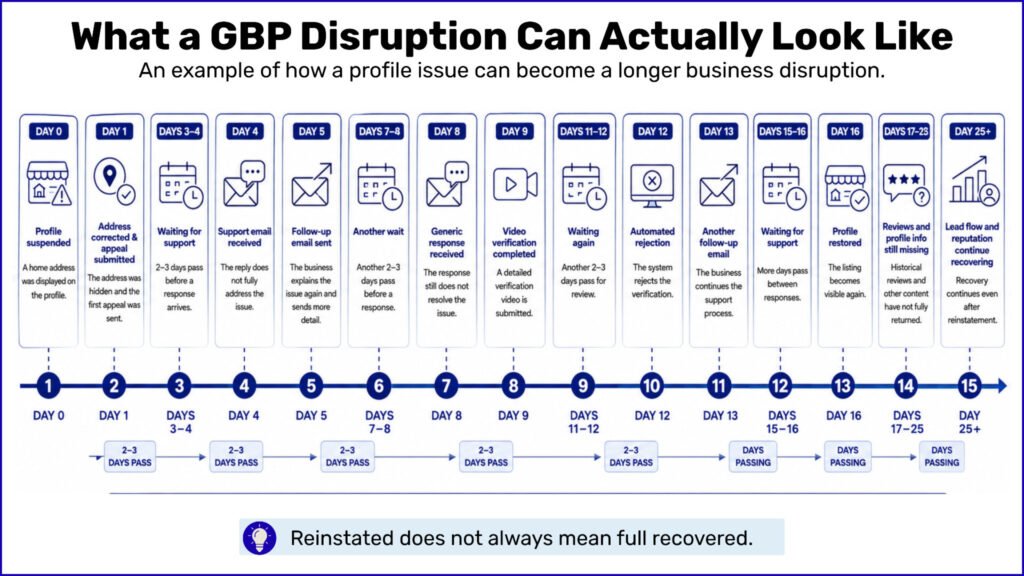
What a Google Business Profile disruption can actually look like
A local service business experienced this after its Google Business Profile was suspended for displaying the owner’s home address. The company was legitimate, but it operated at customer locations and should have been configured as a service-area business with the address hidden or established a physical business location.
Correcting the address was only the beginning. Responses from Google often took several days, leaving the business uncertain about what would happen next. Some support replies didn’t address the specific issue or evidence provided, forcing the business to repeat information and continue pursuing a resolution. Each delay kept the profile offline longer and further affected the company’s bottom line.

The company was also required to complete video verification. The recording showed the surrounding area, street signs, access to the property, business documents, a branded vehicle, and tools and equipment. Although the video met Google’s verification requirements, the automated system rejected it, extending the disruption and requiring additional support interactions.
The profile was eventually restored, but much of its previous information didn’t return. Historical reviews and other profile content were missing, even as new reviews began appearing. Historical performance data was also gone. The listing was technically active again, but one of its most important sources of customer trust hadn’t been fully restored.
During this process, which could take days, weeks, or even months, the business still needed calls, leads, and booked work. Waiting for the next support response couldn’t become its entire marketing strategy.
Experiences like this show why local businesses need to prepare for more than suspensions or verification issues. Recovery can involve delayed responses, automated decisions, repeated requests for evidence, and incomplete restoration. A continuity plan should account for the time between the initial disruption and the point when the profile’s visibility, content, and lead generation have fully returned.
Everything you need to manage your GBP, dominate Google Maps, and attract more customers.
Understand the business risk
A Google Business Profile problem can quickly become a revenue problem when a business depends heavily on local search. A suspension can reduce calls and website visits almost immediately. Missing reviews can weaken customer confidence. Incorrect hours, categories, or contact information can create confusion even when the profile remains visible.
The severity of the impact depends on how much of the company’s business comes from Google. Some businesses use GBP as one part of a broader acquisition strategy that includes organic search, referrals, repeat customers, paid advertising, partnerships, and email marketing. Others rely on Maps and the local pack for most of their new business.
That dependence should be measured before a problem occurs. Review the previous six to 12 months of profile performance, website analytics, call tracking, and lead records to estimate how many opportunities originate from your Google Business Profile. Perfect attribution is unlikely because customers often interact with multiple channels before contacting the business. The goal is to understand your exposure rather than assign every sale to a single source.
A useful question is how long the business could maintain its current pipeline if the profile stopped generating leads tomorrow. A business with several active acquisition channels may experience a temporary decline. One that depends almost entirely on Maps may face a more immediate threat to revenue.
Dig deeper: Why Google Business Profile address changes can disrupt local rankings
Build the continuity plan before it is needed
A useful continuity plan should address four areas:
- Preserve: Protect access, profile information, documentation, and evidence.
- Recover: Diagnose the problem and follow the appropriate recovery process.
- Replace: Activate other lead sources while the profile is impaired.
- Reduce: Lower long-term dependence on a single platform.
These activities often need to happen simultaneously. The recovery process may require business documents, DBAs, ownership records, videos, support case numbers, and an explanation of recent profile changes.
Replacing lost leads may require website updates, paid campaigns, customer outreach, or referral activity. Waiting until a disruption occurs to organize these efforts only adds unnecessary delay.

The plan should identify who owns each responsibility. One person may manage verification, appeals, and support communications, while another monitors lead flow and activates other marketing channels.
Small businesses may assign both responsibilities to the same person, but treating them as separate workstreams helps prevent the recovery process from consuming the entire marketing effort.
Preserve access, records, and evidence
Document ownership and access first. The business should know who holds primary ownership, which accounts have management access, and whether former employees or agencies still have permissions.
Most important, the business itself should retain primary ownership of the profile rather than relying entirely on an employee, contractor, agency, or other outside provider. Treat the profile as the business asset it is. In most cases, agencies and employees should have manager-level access.
Maintain current copies of documents that may be needed during verification or an appeal. Depending on the business and location, these may include:
- Business registrations and licenses.
- Utility, phone, and internet bills from the past three months.
- Tax and insurance records.
- Lease or ownership documents.
- DBA records.
- Other documentation connecting the business name, location, and operations.
Names and addresses should be consistent with how the business is represented publicly.
Document the profile’s current information, including the business name, address or service area, phone number, website, categories, hours, description, services, products, and attributes. Keeping this information in a central location makes it easier to identify unauthorized changes and restore missing details after a disruption.
Visual evidence is especially important for businesses that may need to complete video verification. A storefront should show permanent signage, the exterior of the location, customer-facing areas, and access to employee-only spaces. A service-area business should demonstrate that it operates legitimately through branded vehicles, equipment, tools, work materials, or business documents.
The business should know in advance what evidence it can provide. Verification becomes more difficult when owners are trying to determine what to show while the process is already underway.
Dig deeper: The local SEO gatekeeper: How Google defines your entity
Maintain a historical record of the profile
A continuity plan should include periodic documentation of the profile’s public state. At a minimum, preserve:
- Review count and average rating.
- Primary and secondary categories.
- Services, products, and business hours.
- Photos and posts.
- Ownership and management access.
- Performance data.
- Major profile edits.
- Previous verification requests.
- Support case numbers and correspondence.
Screenshots and exports won’t automatically restore missing information, but they can help establish what existed before the disruption. They also help determine whether the profile has fully recovered.
This matters because reinstatement may restore public visibility without restoring everything that was previously there. Reviews, services, products, photos, or reporting data may still be missing. Local rankings and lead volume may also take time to recover.
A profile should be considered fully recovered only after its information, visibility, and business performance have been reviewed. Finding the listing in Search or Maps confirms that it’s live. It doesn’t confirm that it’s functioning as it did before the disruption.
Diagnose the issue before making changes
When calls or visibility decline, business owners often begin editing the profile immediately. They may change the category, address, service area, phone number, or business name while trying to identify the cause. Making several changes at once can make the original issue harder to diagnose and create new inconsistencies.
The first step is identifying the type of problem. The profile may be suspended, unverified, merged with another listing, or affected by an ownership issue. Reviews may be missing because of a technical problem, a profile merge, or policy enforcement. A decline in leads may result from ranking changes, competition, seasonality, or incorrect information rather than a formal profile restriction.
Before making changes, determine whether the issue involves:
- Suspension or disablement.
- Reverification.
- Ownership or account access.
- A duplicate or merged profile.
- Missing reviews or content.
- Incorrect business information.
- A ranking decline.
- A reporting problem.
- A broader Google issue.
Then review the profile against Google’s guidelines. Confirm that the business is eligible and that its name, address, service area, phone number, website, hours, and categories accurately represent the business.
Correct any genuine errors before submitting an appeal. The explanation provided to Google should remain concise and factual. It should explain what the business is, how and where it operates, what may have changed, and which documents support the profile’s eligibility.
Define what recovery should include
A continuity plan should establish a clear definition of recovery. Public visibility is one part of that definition, but it should also include ownership, profile content, reviews, rankings, and lead generation.
Once the profile is reinstated or verified, check:
- Ownership and management access.
- Business name, address, or service area.
- Phone number and website.
- Primary and secondary categories.
- Services and products.
- Hours, attributes, photos, and posts.
- Review count and average rating.
- Local rankings.
- Calls, website visits, and other interactions.
- Performance reporting.
This process may reveal that the technical issue has been resolved while the commercial impact continues. A profile can return to Search and Maps without immediately regaining its previous visibility. Missing reviews can lower conversion rates even when rankings remain stable. Lost services or incorrect categories can affect which searches surface the business.
Recovery should be measured by both profile functionality and business outcomes. The business needs to know whether customers can find accurate information, whether trust signals have returned, and whether calls and leads are moving back toward previous levels.
Dig deeper: 5-step Google Business Profile audit to improve local rankings
Keep lead generation moving during recovery
The support process can consume significant time and attention, particularly when cases are closed without resolving the underlying problem or when additional verification is required. Continue working through the appropriate support channels, but don’t put the rest of your marketing on hold.

The website becomes especially important during this period. Customers should be able to determine what the business does, where it operates, whether it’s open, and how to get in touch without relying on the Business Profile.
Phone numbers and calls to action should be easy to find, especially on mobile devices. Test contact forms. Clearly explain service areas, business hours, and core services. Testimonials, credentials, project examples, and other trust signals can help replace some of the confidence normally created by the profile and its reviews.
Review what appears for branded searches. The homepage, contact page, and other prominent listings should reinforce that the business is active and available. Social profiles, chamber pages, trade associations, and relevant directories should also contain accurate information.
Customers generally don’t need a detailed explanation of the Google issue. They need confirmation that the business is open and a clear way to get in touch.
Use paid search to protect high-intent demand
When budget is available, paid search can provide one of the fastest ways to replace some lost demand. Focus on searches most likely to generate qualified opportunities rather than trying to replace every lost profile view.
Priority areas may include:
- Branded searches
- Core revenue-generating services
- Urgent or high-intent needs
- Priority towns or service areas
- Campaigns designed to generate calls or estimate requests
Landing pages should make it easy to call, request a quote, or schedule service. Monitor lead quality and cost closely. A surge in paid traffic may look encouraging while producing few qualified inquiries. The goal is to protect the pipeline and revenue, so evaluate results by calls, forms, appointments, and sales rather than clicks alone.
Local Services Ads may also help eligible businesses, although their availability and performance can be affected by account or verification issues. Treat them as one potential channel rather than the entire replacement strategy.
Reconnect with previous customers
Past customers are often one of the fastest sources of new business. Most companies already have years of customer relationships stored in a CRM, invoicing platform, email list, or customer database.
Outreach should give those customers a reason to reconnect. Campaigns may focus on seasonal reminders, maintenance services, follow-up work, new services, previously postponed projects, or referral requests.
A contractor might promote seasonal maintenance or a related service. A painter might contact previous customers about exterior maintenance, deck staining, or another room. A plumber might focus on drain maintenance, water heaters, or seasonal inspections.
The message should focus on the customer’s needs and the business’s availability. The profile disruption doesn’t need to become the centerpiece of the campaign.
Dig deeper: Local 5.0: The next evolution of local SEO is here
Use social media to stay visible and find local demand
Social media can help maintain visibility while your Google Business Profile is unavailable or underperforming. Share recent projects, customer outcomes, seasonal advice, service reminders, and current availability.
Local businesses should also look beyond their own feeds. Community Facebook groups, neighborhood pages, Nextdoor, and similar local forums often include people asking for recommendations in real time. A homeowner may ask for a plumber, painter, electrician, or landscaper without ever opening Google Maps.
Monitor these conversations and participate where appropriate. The best approach is usually to answer helpfully, disclose the business relationship, and avoid turning every conversation into a sales pitch. In some communities, existing customers or referral partners may also recommend the business when relevant.
The goal is to stay visible where local conversations are already happening. During a Google Business Profile disruption, those conversations can provide another source of awareness, referrals, and direct inquiries while the business works to restore its Google presence.
Activate referral and community relationships
Rather than announcing that the profile is experiencing a problem, explain that the business has availability for a particular service and ask whether the partner knows someone who may need help.
Local organizations and community channels can also support visibility. Share recent work, customer outcomes, timely advice, and current availability through social media, neighborhood groups, associations, and community events.
Use these channels thoughtfully. Repeated promotional posts may damage trust, especially in community groups. Helpful participation and consistent visibility tend to produce better long-term results than emergency advertising.
Continue building reputation elsewhere
A suspended Google Business Profile may prevent customers from leaving new Google reviews, while missing historical reviews can weaken conversion even after the profile returns. Don’t put your entire reputation-building strategy on hold while the issue is being resolved.
During the disruption, redirect review requests to credible secondary platforms that are relevant to the business and its customers. Depending on the industry, those may include Yelp, Facebook, the Better Business Bureau, Angi, Houzz, TripAdvisor, Healthgrades, Avvo, or other established trade and professional directories.
Choose a small number of appropriate platforms rather than sending customers to every review site available. The goal is to continue building credible customer feedback in places prospects are likely to consult.
Other reputation-building activities may include:
- Adding approved customer testimonials to the website
- Developing case studies and detailed project examples
- Preserving records of legitimate customer transactions and feedback
- Highlighting customer outcomes through social media and email
- Monitoring whether historical Google reviews return after reinstatement
- Resuming normal Google review requests once the profile is fully active
Don’t encourage customers to repost the same review across multiple platforms or recreate old Google reviews in large numbers. That can appear unnatural and may weaken the credibility of the review program.
Google reviews are important for local visibility and conversion, but they shouldn’t be the business’s only source of public reputation evidence. A broader review presence, supported by testimonials, case studies, and customer stories the business controls, provides additional protection when one platform becomes unavailable.
Reduce dependence after the profile returns
Once the profile is restored, review which continuity efforts produced qualified leads. Some emergency campaigns may no longer be necessary, but the most effective channels can remain part of the ongoing marketing strategy.
A durable acquisition mix may include Google Business Profile, organic search, paid search, referrals, repeat customers, email, social visibility, local partnerships, community involvement, and public relations. The right mix will vary by business. The goal is to prevent any one channel from controlling the entire pipeline.
Owned assets deserve particular attention. Businesses have greater control over their websites, customer databases, email lists, phone numbers, project photos, case studies, and referral relationships than Google’s verification systems, review filters, and support processes.
Together, these owned assets reduce dependence on any single platform and make the business more resilient.
Measure the impact and update the plan
Compare performance before, during, and after the disruption. Useful measures include:
- Calls and website visits.
- Form submissions.
- Qualified leads.
- Appointments and estimates.
- Sales and revenue.
- Advertising costs.
- Cost per lead.
- Staff time spent on recovery.
- Time required for visibility and lead flow to return.
This review can show how much lead volume was lost, which channels replaced it, and what those replacement leads cost. It can also reveal how long the profile took to regain its previous visibility and whether customer conversion returned to previous levels.
Once the incident has stabilized, document what happened. The review should cover the cause of the disruption, records that were difficult to find, recovery steps that worked, channels that generated leads, and areas where customers became confused.
Update the continuity plan based on those findings.
Boost your visibility, earn more reviews, climb higher on Maps, and stay ahead of local competitors.
Protect the business around the profile
Google Business Profile will remain one of the most valuable marketing assets for many local businesses. That value also makes dependence on the platform a meaningful business risk.
No business can control every reverification request, review filter, support decision, or technical problem. They can prepare the evidence needed for recovery, document the profile’s history, and maintain other ways to reach customers.
A strong continuity plan protects the profile, the lead pipeline, and the business behind both. The work begins before a disruption occurs and continues after the listing returns.