

If you apply standard SEO playbooks to a travel website, you’ll likely exhaust your budget with little to show for it.
Most SEO advice is written for sectors operating in a search ecosystem where organic text listings still dominate most user journeys.
In travel, the rules of search are entirely different because Google isn’t just a search engine. It’s a direct transactional competitor, a visual aggregator, and a gatekeeper to visibility.
Winning in this space requires accepting that what works elsewhere will fail here. To build a search strategy that actually drives bookings, travel brands must abandon standard organic best practices and instead master unique challenges:
- Extreme search engine results page (SERP) dominance.
- Complex regulatory constraints.
- Intermittent, non-linear user journeys and highly fragmented user intent.

Travel search is driven by data, not webpages
In almost every other industry, the ultimate goal of SEO is to secure a high-ranking organic text listing.
In the travel sector, particularly for high-intent queries involving hotels, flights, and activities, the traditional “blue link” is functionally dead (and becoming even less relevant as AI, AI Overviews, and other LLMs compete for user attention).
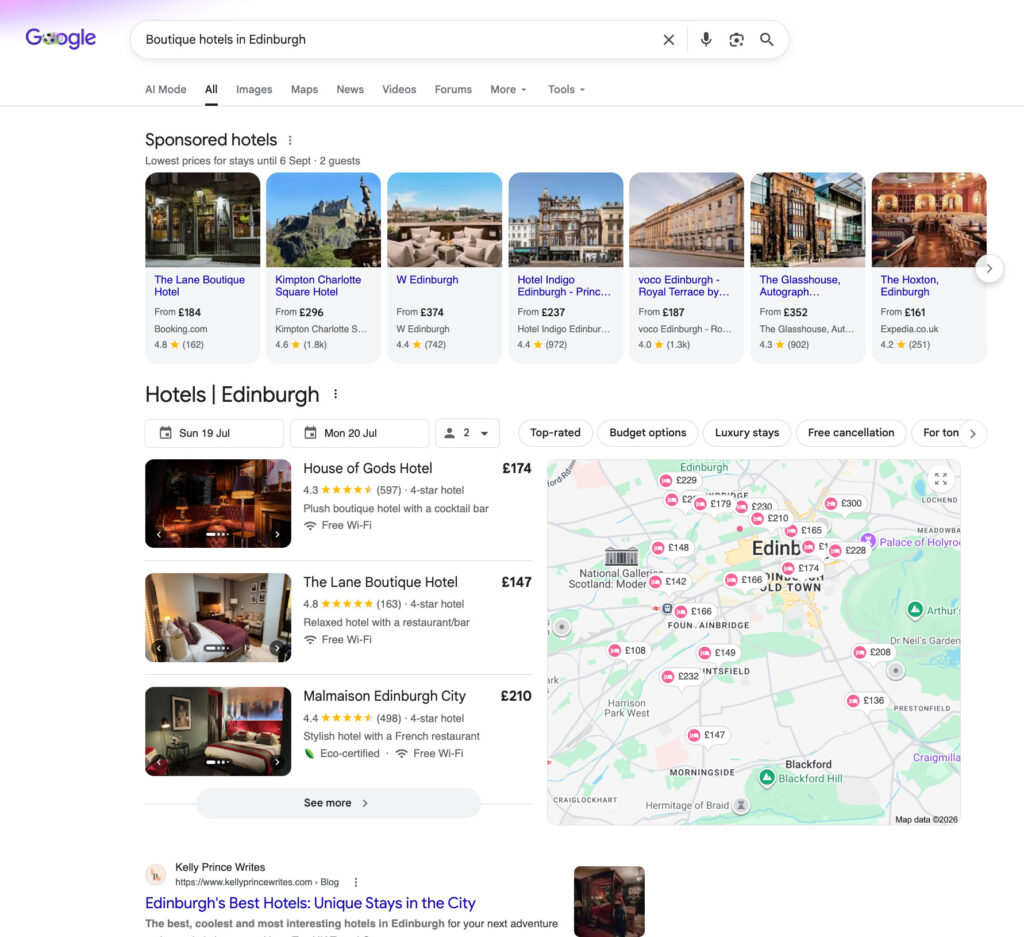
If a user searches for “flights from London to Rome” or “boutique hotels in Edinburgh,” the top of the search page is entirely occupied by Google’s own interactive search tools.
Below these tools sit local map packs, sponsored advertisements, and, in the UK and Europe, the massive “Find results on” directory boxes mandated by antitrust regulations.

Instead of just writing content, successful travel SEOs focus on feed management and entity optimization.
For accommodations and hotels, this means treating Google Hotel Center with the same priority an ecommerce specialist gives their primary website. You must ensure that your real-time pricing feeds, inventory levels, and tax calculations are integrated directly with Google’s API.
Travel entity optimization requires meticulous calibration of your Google Business Profile. Google’s local algorithms categorize hotels and attractions based on physical attributes rather than editorial text.
Whether your property appears in a filtered search for “dog-friendly hotels with free parking” depends entirely on your structured attributes, customer review sentiment analysis, and precise location coordinates.
In travel, the search engine is a database, and your primary job is to format your data so the database can display it without friction.
Dig deeper: AI referrals to travel sites surge 194% as engagement rises: Adobe
Track, grow, and measure your visibility across Google, AI search, social, local, and every channel that influences buying decisions.
How social content bypasses your website
Traditional search campaigns operate under the assumption that organic traffic must land directly on a domain you own to have any measurable value.
In the travel sector, this insular approach ignores how modern searchers, especially younger audiences seeking visual reassurance before booking, actually behave.
Google has adapted to this shift by turning its results pages into visual aggregators that pull content directly from external social networks.

For queries driven by discovery or curation, such as “best rooftop bars in Soho” or “hidden beaches in Cornwall,” Google often serves dedicated “Short Videos” carousels and “Perspectives” feeds directly within the main search results.
These features extract short-form video content from TikTok, Instagram Reels, and YouTube Shorts, allowing users to watch authentic, crowdsourced footage without ever visiting a traditional website. With search engines actively indexing public business posts from platforms like Meta, social media updates are now ingested into search layouts and AI Overviews.
Travel SEO is no longer confined to the boundaries of your content management system. To capture this visual search real estate, digital teams must treat social media profiles as distributed landing pages.
This is further reinforced by Google’s introduction of social and video content analytics within Google Search Console.
Dig deeper: How travel brands can earn AI recommendations
Fragmented and intermittent intent
The standard content marketing advice for B2B or consumer services is to build comprehensive, long-form informational guides. The theory is that if you write a 4,000-word article covering every possible detail of a destination, you’ll build topical authority and guide the reader smoothly down a conversion funnel.
In travel SEO, this approach often yields high bounce rates and very few conversions. Travelers don’t plan trips in a linear fashion, nor do they want to read extensive blocks of text on mobile devices while walking down a busy street.
Travel planning is highly visual, emotional, and fragmented across different devices and moments.

A user searching for “things to do in Cornwall” is usually looking for quick inspiration, geography-based grouping, and immediate utility. If they land on a page with lengthy introductory paragraphs and dense blocks of prose, they’ll return to the search results to find a simpler resource.
Travel content must be built for rapid utility rather than high word counts. Instead of writing long essays, your content layouts should rely on interactive, modular components, such as:
- Tabbed interfaces that allow users to toggle between “Itinerary,” “Cost,” and “Best Time to Visit.”
- Embedded, interactive maps that show the physical proximity of recommended locations.
- Bite-sized, structured lists that clearly state opening hours, entry prices, and booking links.
Structuring content this way also makes it much easier for Google to extract your data for its AI Overviews and visual carousels.
Instead of trying to keep users on a long page of text, the goal should be to provide structured, high-value answers that Google can easily parse.
When your site behaves like a functional tool rather than an online magazine, users are much more likely to bookmark your pages and trust your brand when they’re finally ready to book.
Dig deeper: Why Tripadvisor still matters for local SEO in 2026
A different definition of success
Winning at travel SEO requires a fundamental shift in perspective. Success can’t be measured solely by standard keyword rankings or overall organic traffic levels.
It must be evaluated by how effectively your site appears across Google’s SERP features, how reliably your data feeds communicate real-time pricing, and how quickly your landing pages answer highly specific, visual questions.
By stepping away from generic SEO advice and focusing on technical data feeds, regulatory price compliance, and modular user experiences, travel brands can secure a distinct competitive advantage in one of the most crowded landscapes on the web.