

Negative keywords aren’t a checklist anymore. In 2026, they’re a series of strategic decisions — and how you make them shapes how the algorithm interprets your account.
If you’re still treating negatives like maintenance, you’re missing the point. Every exclusion is a signal: who you want to reach, what you’re willing to pay for, and how your campaigns should perform.
Here are six decisions that define modern negative keyword strategy — and why they matter more than ever.
How negative keywords shape campaign performance
Negative keywords are how you sculpt a campaign so the right ad shows up for the right person. The user’s query should match the ad. The ad should match the landing page. That alignment is what creates a good experience for the person on the other side of the screen (a.k.a., your ideal client).
When that alignment breaks down, you waste budget. You also drag down click-through rate (CTR) and Quality Score, and push CPCs up. All of this is what ultimately makes the algorithm work against you in an ads account.
But many of us were never really taught how negatives fit into an overall account strategy. We were taught how to add them. There’s a big difference.
Now let’s get into the six strategic choices.
1. How aggressive should you be with negatives?
This is the first decision an account manager needs to make, and most people skip it.
Are you scraping the bottom of the barrel every week, pulling out every search term that didn’t convert? Are you letting things slide so you can keep mining new keyword opportunities? Or are you somewhere in the middle, adding negatives mostly to show that you’re doing something?
There’s no universal right answer. But you do need to pick a level of aggression and back it up based on the account’s performance and goals.
A growth-focused account probably shouldn’t be aggressive. An efficiency-focused account probably should. A small-budget account that can’t afford to learn slowly often needs to be more aggressive than an enterprise account that can.
Pick the level. Defend the level when you’re working in the account and talking to your team. Then the rest of your choices become easier.
2. How to use match types for negative keywords
Negatives don’t match the same way regular keywords do — broad, phrase, and exact — but most advertisers default to one match type without thinking about why.
Here’s how I think about it:
- Negative exact match: Use this for strict removal. A specific long-tail variation that’s wasting budget, but you don’t want to nuke similar queries.
- Negative phrase match: Use this for groups of related queries you want gone. Competitor names, certain question phrases, and intent modifiers like “tutorial” or “review.”
- Negative broad match: Use this for words you want eliminated entirely — words like “cheap,” “dangerous,” or “free,” that signal a misaligned audience no matter how the rest of the query is constructed.
This isn’t an either/or decision. A real negative keyword strategy uses all three match types intentionally, in different places, and for different reasons.
3. When should you add negative keywords?
I’ve seen everything here. Some account managers add negatives on a strict weekly cadence, even when the data doesn’t call for it. Some only touch them when something stops converting. Some only review when a quarterly check-in forces them to. And some add them just to look busy on a status report.
My recommendation: don’t add a negative just because a keyword didn’t convert, especially when you’re trying to scale. You never know if it would’ve converted with a little more volume. Be careful, and tie the trigger back to your account’s goals.
- For accounts in growth mode, the trigger might be: “This query has cost more than 3x my target CPA with zero conversions over 90 days.”
- For accounts focused on efficiency, the trigger might be: “This query cost more than $X without converting, period.”
Both are valid. They just align to different goals in different accounts.
4. What time frame should guide your decisions?
How far back are you looking when you make the call to add something as a negative?
A 30-day window is aggressive. You’re cutting things off before they’ve had a real chance to convert. That’s appropriate for short-cycle ecommerce, fast-moving promotions, or tightly capped budgets. But this might not work for all accounts.
A 90-day window is balanced. Long enough for sales cycles to play out, short enough to actually act on. This is the default I recommend for most paid search accounts.
A 365-day window is conservative. You’re giving every query maximum runway. Appropriate for high-consideration B2B or anything with a long buying cycle.
Longer time frames give individual queries more chances to succeed. Shorter time frames protect your budget faster. Pick the time frame that matches the aggressiveness level you set in your top choice, and don’t make these decisions in isolation from each other.
5. How much should you sculpt your campaigns?
This is where the role of AI really starts to matter when it comes to negative keywords.
- How much control do you want over your account?
- And maybe more importantly: how much do you trust the machine?
Some advertisers embed competitor keywords as negatives in non-brand campaigns just to keep the targeting clean. Some account managers let those queries through because they’re converting, even if they technically “shouldn’t.” Some refuse to add negatives at the campaign level at all, because they trust the algorithm to figure out what should match where.
Consider that the machine and the algorithms have more information than we do. The platforms know what was searched before the query and more about user behavior. They know what was searched after. They know what session context the user is in. They can match queries to keywords in ways we can’t replicate manually.
But sculpting accounts is still how we communicate intent to that machine. If you don’t sculpt, the bidding algorithm doesn’t know what you actually want, and it just optimizes against the goals you handed it, which isn’t always the same thing as the outcomes you actually care about.
I lean toward more sculpting in 2026, not less. The algorithm has gotten better and will continue to improve, but so have the ways it can spend your budget on the wrong queries.
6. How should you manage negatives in practice?
This is the choice that didn’t exist five years ago.
In 2026, you have options that previous generations of account managers never had:
- A fully manual review with a spreadsheet and a search term report.
- Google Ads’ built-in negative keyword suggestions.
- A third-party tool that surfaces negatives semantically.
- Pasting your search term report into a chat and letting AI flag candidates for you.
- Delegating the entire task to a tool that adds negatives on autopilot, with no human in the loop.
The question isn’t which one is best. The question is: how comfortable are you removing yourself from the loop? At what level do you want AI to handle this task?
For some accounts that are highly templated, low-stakes, and high-volume, maybe fully delegated AI negative keyword management is fine. For most accounts, I’d recommend a hybrid: AI surfaces candidates, and you approve them. The middle ground gives you speed without sacrificing oversight.
But the most important part is to make this decision intentionally, not by default, and to be able to defend the choice to key stakeholders. If you’re still doing all your negatives by hand in 2026, that should be a deliberate choice, not just “how I’ve always done it.”
A few golden rules that hold up in any era
No matter which choices you make above, a handful of things still hold true:
- Pull the search terms report regularly. The data won’t tell you what to decide, but it will tell you what to decide about. Make sure you look at the reports regularly, and remember no decision is still a decision.
- Keep your negatives updated as your campaigns evolve. The negatives that made sense for last quarter’s strategy may be the wrong ones now.
- Start with a few negatives and build from there. Being too negative too soon is genuinely harmful when an account is in a growth phase.
- Humans don’t search in straight lines. The query that looks irrelevant to your offer might be the final step before a conversion. Ad platforms try to teach us this in their documentation and training and reiterate that intent is messy, nonlinear, and often unpredictable. But as PPC practitioners, we still find ourselves resisting the idea that the system can make these judgment calls on our behalf.
Paul DeMott, owner of Helium, sees this most clearly in high-spend accounts:
- “Most negative keyword lists are too exhaustive and haven’t been revisited in years… aggressive negative lists often hurt more than they help. You’re constraining the algorithm’s exploration on the exact accounts where it has the signal to make smart calls.”
The risk today isn’t under-negating. It’s over-sculpting based on outdated assumptions.
Jordan Brunelle, owner of Good Growth Marketing, points to a related issue: shutting down queries too quickly because they don’t match the product or service literally.
- “A lot of account managers are quick to negate keywords that don’t perfectly match their product/service… we must get into the head of the searcher and consider what their ultimate need is.”
Intent isn’t always obvious at the query level. It often becomes clear only at the conversion level.
Breanne Bartlett, a paid search consultant, frames it simply:
- “Most account managers still treat ‘vague’ queries as bad and overuse negatives to control them… the mistake isn’t allowing these queries, it’s blocking them before you’ve seen how they actually convert.”
Top accounts aren’t restrictive. They’re responsive. They remove proven irrelevance, not theoretical inefficiency.
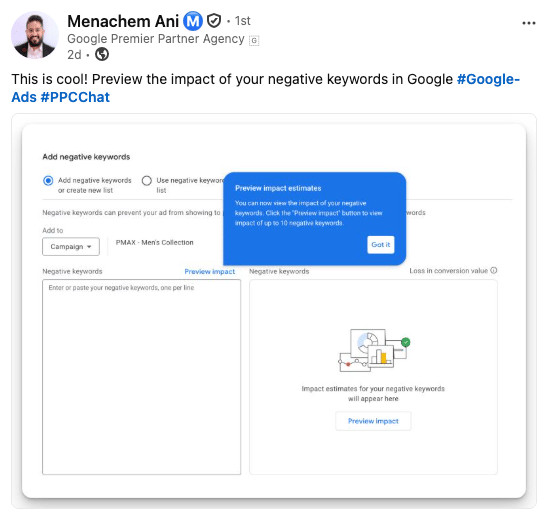
That tension between control and trust is showing up everywhere. As platforms introduce features like previewing the impact of negative keywords before applying them — something Menachem Ani, founder of a Google Premier Partner agency JXT, recently highlighted — the direction is clear: more data-driven decisions, less reactive cleanup.

At the same time, the core principle hasn’t changed. As Boris Beceric, a Google Ads consultant, reminded practitioners, efficiency starts with exclusion:
- “Most small budgets don’t fail because the offer is bad. They fail because the ads get shown for the wrong searches.”

Beceric’s post on LinkedIn reframes negatives as a proactive efficiency tool, not just a cleanup task, and underscores that deciding what not to target is just as strategic as deciding what to include.
Together, these perspectives capture the evolution of negative keyword strategy: from maintenance to signal-shaping, from exclusion to intent communication. The smartest account managers aren’t just adding negatives — they’re auditing, previewing, and sculpting them with purpose and a larger goal in mind.
What your negative keyword decisions are really doing
Negative keywords have always been part of paid search. What’s changed in 2026 is how much depends on how you guide — or defer to — the machine.
The real risk is making decisions about negative keywords on autopilot. Stale lists, over-sculpting, and unexamined habits quietly shape how the algorithm interprets your intent.
Every choice ties back to one question: what are the goals of this ad account?
A growth-focused account makes different choices than an efficiency-focused one. A small-budget account behaves differently from an enterprise one. A B2B account isn’t the same as high-velocity ecommerce. Even the “right” level of control shifts as Smart Bidding gains more signal.
Negative keywords aren’t a checklist in 2026. They’re a series of decisions that compound over time — and the account managers who make them intentionally, with fresh data, and clear goals, are the ones who deliver better results and can explain why.