

The search index is evolving from ranking pages to supporting AI-generated answers. In a blog post published today, Microsoft Bing explained why AI search needs a different indexing system than traditional web search.
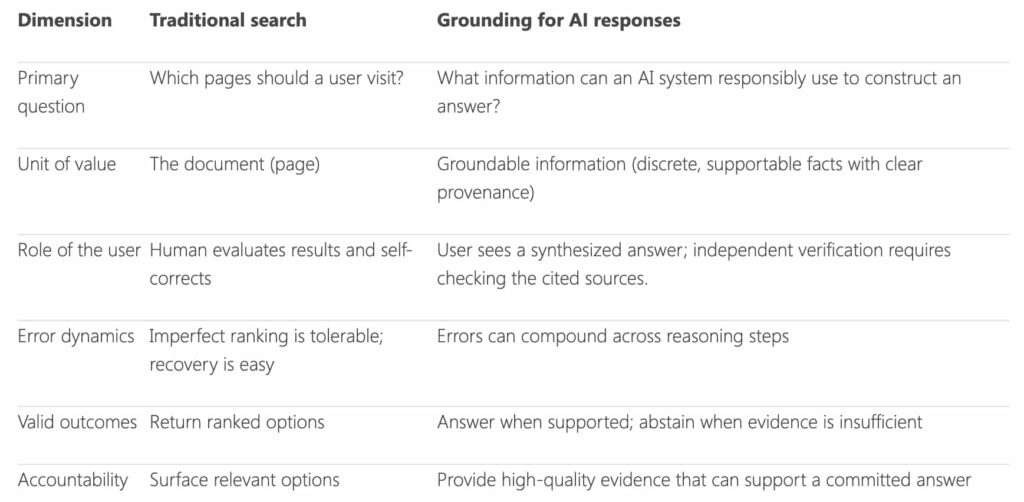
Traditional search vs. grounding systems. Microsoft said traditional search can rely on users to self-correct, while AI systems need stronger evidence because they generate committed answers.
- Traditional search is built around documents. Users get ranked links, scan the results, and decide what to trust.
- Grounding systems are built around supportable facts with clear sourcing. The AI uses that information to generate a combined answer, where mistakes can compound across sources and reasoning steps.
They shared this table:

What’s different. Traditional ranking is optimized for relevance. Grounding must also assess whether information is accurate, up to date, clearly sourced, and sufficient to support an answer. That means AI indexes need to account for whether:
- A page’s meaning survives chunking and transformation.
- The source is clearly identified.
- The information is fresh enough to use.
- Important facts are actually retrievable and groundable.
- Grounding systems need to detect disagreements between sources before generating an answer.
Stale content. Stale content creates a different risk in AI answers, Microsoft said. In traditional search, it may hurt ranking quality. In grounding systems, it can directly generate a wrong answer.
Contradictions. A search engine can rank one source above another and let users decide. Grounding systems must recognize conflicting evidence before turning it into a single answer, according to Microsoft.
Retrieval is more complex. Search is usually a single interaction: query in, ranked results out. Microsoft said grounded AI systems may retrieve information repeatedly, refine based on earlier results, combine evidence, and reassess confidence before answering.
How indexing quality is measured. Search quality has traditionally focused on ranking performance and user behavior. Grounding systems also need to measure factual fidelity, source quality, freshness, evidence strength, and conflict detection. The industry is still learning how to rigorously measure grounding quality, Microsoft said.
Grounding doesn’t replace search. Grounding builds on existing search infrastructure while adding systems focused on evidence quality, attribution, and deciding when an AI system should avoid answering, Microsoft said.
Why we care. For decades, search indexes helped determine which pages users should visit. Today, AI grounding determines which information supports an AI-generated answer. Microsoft described grounding as a new layer on top of traditional search, built for AI systems that need higher confidence in the information they use. That shift could push brands and publishers to focus more on creating information AI systems can confidently use.
The blog post. Evolving role of the index: From ranking pages to supporting answers