

Paid social can spark demand that shows up later in search. But when that journey spans channels, devices, and days, standard attribution often gives the conversion credit to search and leaves social’s influence invisible. So how do you measure the lift?
How measurement can make paid social look like it’s failing
Imagine you have a boss who doesn’t believe in paid social. They’re looking for a reason to cut your paid social or YouTube budget next quarter.
They don’t need to pause your campaigns or declare that social “isn’t working.” They can make the data tell that story by choosing a measurement setup that strips away social’s influence.
For example:
- Relying on last-touch attribution: This gives the conversion to the final click and erases the value of earlier interactions that influenced the journey.
- Restricting credit to a 24-hour conversion window: This excludes much of paid social’s influence, which often takes longer to convert.
- Separating paid social into its own report: This isolates social from paid search, email, and organic, making it harder to see how channels work together.
Each choice removes context and makes paid social look weaker than its actual contribution.
If this sounds familiar, the solution is to measure the demand social creates rather than judging it solely by the conversions it gets direct credit for.
Dig deeper: How to measure paid social’s impact on paid search performance
Uncover the keywords, ads, landing pages, and strategies driving your competitors’ paid search success—and find your next opportunity to outperform them.
How to prove the demand paid social creates
To counter the “designed to fail” analytics story, you have to stop trying to track individual users with broken pixel trails. Instead, step back and measure the broader demand your paid social campaigns create.
1. Measure demand creation by tracking spikes in branded search
The most immediate, undeniable symptom of effective demand creation is a spike in people actively typing your brand name into search engines.
How to execute
Establish a clear baseline of your branded search query volume (impressions and clicks for your exact brand and specific product names) over a 30- to 60-day static period. Scale up or launch your targeted paid social campaign while keeping your paid search budgets, bids, and nonbrand campaigns completely flat.
How to measure
Calculate the percentage increase in branded search volume relative to your social impression spikes. A corresponding rise in brand queries during or immediately following your social spend peaks provides evidence that social is generating new demand for search to capture.
2. Capture delayed revenue by accounting for sales cycle latency windows
Judging paid social on same-day or 24-hour conversions is like evaluating a marathon by the first 50 feet. Social campaigns build cumulative awareness that converts over time.
How to execute
Dive into your multichannel funnel data to identify your true sales cycle length and latency window (the average number of days that elapse between a customer’s first touchpoint and their final purchase).
How to measure
If your business has a typical 14-day conversion lag, map your paid social spend against paid search conversion surges lagged by 14 days rather than same-day data. Aligning your analysis with your natural latency window exposes the delayed search revenue paid social actually created.
Dig deeper: Why search ROAS depends on paid social more than you think
3. Isolate true incrementality by testing paired geographic markets
If your boss demands hard, indisputable evidence, geo-testing remains the gold standard for incrementality because it relies on real-world business outcomes rather than tracking pixels.
How to execute
Select two demographically and historically similar geographic markets (for example, two medium-sized metropolitan areas with comparable baseline sales). Maintain your baseline paid search campaigns across both regions. Turn on (or double) your paid social spend in Region A (the incubator market) while completely blacking out or capping paid social in Region B (the control market) for four to six weeks.
How to measure
Compare the total search conversion volume between the two markets. The net lift in Region A’s search efficiency over Region B represents the true, incremental demand driven solely by your social investment.
What paid media practitioners are saying about measurement
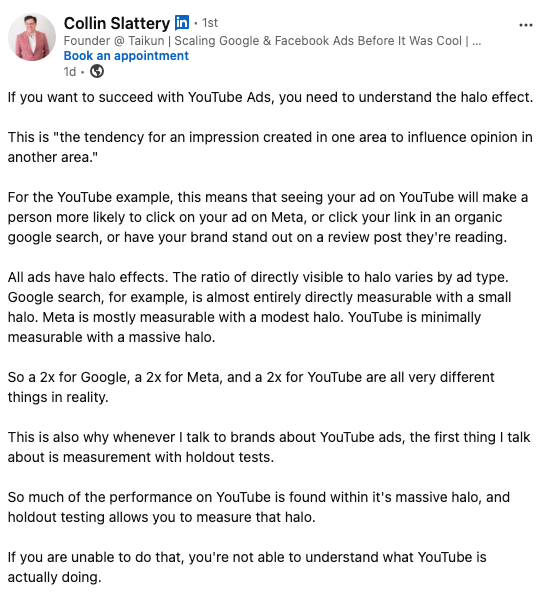
Recent LinkedIn conversations about paid social and upper-funnel measurement point to a common theme: you need to understand a channel’s broader role before deciding whether its performance warrants a change in strategy.
Here’s a look at three perspectives on that challenge:


Dig deeper: How to measure paid social’s impact on PPC
See where competitors are investing, which keywords drive their results, and how to capture more of the market.
Reframe social and search as a demand engine
The next time you present performance data to a skeptical boss, don’t defend paid social as a standalone budget item.
Instead, reframe paid social and paid search as parts of a unified demand engine. Paid social creates market awareness and demand, while paid search captures that intent.
Branded search lift, latency analysis, and regional geo-testing give you evidence of that relationship beyond what last-touch attribution can show. Without the demand created by social, paid search eventually has less intent to capture.