
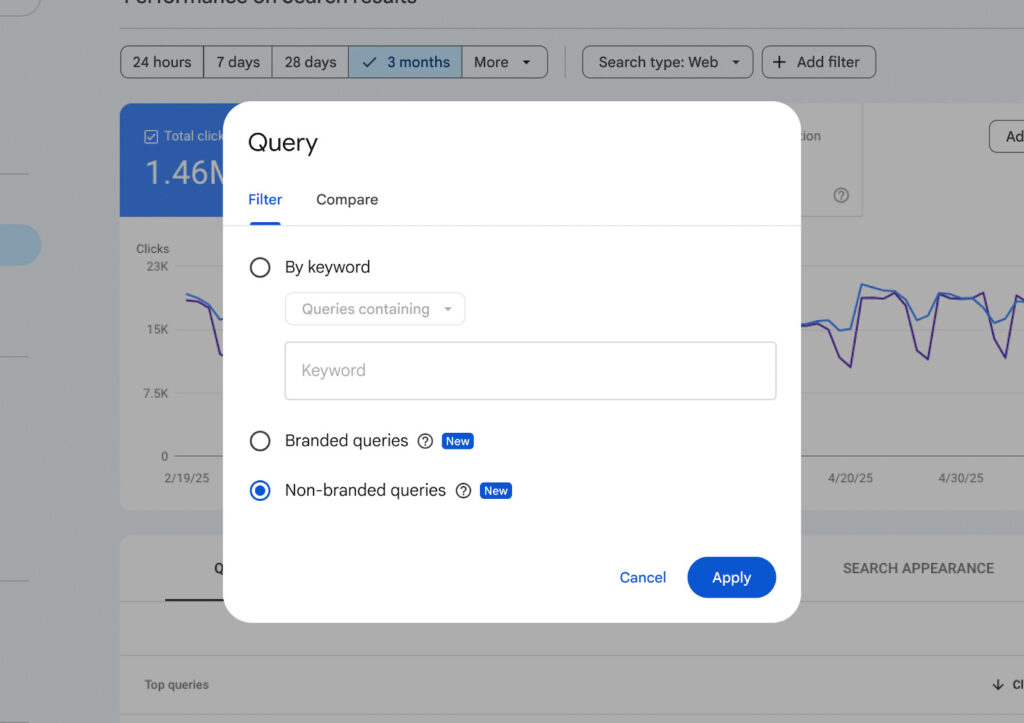

In November 2025, Google solved a persistent SEO reporting challenge: separating branded from non-branded search performance directly in Google Search Console (GSC). The feature is now fully rolled out to eligible properties.
For years, we’ve relied on regular expression (regex) filters, custom dashboards like Looker Studio, or third-party tools — approaches that were often inconsistent and difficult to maintain. Now, GSC’s branded query filter brings that capability natively into one of the most widely used organic reporting platforms.
With this shift, a key gap in SEO reporting becomes easier to address — along with some of the assumptions behind it. Brand demand and discovery can now be evaluated independently, improving performance interpretation and enabling clearer, more defensible reporting grounded in first-party data.
How GSC’s branded query filter works
At its core, the feature does exactly what it promises. It automatically filters queries into:
- Branded queries (queries containing recognized brand terms).
- Non-branded queries (all remaining discovery queries).

The filter appears directly in:
- Performance > Search results > + Add filter > Query.
- Query groups.
- API-accessible data exports.
Together, these features enable:
- Grouping queries by topic or intent.
- Filtering those groups by branded versus non-branded.
- Building layered reports without external processing.
Dig deeper: Google expands Search Console branded queries filter to all eligible sites
The SEO toolkit you know, plus the AI visibility data you need.

Why branded vs. non-branded reporting has been inconsistent
Separating branded from non-branded search performance isn’t new. What’s changed is how practical it is to do consistently.
Historically, we’ve built this segmentation manually using:
- Regex rules in GSC performance reports.
- Keyword tagging in third-party rank-tracking tools.
- Custom dashboards pulling from GA4 or BigQuery.
- Query classification via exports.
These approaches worked, but they were fragile and difficult to maintain at scale. Common challenges included:
- Character limits on regexes.
- International sites with language variants.
- Misspellings that would slip through.
- No shared standard for what counts as a branded term.
Without a consistent framework, segmentation varied by team, tool, and implementation — making it difficult to rely on as a repeatable reporting practice. When data is difficult to access, it doesn’t shape everyday decisions.
GSC’s branded query filter doesn’t make third-party tools obsolete. They remain valuable for competitor brand analysis. GSC becomes the authoritative source for first-party branded performance, while cross-tool comparison shifts from a workaround to a validation step.
The center of gravity shifts back to GSC — right where we want it.
Why SEO performance looks different when you split the data
Branded traffic is both a signal of brand awareness and a high-converting traffic source. It also skews performance when blended with non-branded data.
Without segmentation, reporting often leads to misleading narratives:
- “Our organic CTR is improving” (driven mostly by branded growth).
- “I’m seeing rankings as stable” (while non-branded discovery is declining or vice versa).
- “Traffic was flat year-over-year” (masking rising/declining brand demand).
These patterns make it difficult to understand what’s actually driving performance.
Separating branded and non-branded data allows you to distinguish between brand demand and discovery and evaluate each on its own terms. It also makes it easier to answer key questions:
- Are we growing brand demand or non-branded reach?
- Is our content strategy increasing non-branded visibility?
- If nothing else, is the current strategy working as it should be?
Dig deeper: SEO analytics: How to interpret SEO data and anomalies
How branded vs. non-branded data reveals what’s really happening
Measuring brand health
Branded search trends are among the clearest signals of brand awareness and trust. Monitoring organic performance for branded terms can surface gaps and opportunities across other channels.

For example, using a regex filter to isolate branded performance, this ecommerce property shows clear year-over-year declines over the last three months. That raises important questions:
- Has search demand for the primary branded term increased or decreased?
- Was paid search spend for branded terms adjusted?
- Are there social, video, or PR opportunities that aren’t being fully leveraged?

In this case, further analysis using tools like Keyword Planner (via Google Ads), Google Trends, and third-party keyword platforms showed a 12% year-over-year decline in branded search demand. That contributed to a 32% decrease in branded clicks.
There are additional factors worth exploring — including paid spend and brand sentiment — but isolating branded performance helps pinpoint where to investigate next.
Interpreting performance correctly
Non-branded queries typically drive the majority of organic traffic, while branded queries make up a smaller share but convert at significantly higher rates. These differences reflect user intent.
Searches that include a brand name are usually navigational or transactional, while non-branded queries signal discovery.
As a result, impressions, clicks, CTR, and conversions behave differently across branded and non-branded segments.
Searches that include a brand name often indicate intent to visit that brand’s website (see the ecommerce property CTR comparison chart below). Because of this, branded queries are considered bottom-of-funnel and more likely to convert.

Efficiency, strategy, and measuring discovery
Non-branded performance remains the clearest proxy for:
- Topical authority.
- Content effectiveness.
- Organic discovery and reach.
Tracking non-branded visibility separately allows teams to answer:
- Are we reaching new users?
- Is our content strategy expanding keyword footprints?
- Did recent core algorithm updates, which typically create keyword volatility, impact non-branded traffic?

In the ecommerce example above, non-branded impressions dropped sharply around Sept. 12, 2025 — a period when performance should have been trending upward heading into back-to-school, Halloween, and the holiday season.
In this case, the decline was not tied to SEO strategy. Instead, non-branded impressions dipped following Google’s retirement of the &num=100 parameter in Search Console reporting in mid-September 2025.
Because branded queries typically rank higher, they were less affected by this change, making the issue harder to detect in blended data.
Dig deeper: Is SEO a brand channel or a performance channel? Now it’s both
Track, optimize, and win in Google and AI search from one platform.
More than a feature: A shift in SEO measurement
Most SEO teams already separate branded and non-branded performance, but consistency has been the challenge.
With native segmentation now built into GSC, achieving that consistency becomes far easier. What once required workarounds can now be done directly within the primary reporting interface.
It’s easy to view the branded query filter as just another GSC feature. In reality, it represents something larger:
- Standardized brand classification.
- Native segmentation inside first-party data.
- More consistent and reliable SEO reporting.
- Stronger ties between SEO and broader marketing performance.
This shift changes how SEO work gets done. Teams gain clearer visibility into brand demand trends and discovery performance, and can spend less time reconciling discrepancies across tools and more time interpreting results.
As adoption grows, branded versus non-branded reporting will likely become the default rather than an advanced, custom setup. Reporting becomes more consistent, and performance narratives are easier to support with shared data.
If you’re focused on driving impact, the opportunity is to move beyond reconciling data and toward more confident, consistent interpretation and communication.