

Every week, there’s another headline about the future of search.
Google is losing ground. ChatGPT is growing. Reddit is becoming the place people trust. TikTok is replacing Google for younger audiences. YouTube has become a search engine in its own right.
From the outside, search looks increasingly fragmented. People are discovering brands in more places than ever before.
We’re looking at the consequences through the wrong lens.
Our latest SearchPulse research at Reflect Digital suggests the real shift is about confidence. (Disclosure: I’m Reflect Digital’s founder and CEO.)
The psychological reasons people search haven’t fundamentally changed. People still want to understand. They still want reassurance. They still want to fit in, avoid making mistakes, and feel confident they’re making the right decision.
What’s changing is where they go to build that confidence.
The data only looks contradictory until you think about behavior
At first glance, the research appears contradictory.
We found that 56% of people now regularly use AI search, yet 57% still fall into our Traditional Searcher segment. How can both be true?
People are expanding their search journey across more platforms. The clearest evidence comes from our behavioral segmentation.
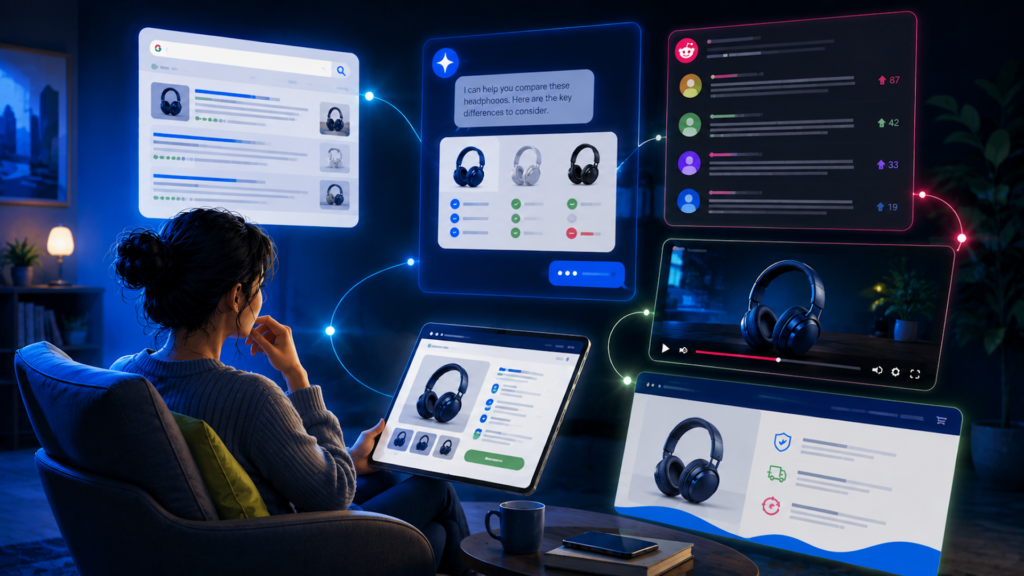
The fastest-growing audience is the “multi-platform searcher” — people who naturally move between search engines, AI, communities, creators, and brand websites before making a decision. They’re assembling confidence from multiple places.
Track, grow, and measure your visibility across Google, AI search, social, local, and every channel that influences buying decisions.
Search behavior doesn’t follow the funnel
Marketing has spent years trying to understand customer journeys. We’ve built funnels, embraced the messy middle, and mapped touchpoints. All of that still has value.
Traditional journey mapping misses something important. People don’t consciously move from awareness to consideration to purchase, nor do they think, “Now I’m going to Google,” or “Now I’m entering the evaluation stage.”
They simply keep resolving uncertainty until they feel confident enough to act. Every interaction fills a different confidence gap. That subtle shift changes how we should think about modern search.
Different platforms serve different needs
We identified four consistent psychological drivers behind search behavior:
- Fact finding: “I need accurate, trustworthy information.”
- Crowdsourcing: “What do people like me think?”
- Taste tuning: “Does this feel right for me?”
- Autopilot: “Help me get this done.”
Those motivations haven’t changed because AI arrived. They’ve always existed. What’s changing is how different platforms satisfy them.
YouTube isn’t successful simply because people like watching videos. Watching something removes uncertainty in a way that text often can’t.
Reddit isn’t valuable because it’s another search engine. Communities provide reassurance through shared experience.
AI excels at helping people understand a topic quickly. Google still plays an important role in verification. Brand websites provide reassurance that you’re buying from the right company.
Platforms are increasingly specializing in different confidence needs.
Dig deeper: Delegation search: Why users outsource decisions to AI
The challenge is understanding confidence
Most marketing teams are still organized around channels:
- SEO.
- Paid search.
- Social.
- PR.
- Content.
Customers don’t think like that. They move between confidence signals until they’re ready to make a decision.
The challenge for marketers isn’t deciding which channel matters most. It’s understanding which confidence gaps their audience still has and making sure they help close them.
How to identify and close confidence gaps
Campaign planning should start with confidence.
1. What confidence does this audience need before they’ll buy?
The answer will vary. A first-time customer needs different reassurance than an existing one. A CFO needs different proof than a marketing manager.
Someone making a $20 purchase has different needs than someone choosing a strategic B2B partner.
2. What confidence assets do we already have?
These pieces of content serve as evidence that reduces uncertainty.
- Customer reviews.
- Case studies.
- Original research.
- Expert opinion.
- Product demonstrations.
- Industry recognition.
- Community recommendations.
- Founder expertise.
Each one answers a different confidence gap.
3. Where will people naturally discover those confidence assets?
This is where platforms come back into the conversation. Different audiences naturally look in different places for different types of reassurance.
The same Trustpilot review can influence someone through a Google search result, an AI answer, your own website, or a direct visit to Trustpilot.
The confidence asset stays the same. The discovery point changes.
4. How will we know we’re building confidence?
This is where marketing needs to evolve. Some confidence is directly observable:
- Traffic.
- Leads.
- Sales.
- Conversions.
Increasingly, some confidence is built in places we’ll never fully attribute.
Someone reads Reddit before searching your brand. They watch a YouTube review. They ask ChatGPT to compare suppliers. They see your research cited by an AI assistant.
Those moments influence decisions, even if they never appear in your analytics platform. They still matter, which means we need to stop judging every confidence-building activity by performance marketing metrics alone.
Some assets exist to generate clicks. Others exist to reduce uncertainty. Both contribute to growth.
Dig deeper: Why ‘search everywhere’ is the new reality for SEO
See where your brand appears, where it doesn’t, and exactly how to win more visibility across search, AI, local, social, and every channel that matters.
The future of search isn’t just about visibility
As AI and zero-click experiences continue to grow, marketers will lose visibility over parts of the customer journey. We can still understand how confidence is built.
That means shifting our thinking from:
- “Which channel drove the conversion?”
to:
- “Which confidence gaps did our marketing help close?”
Search is fragmenting across platforms, but the questions people are trying to answer remain the same. They’re assembling those answers from more places than ever before.
The brands that succeed will understand how confidence is built and make sure they’re present wherever their customers need it.