

Incrementality and attribution are two approaches to measuring marketing performance that are frequently discussed as though they are competing lenses viewing the same data. But they’re actually designed to answer very different questions, using different forms of evidence.
Attribution asks which observed marketing touchpoints should receive credit for a conversion. Incrementality asks whether the marketing activity caused additional conversions that wouldn’t have occurred without it.
A refresher on attribution
Attribution is the favored child of marketing analytics teams everywhere, circa 2015. Marketers discovered that some conversion paths contained multiple touchpoints across the digital landscape, like this:
- Display → Paid Social → Organic Search → Email → Purchase.
That raised questions about which channel should get what “credit”:
- Should the display ad get the most credit for the conversion because it was the first exposure?
- Or should the email, because that’s the touchpoint that finally convinced the user to buy?
- And what about the social ad and the organic presence in the middle?
That’s where attribution modeling came in. Attribution modeling provided frameworks for deciding how that credit should be distributed. Some models assigned the entire conversion to a single touchpoint. Others divided it among multiple interactions.
So if the final value of the conversion is $100, an attribution model tells marketers that display can take credit for $30, email for $30, and the remaining $40 is split between paid social and organic.
Then, when you’re evaluating the success of your channels, you have a more nuanced framework for distributing revenue credit. And when you’re deciding on what channels get what budget for the next fiscal year, you have a way to compare and contrast.
Example: How a $100 conversion might be distributed across four marketing touchpoints.
| Attribution model | Display | Paid Social | Organic Search | How credit is assigned | |
| First-touch | $100 | $0 | $0 | $0 | All credit goes to the first observed interaction. |
| Last-touch | $0 | $0 | $0 | $100 | All credit goes to the final observed interaction before purchase. |
| Linear | $25 | $25 | $25 | $25 | Credit is divided equally among every observed touchpoint. |
| Position- based |
$40 | $10 | $10 | $40 | The first and last interactions receive the most credit, while the middle interactions split the remainder. |
| Time-decay | $10 | $20 | $30 | $40 | Touchpoints receive progressively more credit as they occur closer to the conversion. |
| Data-driven | $30 | $20 | $20 | $30 | Credit is distributed according to each touchpoint’s estimated contribution to the conversion. |
Note: These are simplified examples. Position-based models can use different weighting rules, time-decay allocations depend on timing, and actual data-driven models vary.
Uncover the keywords, ads, landing pages, and strategies driving your competitors’ paid search success—and find your next opportunity to outperform them.
Incrementality 101
Incrementality began to gain renewed interest from marketers around 2020.
Rather than dole out credit for a sale to different touchpoints and channels based on a mathematical equation, incrementality relies on carefully guardrailed tests of real, live sales data that attempt to prove the “true” impact of a marketing activity rather than its correlation. Incrementality tries to answer the question:
- How many of these sales were actually caused by this campaign, without counting how many would have happened regardless?
The answer to that question is what marketers call lift. And through tightly controlled tests leaning on the scientific method, marketers were able to isolate the difference in sales between a group exposed to the marketing activity and an equivalent group that wasn’t exposed to marketing materials.
Incrementality is best explained through an example.
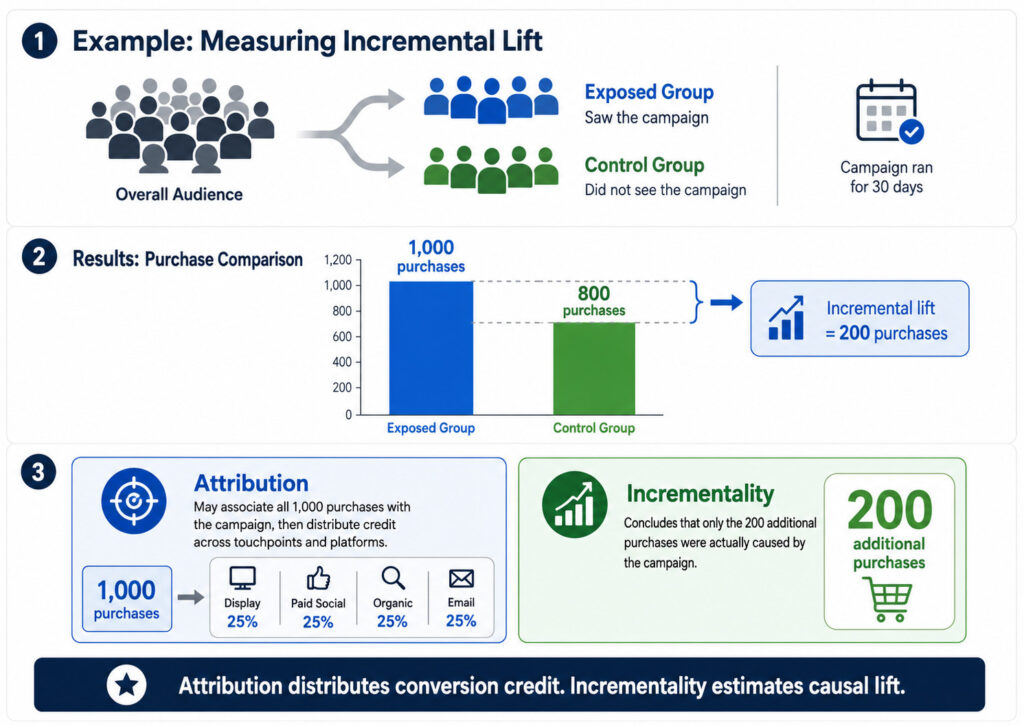
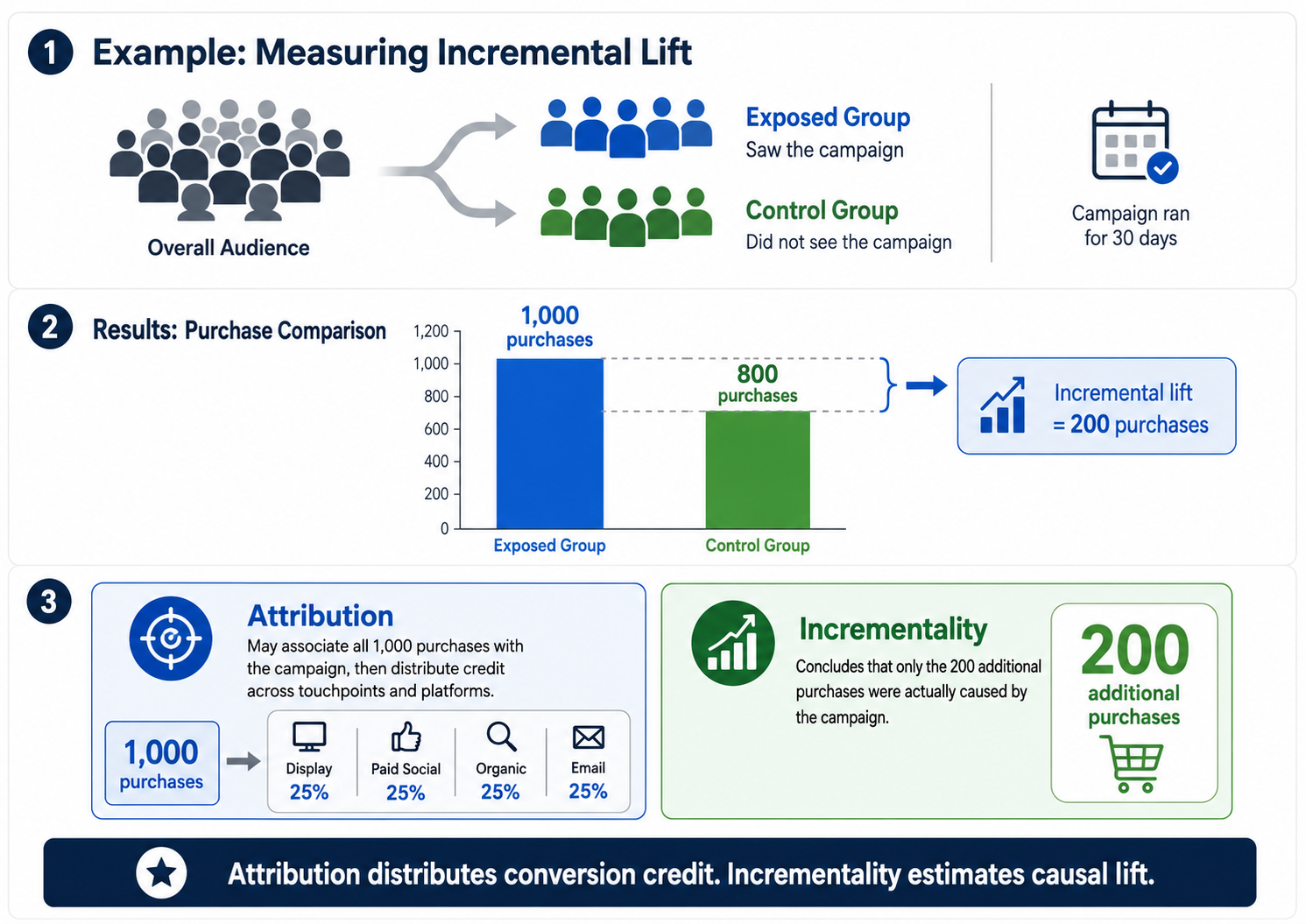
Let’s say you want to discover the lift of a given marketing campaign. So you divide your audience into two groups: a control group of folks who won’t be exposed to the campaign and an exposed group that does see the campaign.
You run your campaign for 30 days, then look at the results. While the exposed group completed 1,000 purchases, the control group completed 800 purchases. The incremental lift of the campaign would be 200 purchases.
An attribution model could associate many or all 1,000 purchases with the campaign. It would allocate the value across the platforms and touchpoints involved according to the model you choose.
Incrementality, on the other hand, would conclude that only those 200 additional purchases were actually caused by the campaign.
Dig deeper: Why attribution and impact are no longer the same thing in PPC
Using attribution and incrementality together
Where marketers go wrong is when they go all in on either framework. The two concepts can play nicely together (provided you’re using the right one to answer the right question). If you’re looking to optimize your campaigns or deep dive into the user journey of your customer, attribution is going to be your best friend, helping you evaluate platforms and touchpoints by giving you a shared success metric with which to compare them.
If, on the other hand, you’re defending your budget from a proposed cut, incrementality is going to be your strongest source of evidence regarding which channels actually create additional business with their budget, rather than capturing business that would have happened anyway.
| Attribution | Incrementality | |
| Primary question | Which observed marketing touchpoints should receive credit for a conversion? | How many additional conversions occurred because of the marketing activity? |
| Best use case | Ongoing campaign optimization, understanding customer journeys, and allocating credit across measurable channels. | Validating whether an investment creates additional business value and informing higher-level budget decisions. |
| Main blind spot | Correlation is not causation: a touchpoint may receive credit for a conversion it did not actually create. | Tests can be expensive, slow, or difficult to design, and results may not explain which individual touchpoints influenced the customer. |
| Most likely stakeholder | Channel managers, performance marketers, platform teams, and marketing analytics teams. | Marketing leadership, finance, data science, growth strategy, and budget owners. |
Where platforms get confused by attribution and incrementality
If there’s one question that has haunted me throughout my career, it’s this one: “Why don’t these numbers match?”
Most often, it’s asked when a channel platform’s reported revenue or conversions differ from the numbers found in the client’s CRM, web analytics, or other source of truth. They almost never line up perfectly.
What can be tough to explain succinctly to a client is this: The fact that they differ doesn’t necessarily mean either is incorrect. Each system applies its own logic based on the interactions it can observe, which conversions should qualify for credit, and how long after an interaction credit can still be attributed. But neither is “wrong.”
An advertising platform may correctly observe and report that a customer viewed or clicked on an ad before purchasing. But evidence that an ad was seen before a purchase isn’t necessarily proof that the ad caused it, nor is it proof that the ad didn’t cause it.
This becomes particularly important with automated campaigns, especially as platforms continue to push these automated solutions on marketers. Automated systems are designed to maximize performance based on the conversion signals defined inside the platform. They’re simply not designed to maximize performance based on your carefully calculated incremental lift test results.
As a result, automated campaigns target audiences, placements, and queries already associated with users likely to convert, such as existing customers, branded searchers, and remarketing audiences. Those conversions may be entirely valid according to the platform’s attribution model, while creating less additional revenue than the campaign report implies.
In other words, automated campaigns can increase the number of conversions credited to a given campaign without actually causing an equal increase in total sales.
Dig deeper: Your ROAS looks great — but is it actually driving growth?
A note on in-platform lift studies
It’s true, platforms are increasingly offering lift studies and other incrementality-focused tools. But it’s a mistake to assume that incremental value is automatically incorporated into automated campaign optimization.
After all, “data without insights is meaningless, and insights without action are pointless.” In other words, a lift study will only affect performance if and when someone applies its findings to the campaign’s objectives, inputs, or budget decisions.
A platform like Google Ads may provide a controlled lift experiment, but unless the advertiser applies the test findings — or selects a campaign setting explicitly designed to optimize for incrementality — the measurement system and the delivery system are still going to be working toward two different definitions of success.
Some platforms are starting to address this. Meta, for example, now offers a very promising incremental attribution model intended to optimize delivery toward conversions it predicts were directly caused by advertising. For now, though, that’s a specific optimization choice that, again, requires action by the advertiser and isn’t an inherent feature of every automated campaign.
See where competitors are investing, which keywords drive their results, and how to capture more of the market.
Know which question you’re trying to answer
In sum, attribution and incrementality aren’t competing methods for finding one definitive metric. They’re different tools designed to answer different questions. And like most tools, they perform best when they’re doing the job they’re designed for. You wouldn’t try to use your Allen wrench as a hammer, would you?
Attribution helps us marketers understand which touchpoints contributed to a conversion and provides a shared basis for comparing channels. Incrementality helps businesses understand whether their marketing investment generated additional conversions that wouldn’t have occurred otherwise.
The best marketers need both. While attribution provides the ongoing signals needed to optimize campaigns and understand customer journeys, incrementality helps validate whether those optimizations are creating new business value or simply capturing demand that already existed.
As automated campaigns take greater control over targeting, placements, bidding, and budget allocation, understanding both sides will only become more important. A system can become exceptionally efficient at maximizing attributed conversions without becoming equally effective at producing incremental growth.
So the next time a platform report contradicts your CRM, don’t assume either number is wrong — ask which question each number was designed to answer.
Dig deeper: The end of easy PPC attribution — and what to do next