Key Takeaways
AI agents are no longer a topic for the future. They’re being deployed inside enterprises right now, routing customer cases, approving transactions, surfacing clinical recommendations, credit underwriting, fraud detection and more.
The question is no longer whether to deploy them. It’s whether you can trust them once you do.
Think back to just eighteen months. The AI paradigm was simple: You typed something in, and got an answer back. Today, that’s changed. Agents are no longer just answering; they’re acting:
- In healthcare, agents cross-reference clinical databases to present real-time provider recommendations.
- In financial services, they’re approving loans and processing claims rather than just routing them for review.
- In retail, agents pull customer interactions across channels to make product recommendations, optimize pricing, and check inventory availability.
This shift changes everything about what governance means. The consequences of getting it wrong aren’t just a bad chatbot response — they’re bad business decisions that are logged, executed, and often irreversible. Most enterprises are racing to deploy agents, but the ones that will win are the ones that govern what those agents do.
The uncomfortable truth about agent “mistakes”
When we see headlines about AI agents making real, business-impacting errors, there’s an uncomfortable truth we have to face: These agents didn’t malfunction. They functioned exactly as designed.
The problem is that they were given access to customer interactions and the ability to make commitments, but they weren’t given policy constraints, quality-checked data, or an audit trail.
If your agent can query your CRM or call an API, you must be able to answer:
- Does it know what data it’s allowed to see?
- Does it check margin thresholds before approving a discount?
- Does it know when to stop and route to a human?
- Does it maintain a detailed audit log of the actions?
If the answer is “we’re not sure,” you have an ungoverned agent. Ungoverned agents don’t make mistakes — they make decisions. And when your agent makes a bad one, your company owns it.
To illustrate this in practice, imagine a sales rep asking an agent: “Can we offer [customer] a 15% discount to close the deal?”
Without governed data, the agent looks at order history, sees that this account is a long-term customer, and responds: “Approved. 15% discount applied. Email sent.” Done.
The problem is that no policy check was run, so the margin data wasn’t validated. It turns out the account is already below your margin threshold, and 15% takes this deal into the red. The email went out. The commitment was made. No audit trail. The rep’s manager finds out a week later when the deal closes at a loss.
The solution: A unified governance platform
Most enterprises live in a fragmented landscape. You have integration, governance, and data platforms from different vendors, managed by different teams, with no shared layer connecting them.
When you introduce an agent into this environment, it inherits and amplifies every siloed problem. It moves faster than any human audit process can keep up with. You can’t bolt governance on after the fact. The only way to solve this is through a unified governance layer.
Salesforce provides one platform where Data 360, Trusted Services, Informatica, and MuleSoft all operate under the same governance framework. This isn’t a strategy stitched together from five vendors; it’s a foundation that already governs trillions of transactions.
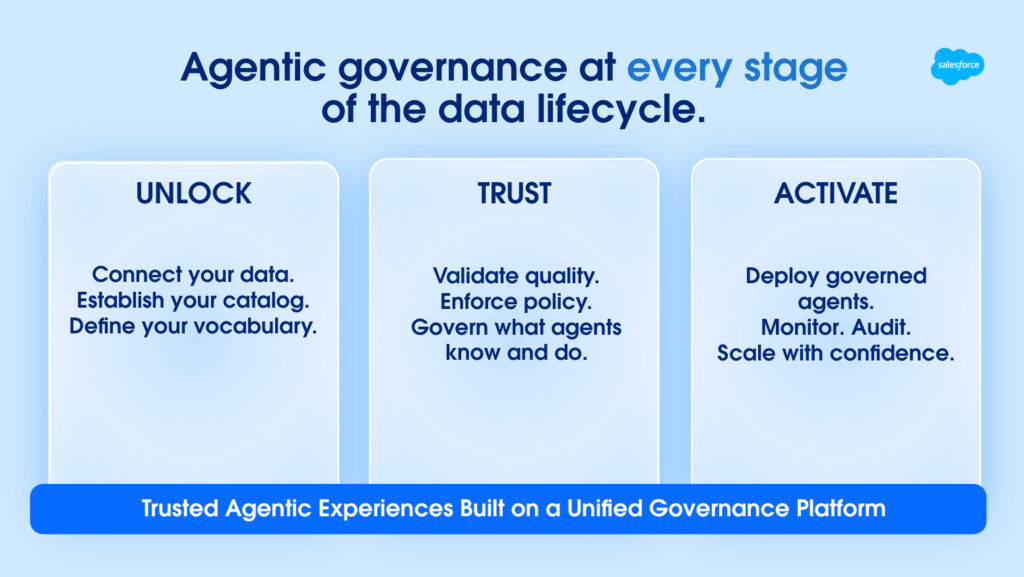
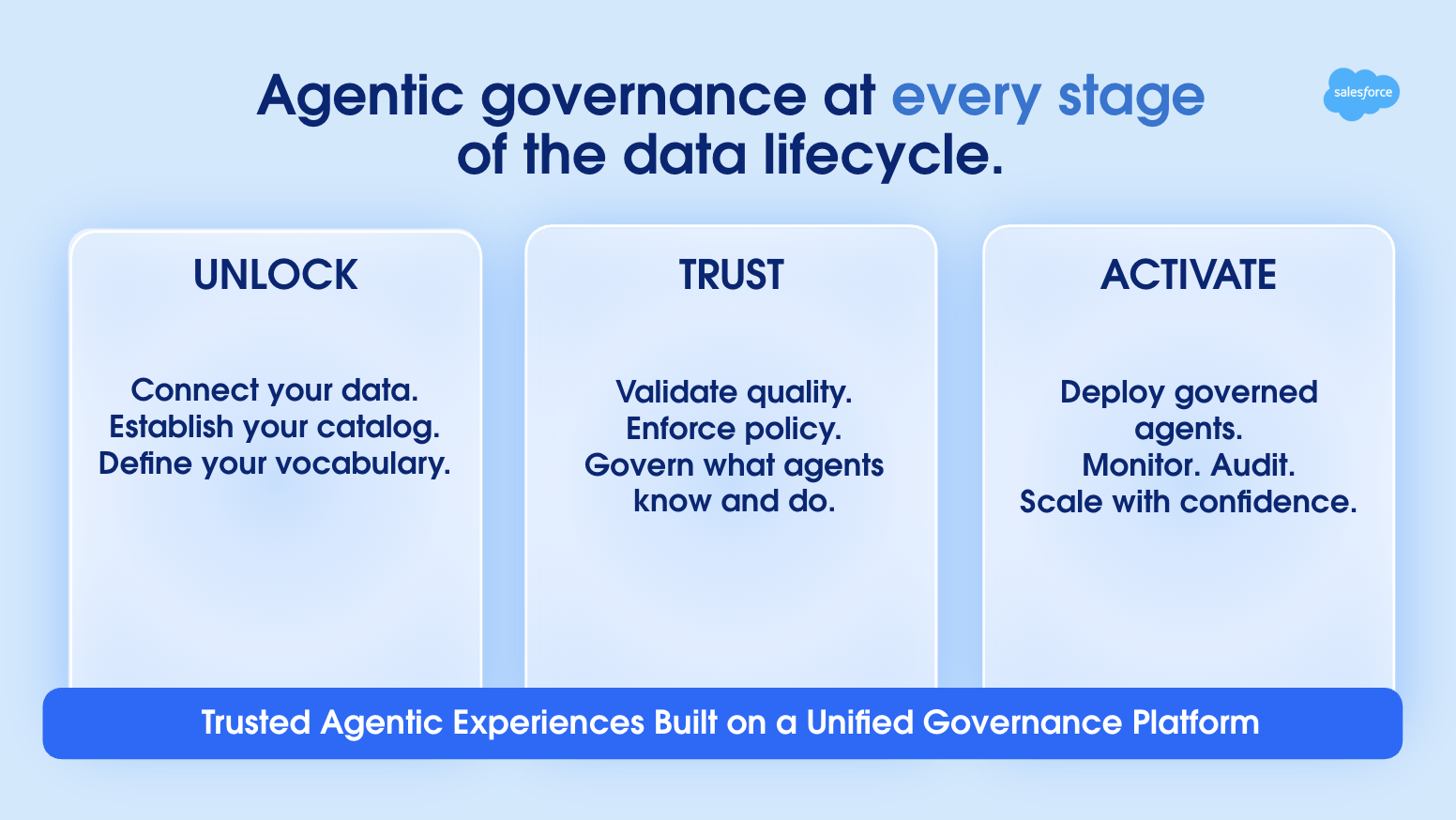
We organize this governance into three deliberate stages:
Stage 1: Unlock
You can’t govern what you can’t see. This is where you establish a shared vocabulary so every agent speaks the same language.
- Informatica: Handles the heavy lifting — finding, classifying, and inventorying data while autogenerating quality rules.
- MuleSoft: Connects everything in real-time, specifically managing MCP (Model Context Protocol) and Agent-to-Agent (A2A) orchestration so agents talk to each other in a governed way.
- Data 360: Ingests data via streaming, batch, and real-time, and federates data via Zero Copy so agents can access data from any warehouse without creating brittle, ungoverned pipelines.
Stage 2: Trust
This is where you define the boundaries of what agents are permitted to know and do.
- Informatica: Ensures everyone is aligned on an enterprise-wide golden record of customers, products and suppliers.
- Data 360: Provides AI-powered tagging for classification, dynamic masking to protect sensitive fields, and lineage to visualize data flows by tracing upstream and downstream impacts.
- Trusted Services: Enforces bulk data classification, encryption, and privacy policies specific to your regulatory requirements.
Stage 3: Activate
This is where you scale with the confidence that every action is controlled.
- MuleSoft: Enforces policies to protect personally identifiable information (PII) and manages LLM token usage across every interaction.
- Data 360: Enforces object, row, and field-level access at runtime so agents only see what the user is authorized to see.
- Trusted Services: Your safety net. It investigates suspicious activity, manages customer consent, and retains field history indefinitely.
Let’s revisit the example earlier, but assume the agent was using governed data.
With governed data, the governance layer runs before the agent responds. Data policy is verified: Is this agent authorized to approve discounts? Margin data is validated from your ERP, as the company’s current margin is pulled in real time. Real-time context is pulled from your CRM, including account history, contract terms, and current pricing tier. The API call to the discount approval system is authorized and logged. And the agent responds: “[customer] is below the margin threshold. Discount exceeds policy DISC-2. Shall I route the VP approval request?”
The prompt is the same, but the outcome is completely different. With governance, the result is correct, auditable, and defensible. When regulators or your board ask if you had controls in place, you need to be able to say “yes.”
Governance is your AI strategy
Governance isn’t the guardrail to your AI strategy — it is your AI strategy. Without it, you don’t have a strategy— you have an experiment.Start on your path to incorporating governance today. With the Agentforce 360 Platform, connect your data, enforce policies, and deploy governed agents that aren’t just powerful, but trusted.
Learn more
Trusted Services Solution Brief
Data 360 Governance Data Sheet