Valentine’s Day is a reminder to focus on what truly matters to our hearts.
At Cloud for Good, one of those priorities is helping our clients protect what matters most: their mission, their data, and the trust of the communities they serve.
Salesforce security isn’t a feature. It isn’t a checkbox. And it’s certainly not a once-a-year audit exercise.
It’s an ongoing leadership responsibility.
Every day, we partner with nonprofits, higher education institutions, and other mission-driven organizations to strategically strengthen their Salesforce security posture, not reactively. In today’s environment of AI acceleration, distributed teams, and increasing compliance pressure, prevention, detection, and response must be intentionally embedded into your Salesforce operating model.
To tide you over, here are 7 reasons we at Cloud for Good love Salesforce Security, and why you will love what we’re covering in this webinar:
1. It Shifts Security From Reactive to Continuous
Salesforce provides powerful native tools that support ongoing security governance, including:
- Security Health Check
- Login history tracking
- Setup audit trail
- Event monitoring (with Shield)
These tools enable continuous visibility into your Salesforce environment. But technology alone isn’t maturity.
Security maturity stems from consistency, which entails regular configuration reviews, monitoring user behavior, and evolving controls alongside your organization.
In high-growth nonprofits and higher education environments, where users, integrations, and data models constantly change, a continuous Salesforce security strategy is essential.
2. It Enforces Smart Access Through Least Privilege
Salesforce’s role-based access model enables organizations to carefully manage who can see and do what by limiting data exposure through:
- Profiles
- Permission sets
- Roles
- Public groups
- User access policies
These tools govern object-level access, field-level visibility, record sharing, and system permissions.
When user access is intentional, documented, and regularly reviewed, risk decreases dramatically, especially in organizations with decentralized teams, seasonal users, advancement offices, or student workers.
Strong access governance is one of the most effective ways to reduce security risks in Salesforce.
3. It Prioritizes Configuration, Behavior, and Access Awareness
Many data breaches don’t stem from external attacks. They stem from unnoticed configuration changes or excessive permissions, which come and go with evolving teams
A mature Salesforce security strategy includes:
- Configuration awareness: Understanding when system settings change and educating the stakeholders about them.
- Behavior awareness: Identifying anomalies in login patterns, exports, or API usage and reporting them in a timely manner.
- Access awareness: Ensuring permissions remain aligned with organizational intent and reviewed on a yearly basis.
With proper monitoring in place, organizations can detect risks early, before they escalate into compliance violations or data loss.
4. It Goes Beyond Basic Permissions
Salesforce Shield is an add-on product designed for organizations with heightened compliance, governance, or risk requirements.
It includes:
- Platform Encryption to encrypt certain sensitive data at rest
- Event Monitoring for deeper visibility into user and system activity
- Field Audit Trail to retain field history data for extended periods
These capabilities support stronger auditing, data governance, and regulatory alignment, particularly for institutions handling highly sensitive donor, student, or research data.
For higher education institutions, healthcare-adjacent nonprofits, and global NGOs, Salesforce Shield can be a critical component of a comprehensive data protection strategy.
5. It Turns Activity Data Into Actionable Insight
Collecting logs is only useful if they’re interpretable. Security Center provides centralized visibility into:
- Security settings
- User access risks
- Policy deviations
- Gaps between intended and actual configuration
CRM Analytics can further highlight trends, anomalies, and high-risk behaviors, reducing time spent manually parsing data and improving decision-making across teams.
This is where security transitions from technical maintenance to strategic oversight.
6. It Supports Structured, Calm Incident Response
While Salesforce does not manage customer-side incident response, the platform provides the data needed to investigate effectively.
Depending on licensing and configuration, organizations can review:
- Login activity and IP history
- Setup changes
- API interactions
- Data export activity
- Permission modifications
Clear processes combined with platform visibility allow organizations to respond methodically rather than reactively. Preparedness reduces disruption.
7. It Clarifies Shared Responsibility
Salesforce’s infrastructure and core platform security (e.g., encryption in transit, multitenancy protections) are handled by Salesforce.
Customers are responsible for:
- Configuration of org security features
- Ongoing monitoring
- User access control
- Enforcement of policies
Understanding this shared model helps leadership teams ensure there are no blind spots in accountability.
Ready to Show Your Salesforce Org Some Love?
Security guidance shouldn’t be generic. Cloud for Good works exclusively with impact organizations. We understand the unique risk landscape you operate in:
- Complex advancement and fundraising models
- Distributed teams and seasonal access
- Compliance pressures
- Limited internal security resources
Our approach blends deep Salesforce expertise with sector-specific context. We don’t just explain features, we help you operationalize them in a way that supports your mission.
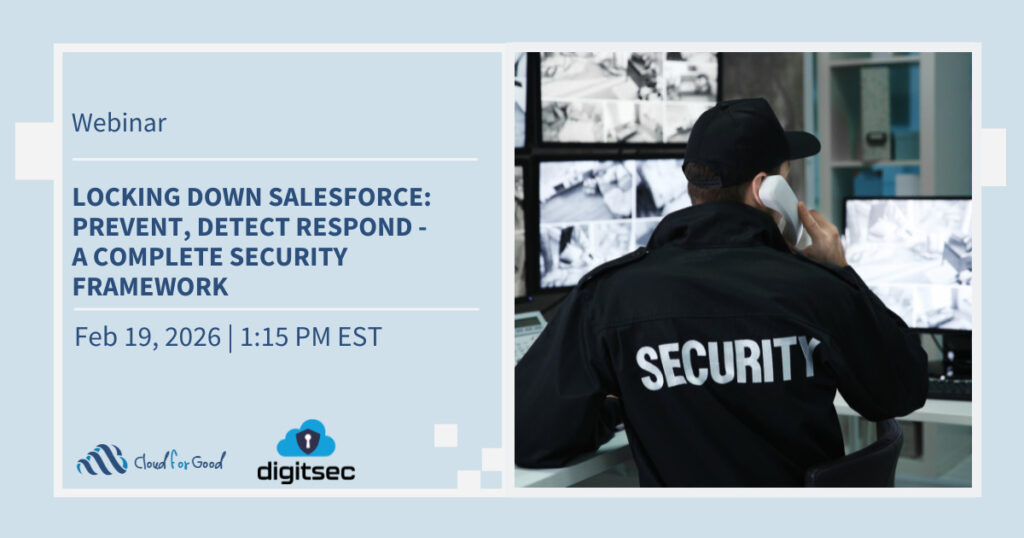
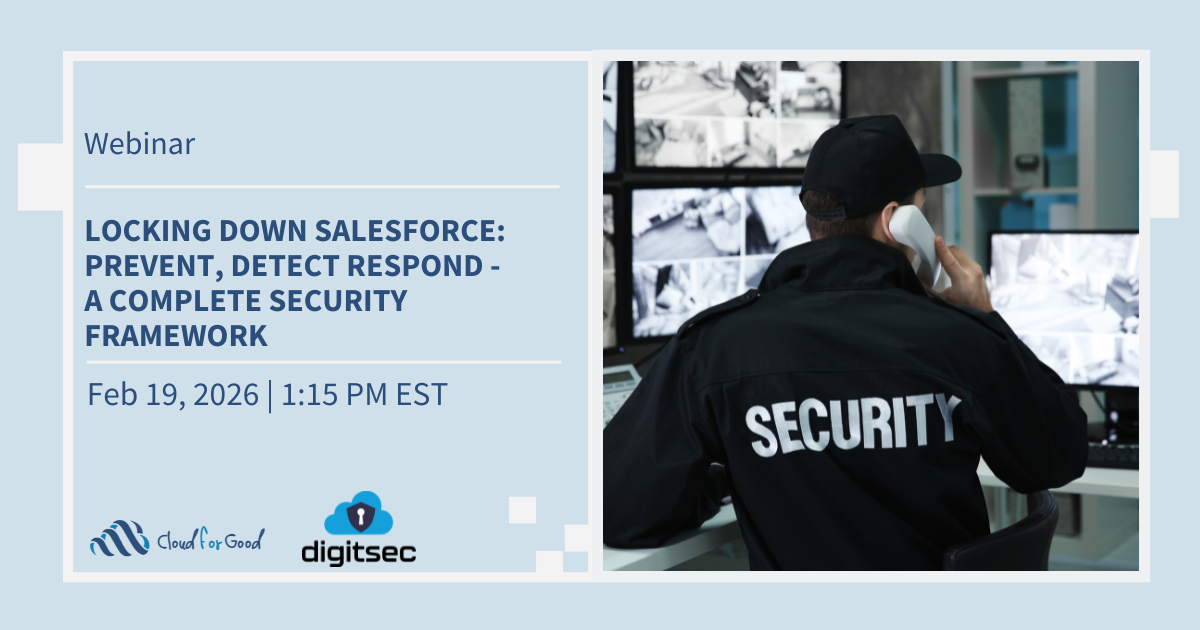
If your organization relies on Salesforce (and let’s be honest, most do), this is a conversation you don’t want to miss. Join us on February 19 for Locking Down Salesforce: Prevent, Detect, Respond. Learn how to proactively reduce risk, detect issues early, and respond with confidence. Because the best Valentine’s gift you can give your organization? A secure, resilient Salesforce environment.
Ready to talk security? Contact Cloud for Good.
The post 7 Reasons We Love Salesforce Security (And You Should Too!) appeared first on Cloud for Good.