Key Takeaways
As you’re reading this, the wave of artificial intelligence (AI) is weaving its agentic layer into just about every business, everywhere. Many business leaders recognize the potential — in fact, a Salesforce study found that 71% of small business owners believe AI will save their company time in the next year.
The truth is, knowing where to start can be daunting. But AI is no longer a futuristic concept; it’s a practical tool that can be integrated into the portfolio you use every day, especially when paired with a reliable customer relationship management (CRM) platform. Gaining AI literacy — understanding what AI is, how it works, and how to apply it responsibly — is the most important next step for your small business. This guide will walk you through the steps to build your team’s AI literacy toward confident growth.
What is AI literacy and why does your SMB need it?
The term AI literacy simply means learning the basic knowledge and set of skills that enable you to effectively and ethically interact with artificial intelligence tools. For an SMB, it means moving beyond hearing about AI to actively understanding its application in your daily operations across sales, service, and marketing.
A key finding from Salesforce shows that 76% of SMBs are already planning to use AI or are actively using it, which means that being literate in AI is quickly becoming a competitive necessity, not just a trend.
Understanding the fundamentals of AI
To build your AI literacy foundation, it’s important to understand what AI actually is. At its core, AI is a set of technologies that allow computers to perform tasks that typically require human intelligence, such as learning, problem-solving, and decision-making. Two things to remember:
AI is built on high-quality data: The quality of your data directly impacts the effectiveness of your AI tools. A robust platform like CRM for small business ensures your AI has a clean, unified view of your customer to draw insights from.
It’s about augmentation, not replacement: AI tools are designed to assist and enhance your team’s capabilities, freeing them up to focus on higher-value tasks that require creativity and human connection.
Automation is the new workday: For a startup, AI applications can look like automating routine customer service responses, predicting which leads are most likely to close, or generating personalized email subject lines for marketing campaigns.
AI Tools for Small Business


Focusing on practical, immediate application
Small businesses and startups have a huge advantage: They’re agile. You don’t need a large-scale deployment to see value. You can start small, and work your way up to bigger workflows. Here are a few ways to implement AI now, to begin seeing immediate results:
For sales, AI can help you score leads, predict future purchases, and personalize marketing content. This level of insight allows small teams to execute campaigns that rival those of much larger companies, driving efficiency in both marketing and sales.
For marketing, AI can help your email campaigns with smart segmenting, crafting and templates, allowing your campaigns to get into more inboxes. Marketing employee agents help to sort through promotional campaign data to highlight the best possible next drivers.
For service, perhaps try AI to instantly summarize customer service cases or draft personalized follow-up emails for your sales team. Use AI to route customer inquiries or provide agents with suggested responses instantly improves efficiency and customer satisfaction.
For all business, just get going. Adam Alfano, EVP of Global SMB and Emerging Products stated, “Just get going. There’s a big promise of massive growth which gives SMBs new optionality to scale that didn’t exist five years ago.” That means whatever AI speaks to you, get moving on it. Learn it, understand it, and scale with it. Let it help you.
Kickstart your SMB with Starter Suite
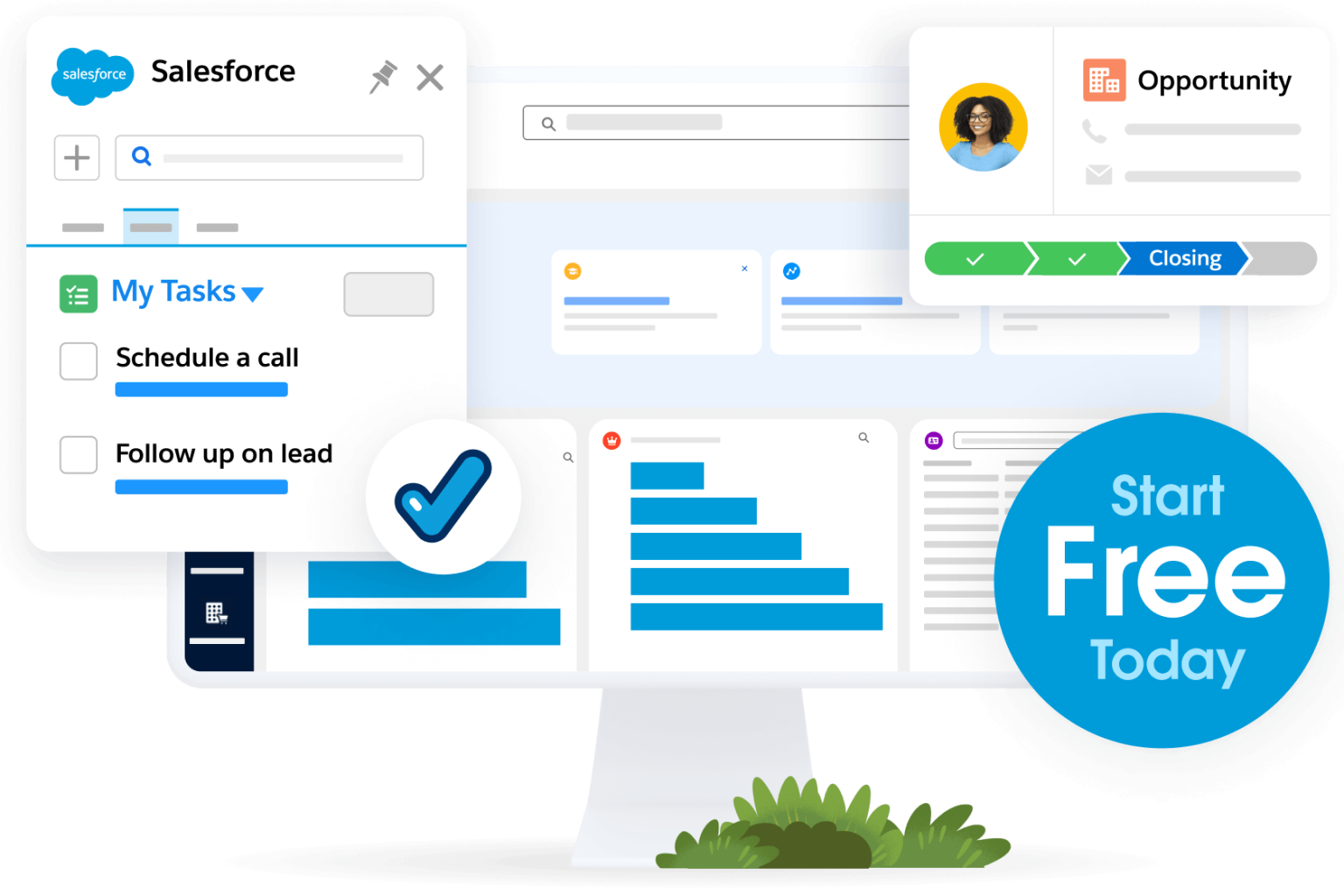
See results from day one with a CRM designed for SMBs — the all-in-one suite for productivity. It all starts with Starter Suite.
Practical steps to grow your team’s AI knowledge
Developing AI literacy doesn’t require hiring more staff. It’s about empowering your existing team with the right tools and training to use AI confidently and responsibly. Since small businesses are often strapped for time and resources, this training should be directly applicable to day-to-day work.
Instead of abstract lectures, focus on hands-on learning within the tools your team already uses, especially your CRM. When your sales rep learns how an AI feature scores leads, they’re immediately seeing the value and practical application.
Trailhead: A great AI resource
Salesforce offers Trailhead, a platform with interactive, guided paths to learn about new technologies, including AI, in bite-sized modules. Encourage your team to dedicate a few minutes each week to a module on AI prompts or ethical use.
Become an AI champion
Identify one person in each department — sales, service, marketing — to become the in-house expert on all things AI. This AI champion can be the first to test new features, share success stories, and train peers, making the learning process organic and peer-driven.




Master the art of the AI prompt
The effectiveness of generative AI tools depends on the quality of the input, or the prompt. Your team needs to learn how to ask AI the right questions to get the most useful output. A study from Salesforce found that 77% of SMBs plan to use generative AI for tasks like writing emails or generating content. Effective prompting skills are essential to capitalize on this, and greatly increase literacy in AI fundamentals.
- Be clear and specific: You are training the AI. Instead of “Write a follow-up email,” prompt the AI with: “Write a follow-up email to a lead who downloaded our e-book, mentioning two benefits of Salesforce’s Starter Suite, and include a 10% discount, using a friendly and upbeat tone.”
- Focus on business outcomes: Train your team to prompt AI based on a desired business result. For example, a service agent could use these tips to summarize a complex case history for a faster resolution. Try inputting the solution to find the problem.
- Train, train and train again: Every time the AI response does not put out what you requested, take the time to ask it again for the correct one. Explain why it was not what you wanted (if you have the time).
Grow Your Small Business With AI Agents
Learn how autonomous AI can scale your small business for efficient growth in our free e-book.
Safety first: Using AI for secure business growth
AI literacy goes beyond knowing how to use a tool; it includes understanding the ethical and security implications. For a small business, protecting customer data and maintaining trust are non-negotiable. Using AI responsibly means prioritizing data security and transparency.
Prioritize ethical AI and data security
When choosing AI tools, ensure they have strong guardrails to protect your customer’s data. Tools built directly into a secure CRM automatically inherit those security and privacy standards.
That said, never input sensitive data. Train your team that customer-identifying information should never be manually entered into public-facing AI tools. When using AI within your CRM, the data is typically secured and masked to maintain privacy.
Also, review and verify all AI output. A core component of AI literacy is critical thinking. AI output should be treated as a draft. Every email, report, or summary generated by AI must be reviewed by a human for accuracy, tone, and compliance before it’s used or sent.
Data 360 is here
Level up your business by transforming scattered data into actionable insights.


It’s your AI literacy journey — make it count
The journey to AI literacy for your startup or small business is less about a destination and more about a process of learning. By focusing on practical application, responsible use, and training, you can turn the uncertainty of AI into a competitive advantage. AI is built directly into the tools you use every day, ready to help you save time and grow smarter. Keep the momentum going on Trailhead.
And when you’re ready, start your journey with the Free or Starter Suite today. Looking for more customization? Explore Pro Suite. Already a Salesforce customer? Activate Foundations to try out Agentforce 360 today.
AI supported the writers and editors who created this article.
Frequently Asked Questions (FAQs)
AI literacy is the functional knowledge required to use AI tools effectively, ethically, and strategically in your business. It’s for everyone on the team. Technical AI expertise involves the ability to build and maintain AI models (data scientists, machine learning engineers) and is typically not required for small businesses to start benefiting from AI.
Not necessarily. Many AI capabilities are now integrated directly into small business tools, such as CRM platforms like Salesforce Starter Suite, often with a clear, subscription-based cost model. You can start with basic AI-powered features (like lead scoring or automated summaries) without needing a massive upfront investment.
Small businesses are often able to see immediate value, especially when starting with AI in customer service or sales enablement. Automating repetitive tasks, like drafting follow-up emails or summarizing case notes, can save employees time and improve efficiency from day one.
Prompt engineering is the skill of crafting clear, specific instructions, or prompts, to get the best, most relevant output from a generative AI tool. Your team needs it because the quality of the AI’s answer is directly proportional to the quality of the prompt, ensuring your AI-generated content is useful and accurate for your business needs.
When you use public-facing AI tools, there can be data risks. However, using AI that is natively built into a secure, trusted platform like an AI CRM (like Salesforce) provides built-in security and ethical guardrails designed to protect your customer data and ensure privacy.