If we told you ten years ago that a random guy rating sandwiches on YouTube would outsell legacy food brands, you’d probably laugh right out loud. But here we are. A simple, unfiltered “lunch review” video can now outperform six-figure ad campaigns. Not because it’s slick, but because it’s relatable, it’s real life. And real is what people know and trust. Creators aren’t just part of the internet anymore. In many ways, they are the internet.
That’s actually a good thing for your small and medium-sized business (SMB). The way people discover products is changing, and that opens up fresh, authentic ways to reach them. If you’ve ever felt like your product deserves more attention but weren’t sure how to get it, the creator economy is a great place to start. In this guide, we’ll walk through what the creator economy is and how you can tap into it. Let’s get started.
What is the creator economy?
The creator economy, in simple terms, is basically people making money online by doing stuff they’re good at (or just wildly passionate about). They teach, review, bake, rant, design, dance, explain, and build. Some do it full time. Some do it in between meetings or just for fun. And somehow, it works. We have created the creator economy, and it’s wildly popular.
Who are creators, really?
When you hear the word creator, you may think artist, engineer, developer even. Or perhaps you think of an influencer? Creators are not just influencers. And, they’re not just people with a million followers. The true creators are the ones who are putting in the work, they are anyone who’s figured out how to share something useful or entertaining online on platforms like YouTube, TikTok, Instagram, Substack, Twitch, and Patreon.
You’ve seen it. The guy reviewing $3 vs $300 headphones with brutal honesty. Or a baker selling classes through Instagram Reels. Or someone reviewing five restaurants in a row and somehow making you question if a three-hour drive for noodles is actually a bad idea. Ah, and let’s not forget the beauty influencers who can convince you that your entire skincare routine is wrong. It’s chaotic. It’s persuasive. And it’s exactly how the internet moves now.
Market your SMB with Salesforce AI


And what do all these creators have in common? They get their audience, they really get them. And their audience? They trust the creators. And, that trust? It’s better than any sales pitch.
The rise of creators
Creators are turning casual hobbies into full-blown businesses. And the wild part? It’s working. Like, really working. Let’s talk numbers for a second (we promise to keep it interesting).
- Over 200 million people consider themselves creators as of 2025.
- The creator economy is projected to reach $480 billion by 2027.
- 52% of creators earning $50k-$100k spend 10 hours or less per week on content creation.
- In the U.S. alone, 27 million creators make income through content.
- Brands are spending a total of $6 billion on influencer marketing.
- Creator campaigns see up to 4x higher engagement compared to traditional ads.
- 91% of creators use artificial intelligence (AI) in the content creation process.
- Investment is flooding in. Mergers and acquisitions in the creator space are up 73% in just the first half of 2025.
In short, creators are no longer a niche group. They’re becoming central to how audiences discover and trust products.
What makes creator-led marketing work
Creator-led marketing work because it feels like a recommendation from a friend who actually tried the thing. It doesn’t sound like a pitch. It sounds like, “Hey, I’ve been using this, and it’s pretty great.” That’s a much easier message to believe and act on. Creators speak in plain language. They know how their audience thinks because they’re part of that audience. So when they explain how a product fits into their day, it doesn’t feel scripted. It feels useful. Sometimes funny. Always human.
And unlike big ad campaigns that vanish when the budget runs out, creator content tends to stick around. People save it, rewatch it, send it to friends. That’s more mileage for less spend. More reach with fewer hoops. If you’re a small business looking to get noticed, this might be one of the smartest marketing bets you can make.
The Small and Medium Business Trends Report
Get the latest trends with the free Small and Medium Business Trends Report
Stay ahead of the curve with insights from Salesforce’s latest Small and Medium Business Trends free report.

Enter a valid e-mail address
Enter a valid e-mail address
Enter a valid e-mail address
Enter a valid e-mail address
Enter a valid e-mail address
Enter a valid e-mail address
Employees
1-20 employees
21-200 employees
201-10,000 employees
10,001+ employees
Select the number of employees
Industry
Automotive
Communications
Financial Services
Healthcare
Tech
Education
Life Sciences
Manufacturing
Media
Nonprofit
Public Sector
Retail & Consumer Goods
Energy & Utilities
Other
Select your industry.
Country/Region
United States
Afghanistan
Albania
Algeria
American Samoa
Andorra
Anguilla
Antarctica
Antigua And Barbuda
Argentina
Armenia
Aruba
Australia
Austria
Azerbaijan
Bahamas, The
Bahrain
Bangladesh
Barbados
Belarus
Belize
Belgium
Benin
Bermuda
Bhutan
Bolivia
Bouvet Is
Bosnia and Herzegovina
Botswana
Brazil
British Indian Ocean Territory
Brunei
Bulgaria
Burkina Faso
Burundi
Cambodia
Cameroon
Canada
Cape Verde
Cayman Is
Central African Republic
Chad
Chile
China
Hong Kong
Macau
Christmas Is
Cocos (Keeling) Is
Colombia
Comoros
Cook Islands
Costa Rica
Cote D’Ivoire (Ivory Coast)
Croatia (Hrvatska)
Cyprus
Czech Republic
Democratic Republic of the Congo
Denmark
Dominica
Dominican Republic
Djibouti
Ecuador
Egypt
El Salvador
Equatorial Guinea
Eritrea
Estonia
Ethiopia
Falkland Is (Is Malvinas)
Faroe Islands
Fiji Islands
Finland
France
French Guiana
French Polynesia
French Southern Territories
F.Y.R.O. Macedonia
Gabon
Gambia, The
Georgia
Germany
Ghana
Gibraltar
Greece
Greenland
Grenada
Guadeloupe
Guam
Guatemala
Guinea
Guinea-Bissau
Guyana
Haiti
Heard and McDonald Is
Honduras
Hungary
Iceland
India
Indonesia
Ireland
Israel
Italy
Jamaica
Japan
Jordan
Kazakhstan
Kenya
Kiribati
Korea, South
Kuwait
Kyrgyzstan
Laos
Latvia
Lebanon
Lesotho
Liberia
Liechtenstein
Lithuania
Luxembourg
Madagascar
Malawi
Malaysia
Maldives
Mali
Malta
Marshall Is
Mauritania
Mauritius
Martinique
Mayotte
Mexico
Micronesia
Moldova
Monaco
Mongolia
Montserrat
Morocco
Mozambique
Myanmar
Namibia
Nauru
Nepal
Netherlands, The
Netherlands Antilles
New Caledonia
New Zealand
Nicaragua
Niger
Nigeria
Niue
Norway
Norfolk Island
Northern Mariana Is
Oman
Pakistan
Palau
Panama
Papua new Guinea
Paraguay
Peru
Philippines
Pitcairn Island
Poland
Portugal
Puerto Rico
Qatar
Republic of the Congo
Reunion
Romania
Russia
Rwanda
Saint Helena
Saint Kitts And Nevis
Saint Lucia
Saint Pierre and Miquelon
Saint Vincent And The Grenadines
Samoa
San Marino
Sao Tome and Principe
Saudi Arabia
Senegal
Serbia
Seychelles
Sierra Leone
Singapore
Slovakia
Slovenia
Solomon Islands
Somalia
South Africa
South Georgia & The S. Sandwich Is
Spain
Sri Lanka
Suriname
Svalbard And Jan Mayen Is
Swaziland
Sweden
Switzerland
Taiwan
Tajikistan
Tanzania
Thailand
Timor-Leste
Togo
Tokelau
Tonga
Trinidad And Tobago
Tunisia
Turkey
Turks And Caicos Is
Turkmenistan
Tuvalu
Uganda
Ukraine
United Arab Emirates
United Kingdom
United States Minor Outlying Is
Uruguay
Uzbekistan
Vanuatu
Vatican City State (Holy See)
Venezuela
Vietnam
Virgin Islands (British)
Virgin Islands (US)
Wallis And Futuna Islands
Western Sahara
Yemen
Zambia
Zimbabwe
Select your Country
State/province
北海道 – Hokkaido
青森県 – Aomori
岩手県 – Iwate
宮城県 – Miyagi
秋田県 – Akita
山形県 – Yamagata
福島県 – Fukushima
茨城県 – Ibaraki
栃木県 – Tochigi
群馬県 – Gunma
埼玉県 – Saitama
千葉県 – Chiba
東京都 – Tokyo
神奈川県 – Kanagawa
新潟県 – Niigata
富山県 – Toyama
石川県 – Ishikawa
福井県 – Fukui
山梨県 – Yamanashi
長野県 – Nagano
岐阜県 – Gifu
静岡県 – Shizuoka
愛知県 – Aichi
三重県 – Mie
滋賀県 – Shiga
京都府 – Kyoto
大阪府 – Osaka
兵庫県 – Hyogo
奈良県 – Nara
和歌山県 – Wakayama
鳥取県 – Tottori
島根県 – Shimane
岡山県 – Okayama
広島県 – Hiroshima
山口県 – Yamaguchi
徳島県 – Tokushima
香川県 – Kagawa
愛媛県 – Ehime
高知県 – Kochi
福岡県 – Fukuoka
佐賀県 – Saga
長崎県 – Nagasaki
熊本県 – Kumamoto
大分県 – Oita
宮崎県 – Miyazaki
鹿児島県 – Kagoshima
沖縄県 – Okinawa
Select a state/province
State/province
Alberta
British Columbia
Manitoba
New Brunswick
Newfoundland
Northwest Territories
Nova Scotia
Nunavut
Ontario
Prince Edward Island
Quebec
Saskatchewan
Yukon
Select a state/province
State/province
Alabama
Alaska
Arizona
Arkansas
California
Colorado
Connecticut
Delaware
District of Columbia
Florida
Georgia
Hawaii
Idaho
Illinois
Indiana
Iowa
Kansas
Kentucky
Louisiana
Maine
Maryland
Massachusetts
Michigan
Minnesota
Mississippi
Missouri
Montana
Nebraska
Nevada
New Hampshire
New Jersey
New Mexico
New York
North Carolina
North Dakota
Ohio
Oklahoma
Oregon
Pennsylvania
Rhode Island
South Carolina
South Dakota
Tennessee
Texas
Utah
Vermont
Virginia
Washington
West Virginia
Wisconsin
Wyoming
Select a state/province
We value your privacy. To learn more, visit our Privacy Statement.
Thank you for downloading the free report!
How small businesses can tap into this shift
The key is to find creators who align with your brand values. Don’t chase views or likes. Your goal is to build trust with the right target audience. Here’s how you can begin.
Start small (no, really)
You don’t need to work with creators who have millions of followers. In fact, smaller audiences often mean higher engagement. Micro-creators and niche experts tend to know their communities well. They read the comments, they reply to messages. And their followers actually care what they say.
If you’re a local business, try looking at city-specific creators or niche newsletters. Selling a business-to-business (B2B) tool? There’s probably a LinkedIn content creator or YouTuber who reviews similar tools already. You just have to look in the right corners of the internet.
Make it a partnership, not a transaction
Invite creators into the process. Treat them like collaborators, not just a line item in your budget. Things you can offer:
- Early access to your product or service
- Affiliate deals or performance-based bonuses
- Creative freedom (this is a big one, nobody likes a forced script)
And be sure not to ghost them after the campaign is over. If it works, keep it going. Long-term creator relationships tend to perform better and feel more authentic to their audience.
Join millions in the growing Salesforce ecosystem
Trailblazers are free to reinvent themselves, free to dream bigger.
Think beyond the post
Once a creator posts about your product, your work isn’t done. You can keep the momentum going by repurposing their content across your own channels:
- Share it in your emails to add authenticity to your campaigns.
- Turn it into social media reels or stories for quick, engaging content.
- Feature it on your online store or product pages as real-world social proof.
Just make sure you have the creator’s permission to reuse their content. Most will say yes, especially if it helps amplify their work, too.
Track what’s working
A customer relationship management (CRM) tool can help here. It keeps all your contacts, creations, and conversations in one place. It tracks what the results look like and whether it’s worth doing it all again. With a powerful CRM like Salesforce, you can automate your marketing as well, we will let you try it out for yourself to see the benefits.
What can you do with a CRM built to reach more prospects?
Automate your marketing campaigns with a CRM built to grow. It all starts with Starter Suite.

What to watch out for before you start collaborating
First off: vibes matter. Just because someone’s TikTok gets millions of views doesn’t mean they’re the right fit for your eco-friendly pet brand. (Do you want your dog treats next to a Hot Cheeto challenge? We didn’t think so.) Your brand has a voice. Their brand has a voice. If those voices wouldn’t match, maybe skip the partnership.
Second, don’t fall into the “they’ll just know what to do” trap. Because spoiler alert: they won’t. What you think is a casual collab can turn into a slow-moving trainwreck when they post it next Tuesday with the wrong link, a blurry image, and your brand name almost invisible. Set expectations. Be specific. Deadlines. Deliverables. Put it all in writing. Be kind and upfront about the goal and the timeline.
Oh and if you’re thinking you need to write a 12-slide brief, three mood boards, and “suggested captions,” take a deep breath. Let creators create. They know their audience. Let them speak in their own voice. Trust them to do what they do best and give helpful input when it’s actually needed.
How CRM tools can make creator partnerships easier
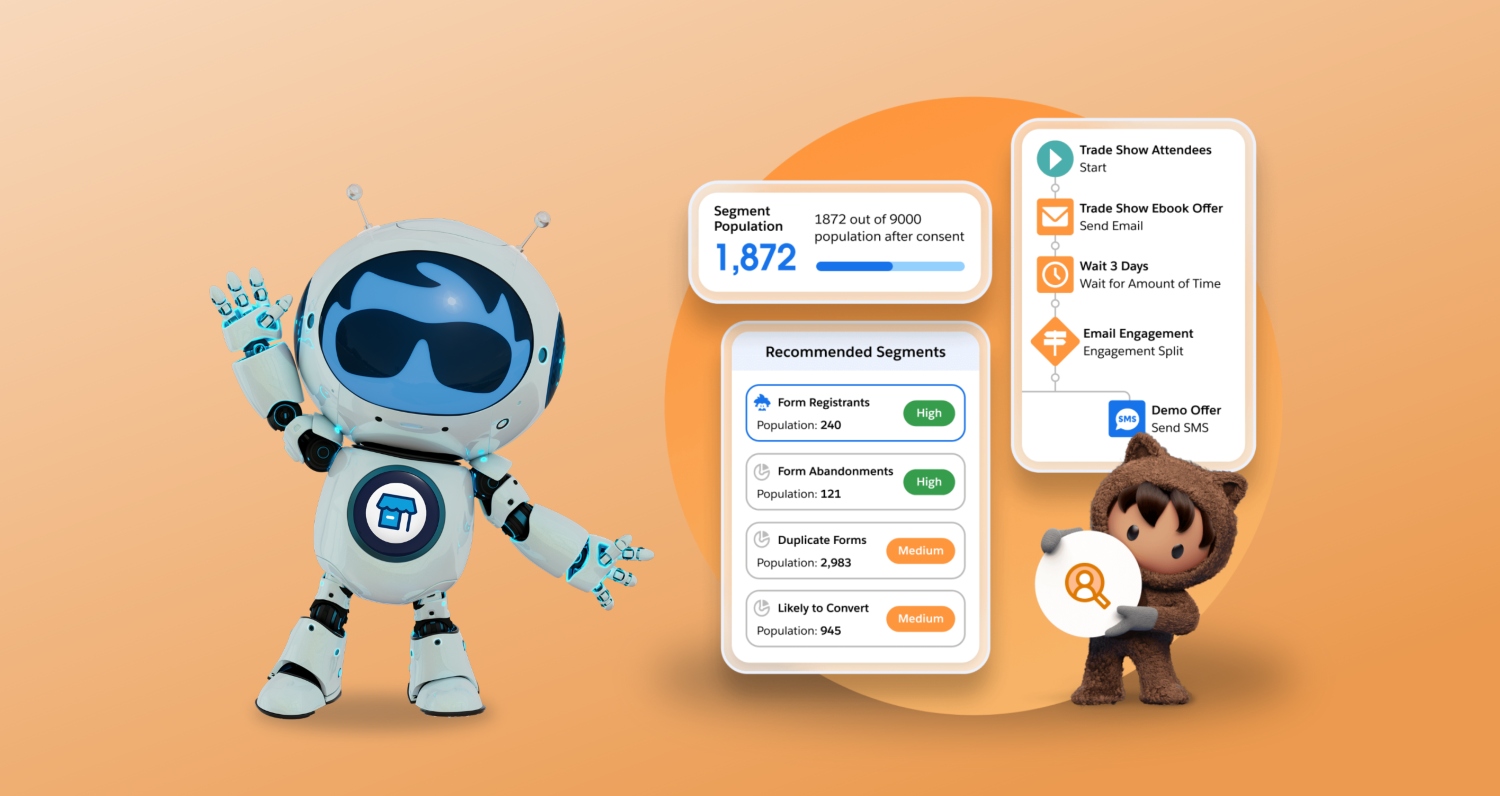
Picture this: An influential creator posts about your product. People find it interesting. They click and maybe even fill out a form. Now what? Here’s what should happen:
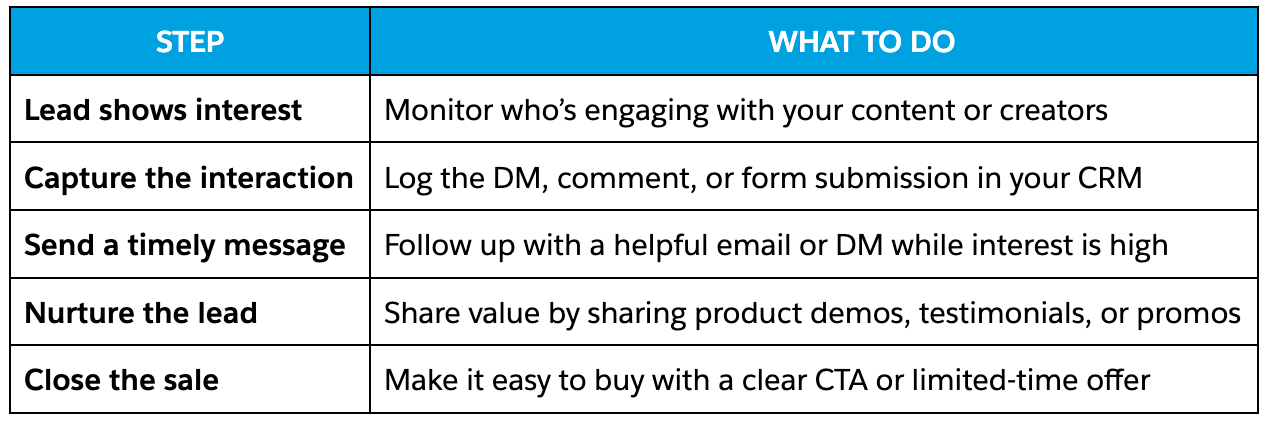
But let’s be real. When a creator post takes off, things can get a little overwhelming. And if you’re teaming up with more than one creator across different platforms, each with their own timeline and content plan? It gets real messy, real fast. A marketing CRM tool can help you capture the buzz and turn it into actual business. It makes the whole process easy and simple. Let’s break it down.
Tracking engagement: See who’s interested
Every creator you work with is like a mini-campaign. One might get traffic from Instagram. Another from YouTube Shorts. A CRM with campaign tracking lets you attribute site visits to specific sources. You can set custom links per creator and know exactly which post drove the clicks. You can see who clicked, where they came from, and what they did next.
Logging interest: Track conversations with potential customers
A CRM helps you log the conversations, no matter where they happen. You can tag the person and note what they asked. You need to nurture people who’ve shown interest but aren’t ready to buy yet. So when you do reach out again, it feels like a warm, personalized nudge.
Nurturing follow-ups: Nurture warm leads who haven’t bought (yet)
People who click won’t convert right away. (In fact, most don’t.) But what if someone was this close, like, added to cart but bailed before checkout? With a CRM, you can set up gentle nudges. Maybe a quick follow-up message. Or a promo reminder a few days later. These little moments of effort turn almost into closed.
Content optimization: Organize creators by product or campaign
You can tag creators by campaign type, product line, or any label that helps you sort and compare later. Ran a campaign for your product and worked with three different creators? Tag them all. Then, next time you’re planning a product drop, you’ll know exactly who delivered last time and how their audience responded.
Wherever you are — just get started.
No matter where you are on your journey as a business owner, you can get started with Starter Suite for free — the CRM made for growth.

Win big in the creator economy with the right tools
The creator economy is exploding. With the right creator partnerships and a CRM tool behind the scenes, you can turn scrolls into sales and likes into loyal customers. Salesforce does all of this, plus helps you automate parts of it. You can see what posts are working, what’s getting clicks, and which leads are worth chasing. Even better, it fits right into your sales and service workflows. It takes the chaos out of creator campaigns. So when creators bring the buzz, you’re ready to turn it into real business.
Start your journey with the Starter Suite today. Looking for more customization? Explore Pro Suite. Already a Salesforce customer? Activate Foundations and try out Agentforce 360 today.
AI supported the writers and editors of this article.
Frequently Asked Questions (FAQs)
Check their tone, values, and audience. If their vibe matches yours and their followers engage authentically, that’s a green flag. Bonus: You should actually like their content.
Yes, a CRM helps you track exactly which creators are bringing in clicks, leads, or sales. You can see their impact in real numbers, not just likes or comments.
That’s totally normal! Not every lead buys right away. But that doesn’t mean they won’t. A CRM lets you tag and track these warm leads. You can set gentle reminders to follow up and keep the conversation going. So when they’re ready, you’re top of mind.
Start with one creator who aligns well with your brand. This helps you test your messaging and audience fit. Once you’ve seen what works (and what doesn’t), you can expand to a few more creators with similar vibes or complementary audiences.
See how many people visit your site, sign up, or buy after seeing the creator’s content. Use simple tools like trackable links or special codes. If their content gets people to act, you’re getting results.