At Salesforce, we’re committed to delivering exceptional user experiences that empower our customers to achieve their goals. Our most recent achievement is the general availability of SLDS 2, the latest design system for Salesforce products built on the Lightning platform. This release marks a significant milestone in our journey to create a more intuitive, cohesive, and scalable user experience across our products.
What’s new in SLDS 2
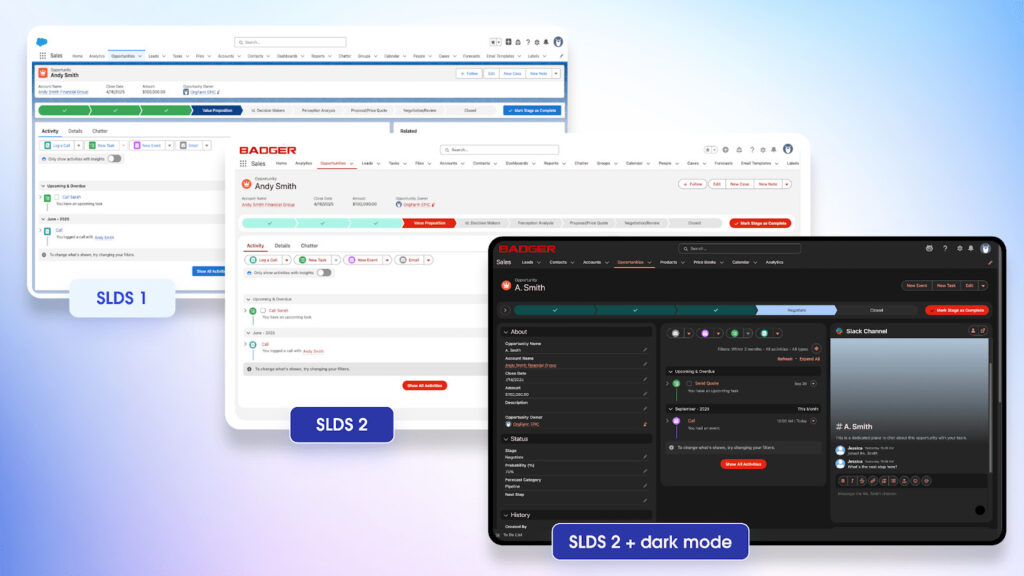
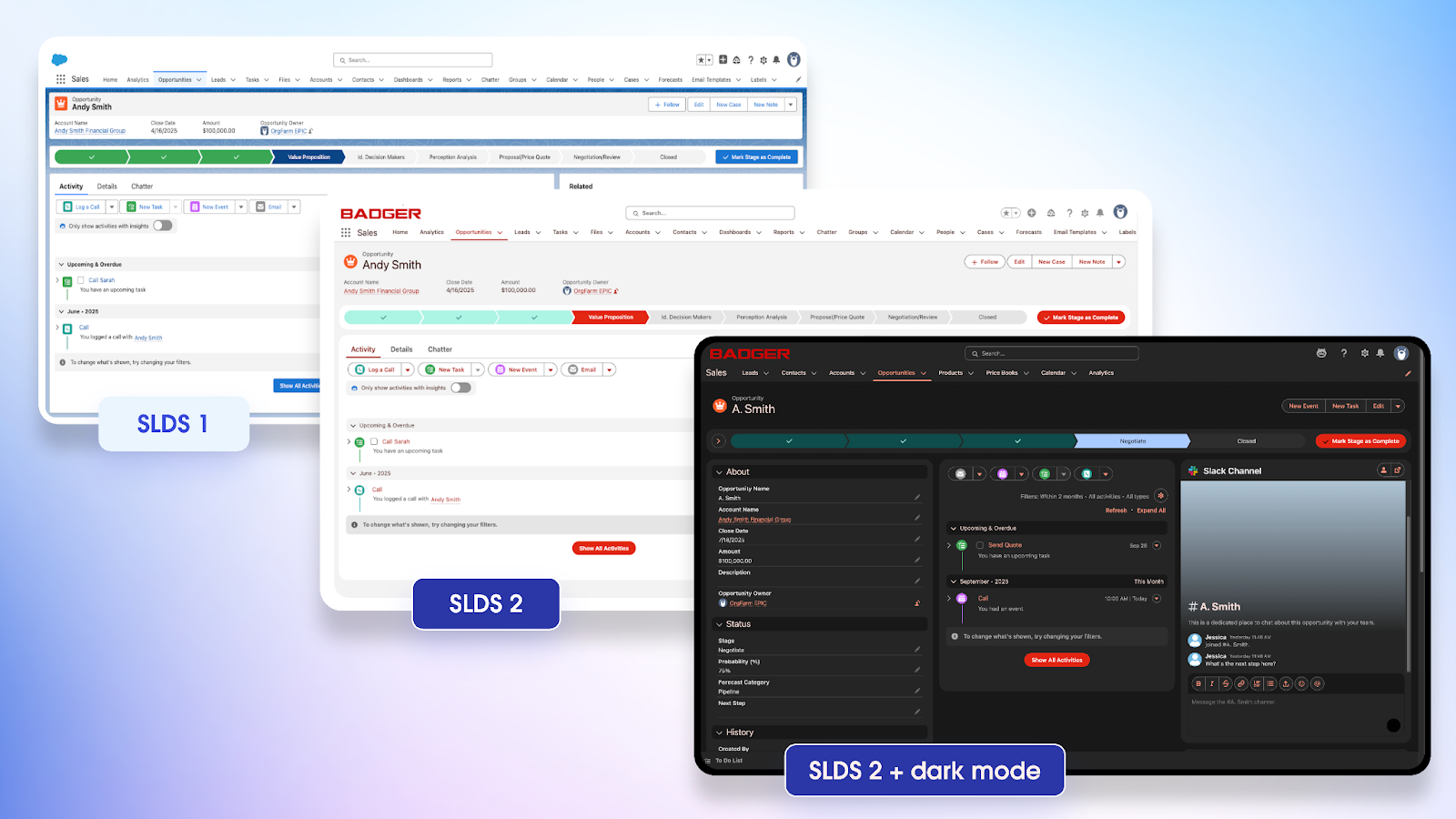
SLDS 2 is now generally available, with Winter ’26, setting a new standard for human and agent collaboration on the Lightning platform. This update brings a more composable framework and a robust styling API that will adapt and grow with our customers. Along with a visual refresh, SLDS 2 opens the door to a new chapter of Salesforce experiences that are dynamically generated, conversational, and deeply personalized.
One of the most exciting features in SLDS 2 is dark mode (beta), now available in Starter Suite orgs. Dark mode is our most highly requested feature, and it offers several benefits, including reduced eye strain in low-light conditions, decreased light sensitivity, and enhanced readability for users with low vision. This feature is exclusive to SLDS 2 themes, making it a compelling reason for customers to transition to the new design system.
Looking ahead: the future of SLDS 2
As we look to the future, we’re guided by Salesforce Chief Experience Officer Kat Holmes and her mission to “make Salesforce fast, compelling, and easy to use,” with flexible and deeply personalized human-to-agent interfaces. To prepare for this future, we’re continuously evolving SLDS 2 as an agentic design system with a composable architecture that can adapt to user needs in real time.
We’re currently focused on enriching our component blueprints with context-aware metadata to generate UI on-demand, based on user behavior and AI interactions. We also aim to establish SLDS 2 as a universal design system, expanding our influence beyond Lightning and helping users tackle design challenges across any UI framework. By positioning SLDS 2 as the design knowledge layer for building an agentic enterprise, we can grow alongside our customers in the shift toward conversational and dynamic experiences.
Customer feedback: shaping the roadmap
Customer feedback is at the heart of how we’re shaping our Design System Roadmap. Recently, we’ve heard from global enterprise customers that they prefer a controlled, phased approach to their SLDS 2 rollout. In response, we’re introducing group-based SLDS 2 activation with the Summer ’26 release. This feature will enable customers to activate SLDS 2 for specific segments of users, rather than org-wide. By offering this option for a phased rollout, and continuously improving our tools, we’re hyperfocused on making the SLDS 2 transition smoother for our customers.
Design System Roadmap
Give us your feedback on the Design System Roadmap



Upcoming features: enhanced Themes and Branding
Customers transitioning to SLDS 2 have a lot to look forward to. With the Summer ’26 release, we’re planning to launch an enhanced Themes and Branding interface that will significantly expand no-code customization controls. This update will allow personalized choices for typography, shadows, sizing, spacing, illustration color, and more. We’ll also include an inline preview screen to inspect and verify custom themes as they’re being created.
We’re even experimenting with the potential of a theming agent that uses AI to automatically detect and apply your company’s brand color palette, and natural language to customize your theme through conversation not clicks.
The role of AI in SLDS 2
AI is rapidly becoming a crucial collaboration tool for developers and designers. We’re excited about the potential to augment AI tools with SLDS 2 to add context and consistency to AI-generated experiences. By using SLDS 2 alongside AI tools, builders can collaborate more effectively across roles and generate accurate, on-brand, and production-ready code. When AI works alongside a foundational design system like SLDS 2, it will not only speed up the design-to-code workflow but also foster a shared understanding and language between designers and developers.
Picture this: A developer is vibe coding components with the latest third-party AI tool, which they’ve connected to the Salesforce DX MCP server. Now, with the guardrails of the design system in place, they can quickly create production-quality code that follows SLDS 2 style guidelines. Their custom components will work in light and dark mode, and are inherently future-proof, because the right styling hooks were automatically applied.
The potential of SLDS 2 to improve AI-generated UI quality, consistency, and accuracy is energizing. But our vision expands beyond Lightning interfaces. We’re asking ourselves, “How can our users benefit from the metadata, context, and unstyled blueprints of SLDS 2 across any platform?” Whether you’re building for Slack, React, or even your own design system, we envision a world where humans and agents, working on any platform, are powered by SLDS 2.
Challenges and opportunities
Designing for AI agents requires UX and engineering teams to shift the way they work. Reskilling in and mastering such areas as conversation design, ontology, context engineering, and prompt design is crucial. It’s an exciting frontier where design goes deeper into the technology stack to shape the way AI behaves and interacts with humans.
As we continue to evolve SLDS 2, we’re committed to delivering a design system that meets the changing needs of our customers. We’re excited to see the impact that SLDS 2 will have on the user experience and look forward to continuing this journey with our community.
Get started with SLDS 2 today!