

Most PPC competitor research focuses on the same things: keywords, ads, landing pages, and offers. But there’s another source of competitive intelligence that can tell you something those tools can’t: what their customers wish they did better.
I see every negative review as free customer research. Someone has already explained what they expected, what disappointed them, and, in many cases, what would have changed their experience.
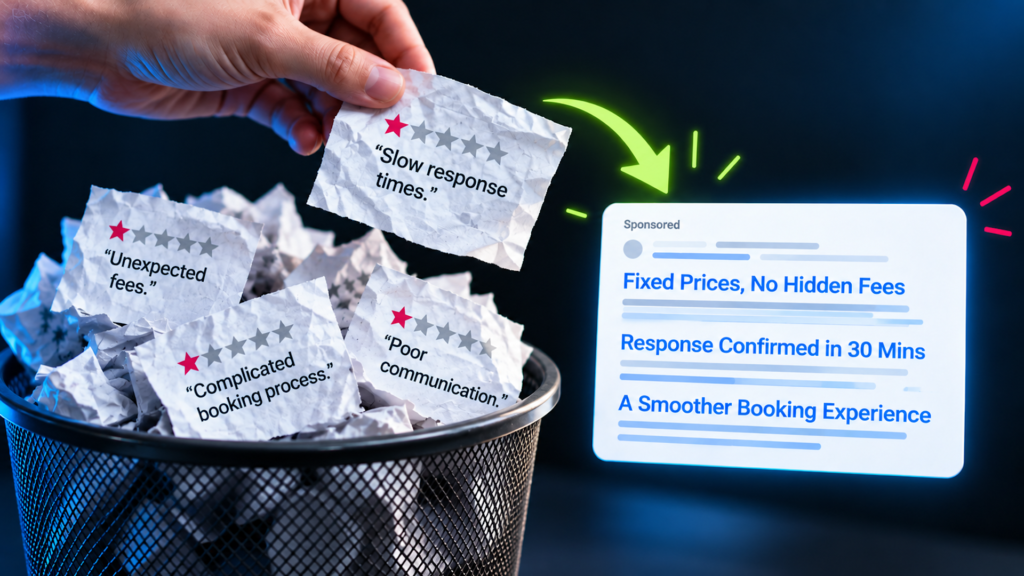
If you read enough reviews, patterns start to appear. Maybe customers repeatedly complain about slow responses, unexpected fees, complicated booking processes, or not knowing what happens next.
Those complaints can help you understand what customers value before they click your ad and where your competitors may be leaving opportunities open. AI simply makes those patterns much faster to find.
Find recurring complaint themes with AI
Collect around 30 to 50 negative or mixed reviews from two or three of your main competitors. These could come from Google, Yelp, Tripadvisor, Booking.com, or another relevant review platform.
Simply copy and paste the reviews into your AI prompt. It can usually work with raw text.
I would focus primarily on one-, two-, and three-star reviews. You can use any AI tool for this. My go-to is Claude.
Try this prompt:
- “Group these reviews into recurring complaint themes. Return a table with the theme, number of mentions, percentage of reviews mentioning it, and one representative example.”
You might end up with:
- 12 complaints about slow response times.
- 9 complaints about unexpected costs.
- 7 complaints about poor communication.
- 6 complaints about a complicated booking process.
- 4 complaints about limited availability.
One complaint could be an isolated experience. If the same frustration appears repeatedly across several competitors, you may have found a broader customer expectation that the market isn’t meeting.
But don’t stop at identifying complaints. Ask what customers wanted instead.
Slow responses may mean customers value certainty. Unexpected costs may point to demand for transparent pricing. Poor communication may show that customers want to understand what happens next.
You don’t want to build ads around your competitors’ weaknesses. You want to build them around what customers value.
Uncover the keywords, ads, landing pages, and strategies driving your competitors’ paid search success—and find your next opportunity to outperform them.
Identify the gap between complaints and your offer
Once you have the recurring themes, compare them with what your own business actually does.
Try this prompt:
- “Based on these reviews, what do customers consistently want that these businesses don’t appear to provide?”
Competitor reviews may repeatedly mention waiting days for a response, unexpected prices, or having to call multiple times for an update.
Now imagine your business already responds within 30 minutes, provides fixed-price quotes, and automatically keeps customers updated. Those operational details could be reasons to choose you.
And yet businesses often leave their strongest differentiators out of their PPC ads and fall back on the same generic messages as everyone else: “Trusted local experts,” “Quality service,” “Get a free quote.”
If your competitors could use the same message, it probably isn’t communicating much of a competitive advantage.
Don’t overlook your own reviews, either. One of my favorite prompts for this exercise is:
- “Here are my reviews and my competitors’ reviews. Compare them and identify my biggest competitive advantages and anything I’m not communicating clearly enough.”
You may discover that customers consistently praise something you barely mention in your ads. If competitors’ customers complain about that same thing, you’ve found a much more interesting message to test.
Dig deeper: How to write paid search ads that outperform your competitors
Audit your operations before you advertise
Warning: Never turn a pattern in competitor reviews into an ad claim your business can’t consistently deliver.
If competitor research reveals that fast replies are a clear market gap, don’t write “Replies within 30 minutes” until you’ve explicitly confirmed with your operations team that your actual lead response time supports it.
Making a promise your business can’t consistently keep will only create frustrated customers and potentially negative reviews of your own.
AI can identify the opportunity, but you need to make sure your business can actually deliver before turning it into PPC copy.
Turn customer pain points into PPC ad copy
Once you’ve validated a genuine operational advantage, test whether making it prominent improves PPC performance.
Instead of filling every headline in a Responsive Search Ad (RSA) with minor keyword variations, balance keyword relevance with competitor gap messaging.
| Headline type | RSA headline example | Strategic purpose |
| Keyword relevance | Emergency Local Plumbers | Matches search intent and maintains Quality Score |
| Competitor gap | Fixed Prices, Zero Hidden Fees | Directly addresses a common pain point: unexpected costs |
| Certainty / CTA | Response Confirmed in 30 Mins | Addresses concerns around slow response times |
If you want AI to help generate ad assets based on your research findings, try this prompt:
- “Based on the complaint themes identified, generate five RSA headline options (max. 30 characters) that highlight our validated strengths and address these customer frustrations.”
Dig deeper: The anatomy of compelling search ad copy
Match the message on your landing page
Changing the ad isn’t enough. If your ad promises transparent pricing but the landing page never explains how pricing works, you’ve created another gap.
Take the strongest themes from your research and ask whether visitors can immediately see the answer to those concerns.
If response time matters, explain when they’ll hear back. If hidden costs are a common frustration, explain your pricing process. If customers are worried about what happens after submitting a form, show the next steps. For example:
Get your quote today!
- Tell us what you need.
- We’ll review your request within 30 minutes.
- You’ll receive a fixed-price quote before any work begins.
You’ve now addressed three possible objections before the visitor even has to ask.
For lead generation campaigns, reducing uncertainty about what happens after someone submits a form may be just as important as improving the form itself.
Use review research to create PPC tests
The biggest mistake would be treating AI’s output as the final answer. Treat it as a source of hypotheses instead.
If reviews suggest customers care about price transparency, test price-transparency messaging. If they complain about response times, test speed. If communication is the recurring frustration, test messaging that explains the process.
Test 1: Ad messaging
- Control: “Trusted Local Plumbers | Get a Free Quote”
- Variant: “Fixed-Price Plumbing Quotes | No Surprise Charges”
Test 2: Landing page
- Control: Standard service page.
- Variant: Add pricing transparency and a clear “what happens next” section.
Test 3: Offer
- Control: “Request a quote.”
- Variant: “Get your fixed-price quote.”
Now you’re using competitor research to create testable PPC hypotheses rather than copying what competitors are already doing.
Give each variant enough time to collect a meaningful sample before judging results. CTR can tell you whether the message attracts attention. Conversion rate tells you whether it persuades. Qualified lead rate tells you whether it attracts the right customers.
A higher CTR isn’t necessarily a win if those clicks produce worse leads.
Dig deeper: Why PPC tests in 2026 call for nuance, not winners
See where competitors are investing, which keywords drive their results, and how to capture more of the market.
Your next PPC idea may already be sitting in a review
Reviews show you what people expected, what frustrated them, and what they wish businesses in your market did differently.
AI makes it easier to turn those comments into patterns. The valuable part comes afterward: comparing them with what your business genuinely does better and turning those opportunities into PPC experiments.
Sometimes the biggest opportunity isn’t creating a new advantage. It’s realizing that you already have one and making sure your next customer can see it before they click.