
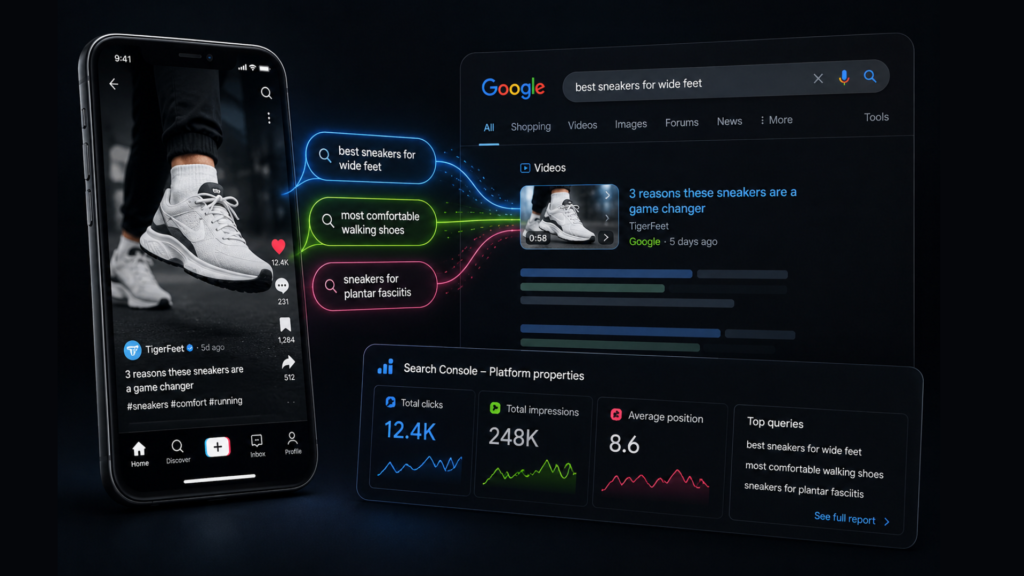

For the entirety of Google Search Console’s life, it has spoken one simple language: your website. Pages, queries, clicks, impressions, all tied to a domain you own and verify.
On July 7, that changed. Google shipped Platform properties, a new property type that lets you verify a social or video account and get the same first-party search performance data GSC has always given website owners. Think clicks, impressions, CTR, average position, and the actual queries behind them — just pointed at your social presence instead.
Worth noting up front: This covers Search, Discover, and News. So a TikTok clip or a YouTube Short can now be tracked across all three surfaces the same way you’d track a blog post.
The mechanics of the launch — which platforms are supported, how verification works, and how this differs from Google’s separate Search profiles feature — are already well covered.
However, one detail deserves repeating because it’s time-sensitive: there’s no historical backfill. Data collection starts the moment you verify. That means every week you spend deciding whether this is useful is a week of query data you can’t get back.
Let’s take a look at what this means for brands and SEOs, some examples of what it looks like in practice, and what it means for marketing going forward.
What GSC Platform properties actually changes for brands
The obvious win is a single first-party lens that gives brands access to both owned and earned content, instead of having to stitch together GA4 and native platform dashboards with a hefty dollop of guesswork.
But Google’s own guidance points at something more specific than better reporting. It points at a workflow. Three parts of it are worth knowing about:
- Query groups: The Insights report clusters the search terms driving traffic into top, trending-up, and trending-down groups. That’s a real input for planning captions, hashtags and next topics. Ultimately, you’re working from demand that already exists rather than guessing at it.
- The 24-hour filter: If a post starts picking up search traffic within a day of going live, you can catch it while it’s still live and act by cross-promoting to another platform or timing a follow-up.
- Format comparisons: Using URL-based comparison filters, you can put Shorts against long-form, or Reels against static posts, and get an actual answer to “should we be putting more into short-form?”
These same three mechanics also change how you should work with creators. None of those three workflow parts are limited to owned content decisions, despite the signals coming from owned data.
Track, grow, and measure your visibility across Google, AI search, social, local, and every channel that influences buying decisions.
How GSC Platform properties can reshape creator partnerships
Smart brands could already be considering running them through a creator program to answer the questions brands have historically had to take on faith.
Query groups show you which conversations you already have traction in, but that also means, by omission, they tell you which conversations you don’t have a presence in. These insights become the foundations of an honest brief for creator activity.
Rather than simply picking creators based on reach and hoping the relevance follows, you can point to specific query territory you’re absent from and brief against it — developing your presence within new conversations. Alternatively, you could double down within a conversation by partnering with creators who can champion your brand, further developing your presence and preference.
This thinking reframes creator spend as buying coverage of conversations you don’t own yet or want to show up more within, rather than taking a risk on buying an audience you hope overlaps with yours.
Format comparisons can also feed straight into the brief itself. For example, if your own data shows Shorts consistently earning search visibility while long-form doesn’t for your category, that’s a concrete production instruction for a creator rather than a stylistic preference.
And the 24-hour filter gives campaign measurement a dimension it didn’t have before. During a live campaign, you can see whether creator content is earning genuine search visibility or just in-app impressions. This could provide a better read on whether the work is generating durable discovery or a spike that vanishes with feed changes.
There’s a neat symmetry here, too. This data lets creators show that their content genuinely ranks for specific searches, rather than simply racking up views. Platform properties give both sides of the negotiation the same evidence base and metrics.
Creator conversations that once centered on follower counts can now focus on which queries each party actually shows up for. That’s a far stronger basis for partnerships and can strengthen search marketing across the social-search landscape.
Dig deeper: Why creator-led content marketing is the new standard in search
An example of how GSC Platform properties could work in the wild
Picture a hypothetical running shoe brand called Tiger Feet. They connect their Instagram and YouTube properties to the GSC Platform properties, and a few weeks later, the Performance report shows something nobody expected: A Reel about lacing techniques for wide feet is pulling steady clicks from Google for variations of “how to lace running shoes wide feet,” while the website has no page targeting that query.
That’s three decisions in one data point:
- There’s proven demand: You’re seeing real-world results for a topic nobody on the Tiger Feet content team had previously flagged, and you know it’s real because people are searching it and landing on your content.
- You’re capturing it in the wrong format for conversion. A Reel earns the click but sells nothing. A product-linked guide on your site, with the video embedded, could.
- You now know what to write and roughly how to angle it. Because Platform properties give you the exact query language, rather than a keyword tool’s approximation of it, you have a road map to where to focus your content next.
Run the same logic in reverse, and it’s just as useful: If a social post is already ranking well for a query, that’s a case for not commissioning a page that could end up competing with it.
That’s the shift. Social content stops being measured purely on engagement and starts being measured on demand, which is a completely different question and a much more commercially useful one.
Platform properties give you first-party data, not competitive visibility
Platform properties only work on accounts you can verify, which means you get your own data and nothing else. No competitor view. No share of voice. No category benchmark.
Every other discipline in search has some form of competitive visibility. You can see who’s outranking you organically, estimate what competitors are bidding on, audit their backlinks, and track their positions.
Here, you get a perfectly clear view of your own performance and no visibility elsewhere — so this data should be combined with SERP analysis and manual research rather than relying on it in isolation.
What are the practical consequences of this limitation? It means:
- You can’t tell good from great. If an article pulls 400 clicks from Google in a month, is that strong for your category or embarrassing? There’s no external reference point, so you’re benchmarking against your own history and nothing more.
- You’ll spot demand, not competition: Query groups will tell you people are searching a topic and finding you. They won’t tell you that three competitors are already better positioned for it, or that the space is wide open. That still needs conventional keyword and SERP research alongside it.
- Absence of data isn’t absence of opportunity: A query showing nothing in your reports might mean no demand, or it might mean healthy demand that’s all going to someone else. The report can’t distinguish between the two, and it’s an easy mistake to make.
What Platform properties change for SEOs
The useful framing here isn’t that it’s a new report for SEOs to get lost within. The way to approach this development is as if it’s a new content inventory that behaves like your existing one.
That’s because Platform properties speak the vocabulary SEOs already work in, which means social content can easily fold into existing workflows instead of sitting in a silo owned by another team — further affording brands the opportunity to break down silos at a time when discovery of brands relies on collaboration across organic media strategies.
What can you do as an SEO with Platform properties? Turns out, a lot:
- Gap and overlap analysis: You can check whether a query is already being answered by the brand’s own social content (or ask creator partners to share insights on their answers on your behalf) before commissioning a page for it. You can also spot cases where a page and an article are quietly competing and determine whether or not this is a good or bad thing.
- Test captions and titles like meta titles: You can annotate the date that you rewrote a TikTok caption or YouTube title and then compare performance on either side of it. Same discipline you’d apply to standard optimizations.
- Apply structural thinking off-site: Comparing things like playlist performance or formats within a platform allows you to think about grouping and cannibalization for content that doesn’t even live on your domain at all.
There are two caveats worth bringing up with clients before this lands in a report.
- Reporting carries the usual Search Console delays, so this isn’t a real-time dashboard despite the 24-hour view.
- Coverage will vary by platform and content type while the rollout matures, so early numbers need to be treated as directional rather than definitive.
Social strategy has traditionally sat with the social team and been judged on engagement. Platform properties give SEOs a legitimate reason to be in that conversation. The content is now visible in the same tool, in the same terms they already report in and understand, and that they can develop effective strategies around.
Dig deeper: How to optimize influencer content for search everywhere
What GSC Platform properties change for search marketing, generally
If you step back and look at this new rollout, it confirms something Google has been building toward for years: The results page stopped being a list of blue links a long time ago.
Google’s own documentation shows exactly where this content appears — short-video carousels, “latest posts” carousels, and “what people are saying” SERP features — all within Search and Discover results.
Platform properties are Google handing marketers an instrument for a part of the SERP that was already there and simply going unmeasured. This points to three things worth thinking about:
- The search universe is expanding, and the SEO/social divide keeps dissolving: When both are measured in the same tool with the same metrics, it gets harder to defend treating them as separate disciplines with separate owners and separate budgets.
- Feed-based discovery is becoming as strategically important as query-based search: In terms of the role search plays in a brand’s discovery, that shift has been visible for a while, and this is the first proper measurement tool for it.
- Google is now building on the assumption that search behavior is cross-platform: Google isn’t just tolerating the fact that people search for things they saw on TikTok anymore. Instead, it’s actively shipping insights that acknowledge that it’s happening.
See where your brand appears, where it doesn’t, and exactly how to win more visibility across search, AI, local, social, and every channel that matters.
What you can do this week to take advantage of Platform properties
You should connect every active social account now. Don’t wait for a question that needs answering. With no backfill, any account you haven’t connected to is a question you won’t be able to answer later. Take advantage.
If you’re an SEO, rather than a social manager, get yourself into that reporting. Query groups and format comparisons are exactly the kind of data that should be shaping a content calendar. For most brands, that decision-making is happening without SEO as part of the conversation — the best brands will ensure that that changes.
I’ll admit that this isn’t a dramatic feature, on the face of it, although I, for one, am extremely excited about the potential this affords “search everywhere” strategy considerations. The new platform properties are Google quietly conceding that “search performance” was never really about the website. It was always about wherever people go looking for answers.