
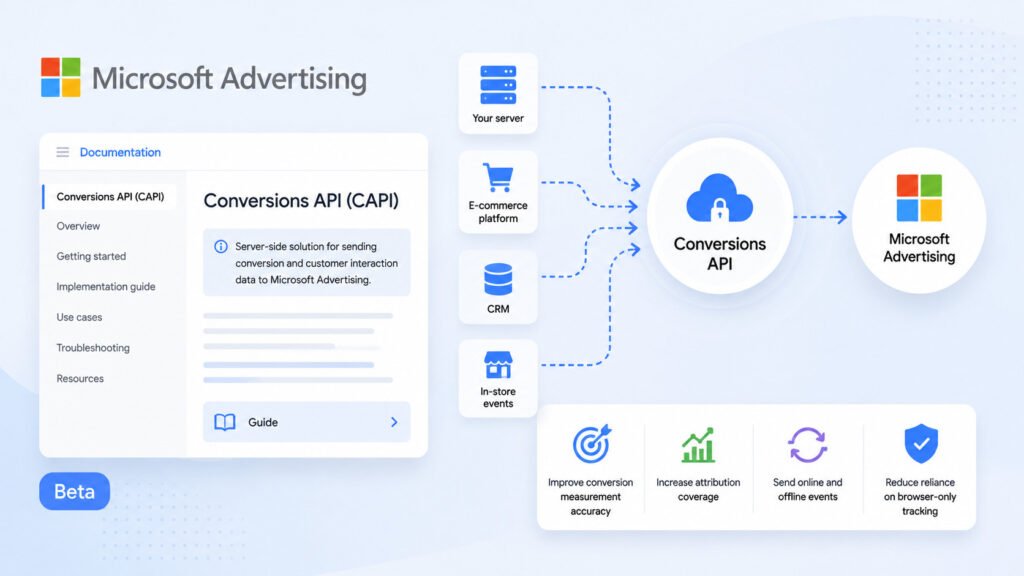

Microsoft is giving advertisers a new server-side option for sending conversion data directly to its advertising platform, reducing their dependence on browser-based tracking.
What’s happening. Microsoft Advertising has published new documentation for its Conversions API (CAPI), a server-side measurement solution currently in beta.
CAPI lets advertisers send conversion and customer interaction data directly from their own systems to Microsoft Advertising through a single connection.
The details. Microsoft says the Conversions API can support multiple measurement scenarios, including online and offline events.
The potential benefits include:
- Improving conversion measurement accuracy.
- Increasing attribution coverage.
- Sending both online and offline conversion events.
- Reducing reliance on browser-only tracking methods.
- Supporting multiple measurement use cases through one server-side integration.
How it works. Microsoft recommends using CAPI alongside Universal Event Tracking (UET) rather than treating it as a replacement.
UET continues to capture activity in the browser, while CAPI provides a server-to-server connection for sending event data directly to Microsoft Advertising.
Using the two together can give advertisers more complete measurement coverage when browser signals are unavailable or limited.
Why we care. CAPI gives Microsoft advertisers another way to preserve conversion signals and connect online advertising with actions that happen outside the browser, including offline events. For advertisers already investing in server-side measurement across other ad platforms, Microsoft’s solution could also make it easier to build a more consistent measurement strategy across channels.
Yes, but. CAPI remains in beta and isn’t available to every Microsoft Advertising account yet.
Advertisers will also need the technical resources to establish and maintain a server-side integration, making implementation more involved than simply installing a browser tag.
The big picture. Microsoft is following the broader advertising industry’s shift toward combining browser and server-side signals rather than relying exclusively on tracking pixels.
The new documentation shows that server-side measurement is moving from an advanced implementation option toward a standard part of advertisers’ measurement stacks.