
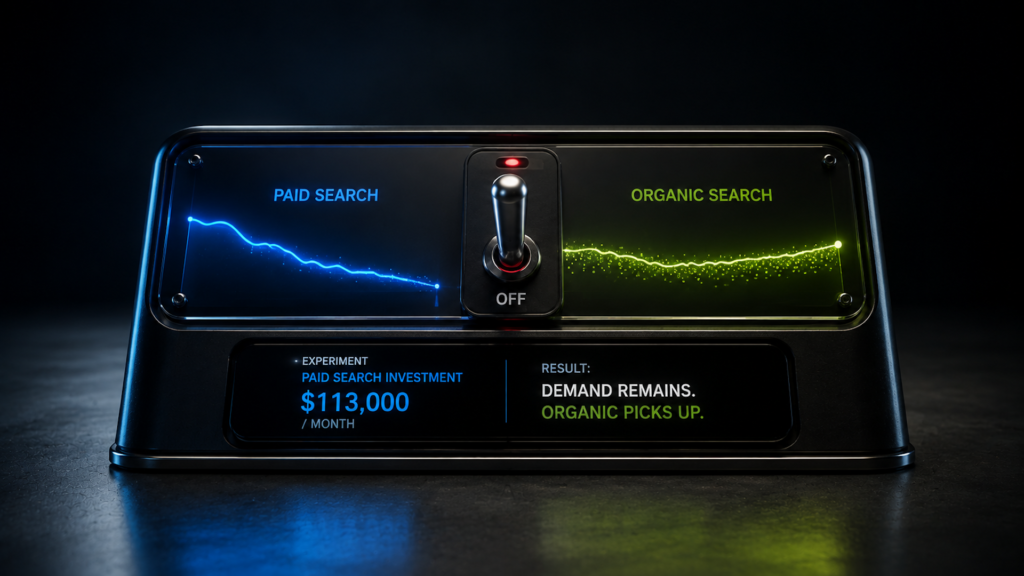

I turned off $113,000 a month in paid search.
Thirteen weeks later, 65% of the paid-attributed revenue had been recaptured through organic and direct, and the analysis showed that nearly nine out of 10 dollars in the branded campaign I studied had been defending clicks organic was already positioned to win.
Every performance marketer has the same recurring nightmare.
You turn off paid search. Traffic goes rogue. Revenue goes full “Thelma & Louise” and drives off a cliff. Then, during Monday’s leadership meeting, someone asks (very calmly, which is somehow worse) what you thought would happen.
So paid stays on. Forever.
It becomes the unwanted houseguest eating everything in your fridge with no indication of finding an apartment. I wanted to know if it deserved to be there.
Experiment: Were they spending $113K buying customers or buying our own clicks?
I was asked to answer this question:
How much of our paid search budget was bringing in customers they wouldn’t have reached otherwise, and how much was paying Google for clicks our organic listings were already winning?
This was what I wanted to test by turning it off.
A company paused branded paid search across four of its largest markets: the United States, United Kingdom, Australia, and Canada.
By the end of the month, most non-brand paid search had been paused, too. Branded search never came back.
Before the pause, the company was spending $106,000 to $119,000 per month across branded search, non-brand search, Shopping, and Performance Max, so I’ll say $113,000 per month on average.
Dig deeper: Paid search click share doubles as organic clicks fall: Study
Track, grow, and measure your visibility across Google, AI search, social, local, and every channel that influences buying decisions.
The questions that make paid search hard to turn off
There’s always a “but what if.”
- What if the ad at the top of the page makes someone trust the brand a little more?
- What if seeing paid and organic together gives us more real estate on the SERP?
- What if competitors start bidding on our name?
- What if turning paid off doesn’t move the click downstairs to organic but makes the click disappear entirely?
This is the paid search halo.
And unlike Bigfoot, there’s some evidence it exists.
Google studied more than 400 advertisers that paused search campaigns and found that, on average, 89% of ad clicks were incremental. Organic search didn’t magically pick up most of the traffic when the ads went away. Google’s follow-up research also found that incrementality changes depending on whether an organic result appears and where it ranks.
Which sounds like a fairly compelling reason to leave the credit card where it is.
Except there’s another famous experiment.
eBay turned off branded paid search and found that almost all of the missing paid clicks and attributed sales were immediately captured by organic search. For a household-name brand with strong organic visibility, the ads were intercepting customers who already knew where they were going.
So which one is right? Annoyingly: both.
Paid search can create incremental traffic. It can also charge you admission for customers who were already standing in line.
The only way to know which one you’re buying is to measure it. So I did.
I wanted to know what our halo cost and whether there was anything underneath it.
Putting paid and organic in one spreadsheet
I brought every Google Ads search term and its associated spend together with every matching Search Console query and its organic clicks.
Then I matched them keyword by keyword across the same period to understand what the company was paying for.
I sorted each query into one of three categories:
- Cannibalized: The company paid for a click organic was already positioned to win.
- Dependent: Organic performance benefited from paid support and declined when the ads disappeared.
- Incremental: Paid search reached a customer that organic search couldn’t have captured.
Then I ran one of the company’s branded campaigns through the model.
Dig deeper: How to prevent PPC from cannibalizing your SEO efforts
The impact: 89% defense, 11% offense
On queries where paid and organic overlapped, organic was already winning 71% of clicks, even with the ads running.
Of the $36,129 spent in the branded campaign I analyzed, only $3,945, or 10.9%, appeared to buy clicks organic couldn’t have captured.
The other $32,184?
Brand defense.
Nearly nine out of every 10 dollars were going toward traffic the company was already positioned to receive.
Turns out, a lot of our “paid acquisition” was organic traffic with a cover charge.
| Metric | Result |
| Branded spend | $36,129 |
| Organic share of overlapping clicks | 71% |
| Incremental spend | $3,945 |
| Incremental share | 10.9% |
| Brand-defense spend | $32,184 |
| Brand-defense share | 89.1% |
| Annualized incremental spend | ~$15,000 |
| Annualized cannibalized spend | ~$128,000 |
Then, the company turned off paid — and organic moved in
Six weeks after the pause, organic search began doing what I hoped it would do: reaching over and collecting some of the clicks paid search used to purchase.
And once the full revenue data became available, the story became much easier to quantify.
Organic revenue increased $18,000 to $28,000 per month over the pre-pause baseline.
Direct revenue initially increased by about $14,000 per month. By week 13 and beyond, the direct revenue lift had climbed to roughly $54,000 per month.
Combined organic and direct revenue recaptured 30% of the paid-attributed revenue within six weeks. By week 13, recapture had reached 65%.
All while spending nothing to acquire those visits through paid search.
| Time after pause | Organic revenue change/month | Direct revenue change/month | Recapture |
| Weeks 1-6 | +$17,800 | +$14,500 | 30% |
| Weeks 7-12 | +$28,100 | +$14,100 | 39% |
| Weeks 13+ | +$15,800 | +$54,000 | 65% |
Comparing the paid-on period with the later paid-off period, organic clicks increased across several of the company’s most commercially valuable product terms.
| Query type | Paid on | Paid off | Change |
| Core product term | 5,144 | 5,858 | +14% |
| Premium product term | 638 | 990 | +55% |
| Product variant | 228 | 402 | +76% |
| Category plural | 315 | 444 | +41% |
| Product variant | 206 | 289 | +40% |
| Brand + category | 265 | 352 | +33% |
| Entry-level product | 433 | 490 | +13% |
Across every commercial query shown here, organic clicks went up after paid went away.
Clicks came back faster than the money
Paid and organic are two doors leading into the same room. Shut one, and customers don’t necessarily go home. Plenty of them use the other door.
The catch is that they don’t all buy at the same rate. Paid traffic converted at about 2.9%. Organic converted closer to 2.3%.
So the clicks came back faster than the revenue did.
Did organic replace paid?
Not perfectly. But far more of it than the original attribution ever suggested.
Dig deeper: How SEO and PPC build trust across search: Case study
See where your brand appears, where it doesn’t, and exactly how to win more visibility across search, AI, local, social, and every channel that matters.
What I learned: Revenue isn’t profit
This is usually where case studies start polishing the numbers until everyone involved looks brilliant. I won’t.
Top-line revenue fell roughly $30,000 to $40,000 per month from the pre-pause baseline.
That happened. But after accounting for media spend that was no longer going to Google, the working estimate put net P&L roughly $5,000 to $20,000 per month higher.
That may sound contradictory. It isn’t.
Did the company sell slightly less? Yes.
Did the business potentially make more money? Also yes.
And that may be the most important thing this experiment uncovered.
Channel dashboards are good at telling you what revenue an ad touched.
They’re less good at telling you whether you needed to buy the touch in the first place.
The company had been spending six figures a month on paid search. In the branded campaign I analyzed, 89% of the spend was defense rather than incremental acquisition.
Six weeks after paid went dark, organic and direct had recaptured 30% of the lost paid-attributed revenue.
By week 13, they’d recaptured 65%. That doesn’t mean branded paid search is bad.
Competitors exist. SERPs change. Organic can’t capture every click. And in this experiment, paid traffic converted better.
It means you should know what you’re paying for. “We’ve always run branded search” isn’t a strategy.
Measure the halo. Price the defense. Give organic enough time to show you what it can carry.
And above all, don’t confuse less attributed revenue with a worse business.
This company turned off the money. The customers kept coming.
They just stopped paying Google to introduce them to people who were already looking.