

AI search is changing at a pace none of us has experienced before in marketing.
The presentations I saw at Zero Click NY highlighted both how much AI search has changed over the past six months and the characteristics that may become lasting features of the landscape.
Of all the points covered, these seven stood out as the most important.
From the rise of the marketing engineer, to the differences between Claude and ChatGPT results, to Claude’s meteoric rise among businesses over the past 12 months, here are the most impactful takeaways I left with.
1. Every AI relies on different content
ChatGPT and Claude share only about 8% of their citations, per Profound data. Put differently, 92% of what ChatGPT cites wouldn’t be cited by Claude for the same query. A brand can own visibility in one engine and be virtually invisible in the other.
On top of that, they don’t just cite different websites. They prefer different kinds of content.
- ChatGPT indexes heavily on community content: Reddit, Quora, and forums make up roughly 16% of its citations.
- Claude sits at less than 1%. Claude, by contrast, loves listicles (36% of citations vs. ChatGPT’s ~20%) and opinion content (13.2% vs. 7.2%).
The relationship to traditional search splits the same way. About 64% of the websites Claude cites also appear in Google’s top 50 for the same query. For ChatGPT, it’s only 37%.
In other words, “just do the SEO work you’ve been doing” might work for Claude visibility, but likely won’t for ChatGPT.
Takeaway: It’s critical to communicate to stakeholders that “AI visibility” will inevitably vary by LLM, and you’ll have to prioritize them depending on whom you’re trying to reach (more on that later).
Track visibility by engine because the work that wins in one might do almost nothing in another. UGC and community seeding move ChatGPT, while listicles and traditional rankings move the needle on Claude.
See where your brand appears in AI search, where competitors are winning, and what it takes to become the answer AI recommends.
2. Claude is quietly winning B2B — so sequence your optimization by audience
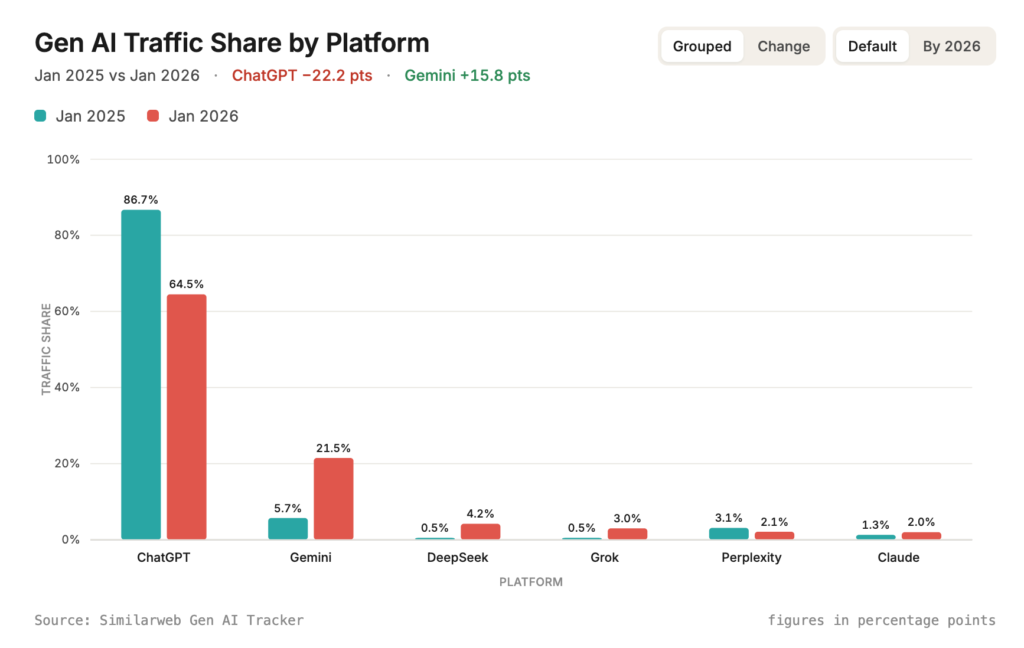
If you’ve seen the generative AI traffic-share charts, Claude looks like a rounding error.

But web traffic is the wrong chart. Roughly 85% of Anthropic’s revenue comes from enterprise and API usage that never shows up in consumer traffic data.

The right chart comes from Ramp’s AI Index, which tracks corporate card spend across tens of thousands of businesses.
A year ago, single digits of those businesses were paying for Anthropic. Today, it’s 34.4% — ahead of OpenAI at 32.3%. For the first time, more businesses pay Anthropic than OpenAI.
I came away from this presentation asking myself: If business users are increasingly living in Claude while consumers live in ChatGPT, shouldn’t your optimization priorities focus on where your audience is?
Should B2B brands prioritize Claude visibility first? Should B2C brands prioritize ChatGPT first?
Almost nobody is doing this because people aren’t really thinking about who uses ChatGPT, Gemini, or Claude. That will likely change.
3. ChatGPT ads are here, and this is what we’re seeing
The moment is here: Your competitors are buying visibility through ChatGPT ads. ChatGPT ads are live and self-serve, sitting directly inside the chat product.
The same two weeks brought GPT 5.5, citation chips turning into clickable hyperlinks (referral traffic jumped roughly 60% overnight, with homepage referral share leaping from roughly 3.5% to 24%), and Google moving AI Mode into its main search box.

None of that was an accident. The hyperlinks are the click-tracking rails an ads business needs. The analysis of more than 100,000 ad placements surfaced three things everyone should internalize.
ChatGPT Ads match on topic
Ads match on topic similarity, not intent. Only 14% of real user prompts carry commercial intent, but 20% of prompts trigger ads — a math problem can serve an ad.
The embedding analysis found that ad titles and descriptions are the single biggest drivers of which conversations you show up in. Your title and description are now targeting parameters, not just creative.
Paying for ads
“Pay-to-play” is here. About one in five ad placements appears against a mention of a direct competitor, and the brand mentioned organically shows up as the advertiser only about 8% of the time.
Someone else is twice as likely to be the advertiser on your organic mention as you are.
Startup CRM Adia is already placing ads against prompts where Salesforce appears, and Salesforce is playing defense, showing paid placements 40% of the time, even when it’s already mentioned organically.
Ad inventory is scarce and expensive
ChatGPT shows roughly one ad per conversation, the median conversation is three turns, only 30% of eligible users see ads at all, and CPMs/CPCs are running around four times Meta’s.
Expect that to change in predictable ways: more ad slots per answer, ads deeper into conversations, and follow-up suggestions engineered to create more turns, which means more inventory.
The lesson: Organic AEO and paid defense are now the same job. If you’re tracking your brand’s organic citations but not who’s advertising against them, you’re seeing half the board.
4. Claude is the most directly optimizable AI right now
When Claude searches the web, it pulls from Brave. Not “influenced by” Brave. According to the talk I saw, it pulls directly from it.
In Profound’s latest testing, 79.2% of Claude’s citations came directly from Brave’s top 10 results for the equivalent search.
There’s no meaningful reshuffling or reranking. No other model trusts its search provider to anything like this.
That makes Claude the most directly optimizable model in AI search: a visible index, a checkable ranking, and (as we’ll see next) predictable retrieval behavior.
If takeaway 2 convinced you that Claude matters for B2B, this is the playbook: Figure out where you rank on Brave for your key prompts and treat that as your Claude visibility roadmap.
A window this transparent doesn’t stay open. Optimize for it while it exists.
Dig deeper. Claude visibility may depend heavily on Brave Search rankings, new data suggests
5. Claude only performs web searches a third of the time
There’s a catch, and it’s a big one. ChatGPT triggers web search on roughly 95% of prompts. Claude searches only about a third of the time — likely because every search costs money (Brave’s public API pricing runs around $5 per thousand searches), so Claude has a real financial incentive to answer from its weights.
You can only optimize Claude when it actually retrieves.
The good news is that its search behavior is predictable. Recency-framed prompts (“best X in 2026”) trigger search about 81% of the time.
Ranking-oriented prompts (“top 10…”) trigger it 67% of the time, location-dependent prompts 55%, and comparisons 51%.
Definitional and procedural prompts — “what is a CRM?” and “how do I…” — mostly don’t trigger search at all, which makes them nearly worthless optimization targets for Claude.
The lesson: Before you invest in Claude visibility for a prompt category, test whether Claude actually searches for it.
Recency, rankings, locations, and comparisons are the surface areas where Brave rankings translate into Claude citations.
Everything else is answered from memory you can’t touch.
6. Query fan-out: A raffle on one stage, near-deterministic on another
Two speakers described the same mechanism in almost opposite terms, and the tension between them is instructive.
Query fan-out is the set of synthetic queries an AI engine runs in the background to gather content before generating an answer.
Mike King of iPullRank framed it as a raffle: You can’t see or control the fan-out, so the job is to maximize your raffle tickets — more surface area across owned, earned, and shared properties, and, crucially, the right content formats.
Even if you rank for a fanned-out query, the wrong format makes you ineligible.
His research points to new measures of what wins retrieval — content-to-query cosine similarity and information gain both correlate strongly with AI search performance.
Josh Blyskal of Profound’s data tells a different story for Claude specifically: Its fan-outs are near-deterministic.
The same prompt produces the same fan-out string about 65% of the time, and 94% of Claude’s fan-outs are stamped with the current year (ChatGPT does this only 17% of the time).
ChatGPT’s fan-outs churn constantly. Claude barely moves. Both views may be right — for different engines.
Where fan-outs are stable, as in Claude, you can read them and build content targeted directly at them. The year-stamping behavior alone argues for putting the current year in your titles.
Where fan-outs are volatile, as in ChatGPT, King’s raffle logic applies: Buy more tickets through formats and surface area.
One mechanism, two strategies, chosen per engine. Which, again, may require you to prioritize one over the other.
7. The marketing engineer is here, and agents are the new workforce
It would be easy to dismiss “marketing engineer” as a vendor-manufactured job title. The hiring market says otherwise.
Google has hired its first marketing engineer. Figma posted the role at a $295,000 base salary. RBC and Autodesk have made hires.
It became a breakout search term on Google, and Google’s own AI marketing lead called marketing engineers “the hire for 2026.”
Who is the ideal candidate to become a marketing engineer? Is this a role where you start with an engineer and teach them marketing, or vice versa?
The emerging consensus profile is a marketer first — someone with channel experience and taste — who builds and maintains AI systems, reports to the head of marketing, and unblocks the rest of the team. A marketer who ships systems end to end.
The underlying logic is that most marketing work decomposes into pipelines: extract data, transform it, and load it somewhere useful. Agents can now run those pipelines on a loop.
- Monitoring competitor pricing and auto-generating sales battle cards.
- Watching landing pages and AEO presence on a schedule and staging A/B tests.
- Pulling objection themes out of 800 sales calls and drafting content to address each one.
Tasks that used to be “we’ll get to it someday” projects become an afternoon of agent building. The constraint stops being headcount and becomes creativity.
If your team doesn’t have someone in this role yet, there’s a good chance it will eventually.
Track your visibility across AI search, uncover missed opportunities, and grow your presence where customers are asking questions.
The job now: Figuring out how this all works
There still is no clear playbook for AI search. When that playbook does emerge, however, the first step may be to prioritize one LLM over another based on who you want to find you.
And in many cases, that “who” is going to be an agent. At the same time, we’ll have agents assisting us in the work we’re doing, and the demand for people who can engineer these systems will continue to grow.