Recurring revenue, or providing a subscription service, is an awesome growth strategy. Every solid business owner knows it. However, when you introduce recurring revenue models, the excitement of steady income can quickly turn into missed invoices and manual spreadsheets. You need a way to track who owes what, without spending your entire time buried in paperwork.
The right approach to subscription management for small business helps you focus on growth instead of admin work. By connecting your sales, service, and finance tools, you can create a smooth experience for your subscription customers while keeping your operations lean. This guide shows how you can use smart tools to scale recurring revenue and keep customers happy for the long haul. Let’s get started.
What is subscription management for small businesses?
Subscription management is the process of overseeing the entire lifecycle of a recurring customer relationship, from initial sign-up and billing to payment processing, modifications, renewals, and cancellations.
For a small and growing businesses, it involves using specialized software to automate tasks like recurring invoicing, dunning (managing failed payments), and prorated adjustments. This automation is important for steady cash flow, reducing manual tasks, and providing a consistent experience for subscribers, ultimately supporting growth through recurring revenue.
What’s included in subscription management:
- Billing and invoicing: Ensures accurate, on-time generation of recurring invoices.
- Payment processing: Handles multiple payment methods, tokenization for security, and processing of recurring charges.
- Dunning management: Automated workflows for recovering failed payments (credit card retries, reminder emails).
- Subscription change management: Automatically calculates pro-rated charges for upgrades, downgrades, and plan changes.
- Customer self-service portal: Allows customers to manage payment details, download invoices, and update their plans independently.
- Tax and compliance: Calculates relevant taxes (sales tax) and maintains compliance with payment security standards.
- Reporting: Provides real-time data on monthly recurring revenue (MRR), churn, and customer lifetime value (CLV) to support growth decisions.
Pro tip: Tools like Salesforce help teams track subscriber activity, conversations, and opportunities directly in the CRM so nothing slips through the cracks.
Scale your revenue with subscription management
Managing recurring payments manually is a recipe for missed opportunities and frustrated customers. You can automate the entire subscription lifecycle from the first quote to the final renewal. This ensures that every invoice goes out on time and every payment is recorded accurately in your system.
Startups often struggle with complex pricing models as they test different ways to deliver value. A business management tool like a customer relationship management (CRM) platform allows you to update your offerings and manage tiered pricing without breaking your back-office processes.
Setting up a subscription management system is like building the engine of a recurring revenue business. It’s not just about taking payments; it’s about managing the entire lifecycle of a customer — from the first “Sign Up” to the inevitable (but hopefully rare) “Cancel.”
Here are a few ways you can automate your subscription service:
- Set up your system to generate and send bills automatically on a schedule that works for your clients.
- Use automated workflows to nudge customers about upcoming or overdue payments so you don’t have to send manual emails.
- Handle mid-month upgrades or downgrades easily without calculating the math by hand every time.
Get Salesforce free for 30 days.
No credit card required, no software to install.

Step-by-step guide to get your subscription system up and running
This step-by-step guide will help you get your subscription system up and running with no problems. Here’s a quick list:
1. Define your subscription logic
Before touching any code or software, you need to map out how your business actually works.
When setting up subscription billing for a small business, key decisions involve choosing the pricing model — such as flat-rate, tiered (Basic, Pro), or usage-based — and defining the billing cycles (monthly or annually), with annual discounts often used to boost cash flow.
And, the strategy for attracting new customers must be determined, which includes deciding whether to offer a “freemium” version or a structured trial period, such as a 14-day free trial, and whether a credit card will be required upfront.
2. Choose your tech stack adventure
For subscription management software, you have a lot of choices. Here are the tools you need to consider when choosing subscription based marketing:
- CRM: Centralizes subscriber data to track engagement and manage renewal cycles.
- Subscription billing: Automates recurring payments and handles failed credit card retries.
- Accounting software: Records subscription revenue and manages tax compliance for recurring sales.
- Productivity suite: Hosts the professional email used for sending invoices and account notifications.
- Internal communication: Enables teams to resolve subscriber issues and billing disputes in real-time.
- Project management: Organizes onboarding workflows to ensure new subscribers receive their services.
- Password manager: Secures access to payment gateways and sensitive customer billing portals.
Pro Tip: An AI-powered CRM can handle these recommended subscription tools in an all-in-one platform. Check out how CRMs can help with everything on this list.
3. Map the subscription lifecycle
It’s time to map out the subscription path. You need to create workflows for every stage of the customer journey:
- Signup and checkout: Securely capturing payment details.
- Provisioning: Automatically granting access to your service once the payment clears.
- Renewal: Sending invoices and processing the next charge.
- Dunning: What happens if a card is declined? (e.g., retry 3 times, then email the user).
- Modification: Handling “pro-rated” charges when a user upgrades or downgrades mid-month.
Pro Tip: “Dunning” is just a fancy word for “asking for money when a payment fails.” Setting up automated retry logic and reminder emails can recover 10% to 20% of lost revenue that would otherwise vanish due to expired credit cards.
4. Tackle tax and compliance
Taxes and compliance are an important part of subscription management. You’ll need to learn about your location taxes and compliances, as each are unique to where you’re based. This is the part most people overlook until it’s too late.
Depending on where your customers are, you may need to collect VAT (EU) or Sales Tax (U.S.). Many modern managers (like Stripe Tax) handle this automatically.
To comply with all data, keep it safe and secure. Ensure you never store raw credit card numbers on your own servers. Use “tokenization” so the sensitive data stays with the payment provider.
5. Build the Customer Portal
A great self-service portal improves customer experience and reduces support work by letting users manage their own subscriptions. Customers can instantly check billing details, update payment info (reducing churn), download invoices, and change their plans (upgrading, downgrading, or swapping plans or add-ons) with clear financial info.
The best portals also offer service pausing for retention, provide easy cancellation (with an exit survey), let B2B admins manage team seats and permissions, and serve as a main source for support and documents.
- Update their credit card info.
- Download past invoices.
- Upgrade, downgrade, or cancel without needing to email your support team.
6. Test with “sandboxes”
A dedicated sandbox is important for any business using or changing its billing system. This separate, non-live environment copies the real system, allowing you to safely test new plans, pricing, or billing rules without affecting customer data or money. It’s also important for developers to integrate the system using fake payment methods and for new employees to practice. Using a sandbox turns the high-risk process of system management into a controlled, low-risk task.
- Use “test cards” provided by the platform to simulate successful payments, declined cards, and expired subscriptions.
- Verify that when a subscription is canceled in the billing system, your app actually shuts off the user’s access.
7. Integrate it all into your CRM
Integrating subscription data with your CRM removes data entry errors and gives sales, marketing, and service teams up-to-date customer profiles. The benefits include a complete view of the customer for better sales and support, more accurate financial forecasting, improved efficiency, and the ability to personalize recurring customer experiences.
- Centralized customer view: Ensure every team member (sales, service, marketing) sees real-time subscription status, billing history, and upcoming renewal dates directly in the CRM.
- Automate workflows: Trigger CRM follow-up tasks for sales when a customer upgrades, or create a high-priority service ticket when a payment fails.
What’s your agentic AI strategy?
Our playbook is your free guide to becoming an agentic enterprise. Learn about use cases, deployment, and AI skills, and download interactive worksheets for your team.

Enhancing customer loyalty with smart tools
Retaining an existing customer is much more cost-effective than finding a new one — especially for a growing SMB. By using artificial intelligence (AI) to analyze customer behavior, you can identify which subscribers might be at risk of leaving. This proactive approach lets your service team reach out with the right offer at the right time.
Empowering customers through self-service
- Customer portals: Give your clients a secure place to update their credit card info or change their plans on their own time.
- Clear communication: Send automated receipts and renewal notices so there are never any surprises on a customer’s bank statement.
- Predictive insights: Use Agentforce to suggest the next best product based on how a subscriber is actually using your services.
Streamlining team productivity
Data silos are the enemy of subscription management success. When your marketing, sales, service, and commerce teams all see the same information, you reduce the confusion of conflicting records. A unified solution for subscription management ensures that everyone has a clear view of the customer journey.
- Shared visibility: Ensure your service reps and AI agents can see a customer’s billing history immediately when they pick up the phone.
- Lead-to-cash speed: Move from a signed contract to a processed payment in minutes instead of days.
- Integrated apps: Connect your favorite productivity tools to your main platform to keep all your work in one place.
Gaining insights from your subscription data
Understanding your revenue is pretty important for making informed decisions about your future. With a subscription management tool, you can see real-time reports on your growth and churn rates. This data helps you understand which products are performing well and where you might need to adjust your strategy.
Here are a few key metrics to track:
- Churn rate: Monitor how many customers are leaving and look for patterns that help you fix the underlying issues.
- Lifetime value: Calculate how much a customer is worth over the entire duration of their relationship with your business.
- Revenue retention: Track how much revenue stays with you month over month to ensure your business remains healthy.
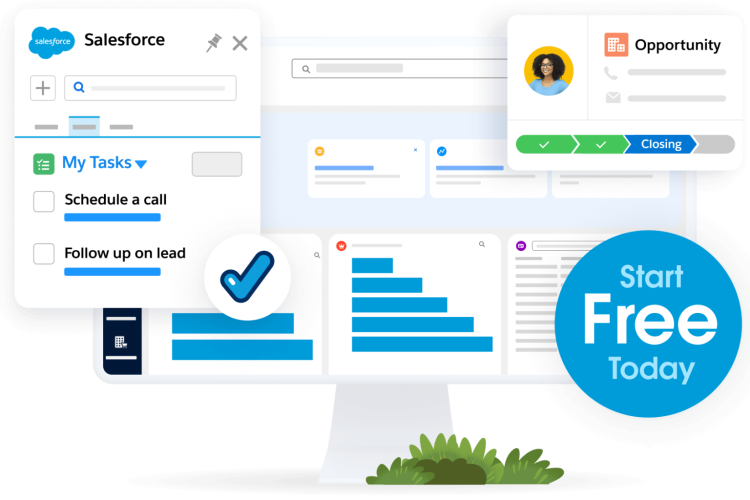
Try Salesforce for free.
See how growing businesses are using Salesforce Suites to scale fast. No credit card required, no software to install.
It all starts with Starter Suite.
Enter a valid e-mail address
Enter a valid e-mail address
Enter a valid e-mail address
Enter a valid e-mail address
Enter a valid e-mail address
Enter a valid e-mail address
Employees
1-20 employees
21-200 employees
201-10,000 employees
10,001+ employees
Select the number of employees
Industry
Automotive
Communications
Financial Services
Healthcare
Tech
Education
Life Sciences
Manufacturing
Media
Nonprofit
Public Sector
Retail & Consumer Goods
Energy & Utilities
Other
Select your industry.
Country/Region
United States
Afghanistan
Albania
Algeria
American Samoa
Andorra
Anguilla
Antarctica
Antigua & Barbuda
Argentina
Armenia
Aruba
Australia
Austria
Azerbaijan
Bahamas
Bahrain
Bangladesh
Barbados
Belarus
Belgium
Belize
Benin
Bermuda
Bhutan
Bolivia
Bosnia & Herzegovina
Botswana
Bouvet Island
Brazil
British Indian Ocean Territory
British Virgin Islands
Brunei
Bulgaria
Burkina Faso
Burundi
Cambodia
Cameroon
Canada
Cape Verde
Caribbean Netherlands
Cayman Islands
Central African Republic
Chad
Chile
China
Christmas Island
Cocos (Keeling) Islands
Colombia
Comoros
Congo – Brazzaville
Congo – Kinshasa
Cook Islands
Costa Rica
Croatia
Curaçao
Cyprus
Czechia
Côte d’Ivoire
Denmark
Djibouti
Dominica
Dominican Republic
Ecuador
Egypt
El Salvador
Equatorial Guinea
Eritrea
Estonia
Eswatini
Ethiopia
Falkland Islands
Faroe Islands
Fiji
Finland
France
French Guiana
French Polynesia
French Southern Territories
Gabon
Gambia
Georgia
Germany
Ghana
Gibraltar
Greece
Greenland
Grenada
Guadeloupe
Guam
Guatemala
Guinea
Guinea-Bissau
Guyana
Haiti
Heard & McDonald Islands
Honduras
Hong Kong SAR China
Hungary
Iceland
India
Indonesia
Ireland
Israel
Italy
Jamaica
Japan
Jordan
Kazakhstan
Kenya
Kiribati
Kuwait
Kyrgyzstan
Laos
Latvia
Lebanon
Lesotho
Liberia
Liechtenstein
Lithuania
Luxembourg
Macao SAR China
Madagascar
Malawi
Malaysia
Maldives
Mali
Malta
Marshall Islands
Martinique
Mauritania
Mauritius
Mayotte
Mexico
Micronesia
Moldova
Monaco
Mongolia
Montserrat
Morocco
Mozambique
Myanmar (Burma)
Namibia
Nauru
Nepal
Netherlands
New Caledonia
New Zealand
Nicaragua
Niger
Nigeria
Niue
Norfolk Island
North Macedonia
Northern Mariana Islands
Norway
Oman
Pakistan
Palau
Panama
Papua New Guinea
Paraguay
Peru
Philippines
Pitcairn Islands
Poland
Portugal
Puerto Rico
Qatar
Romania
Russia
Rwanda
Réunion
Samoa
San Marino
Saudi Arabia
Senegal
Serbia
Seychelles
Sierra Leone
Singapore
Sint Maarten
Slovakia
Slovenia
Solomon Islands
Somalia
South Africa
South Georgia & South Sandwich Islands
South Korea
Spain
Sri Lanka
St. Helena
St. Kitts & Nevis
St. Lucia
St. Pierre & Miquelon
St. Vincent & Grenadines
Suriname
Svalbard & Jan Mayen
Sweden
Switzerland
São Tomé & Príncipe
Taiwan
Tajikistan
Tanzania
Thailand
Timor-Leste
Togo
Tokelau
Tonga
Trinidad & Tobago
Tunisia
Turkey
Turkmenistan
Turks & Caicos Islands
Tuvalu
U.S. Outlying Islands
U.S. Virgin Islands
Uganda
Ukraine
United Arab Emirates
United Kingdom
Uruguay
Uzbekistan
Vanuatu
Vatican City
Venezuela
Vietnam
Wallis & Futuna
Western Sahara
Yemen
Zambia
Zimbabwe
Select your Country
State/province
北海道 – Hokkaido
青森県 – Aomori
岩手県 – Iwate
宮城県 – Miyagi
秋田県 – Akita
山形県 – Yamagata
福島県 – Fukushima
茨城県 – Ibaraki
栃木県 – Tochigi
群馬県 – Gunma
埼玉県 – Saitama
千葉県 – Chiba
東京都 – Tokyo
神奈川県 – Kanagawa
新潟県 – Niigata
富山県 – Toyama
石川県 – Ishikawa
福井県 – Fukui
山梨県 – Yamanashi
長野県 – Nagano
岐阜県 – Gifu
静岡県 – Shizuoka
愛知県 – Aichi
三重県 – Mie
滋賀県 – Shiga
京都府 – Kyoto
大阪府 – Osaka
兵庫県 – Hyogo
奈良県 – Nara
和歌山県 – Wakayama
鳥取県 – Tottori
島根県 – Shimane
岡山県 – Okayama
広島県 – Hiroshima
山口県 – Yamaguchi
徳島県 – Tokushima
香川県 – Kagawa
愛媛県 – Ehime
高知県 – Kochi
福岡県 – Fukuoka
佐賀県 – Saga
長崎県 – Nagasaki
熊本県 – Kumamoto
大分県 – Oita
宮崎県 – Miyazaki
鹿児島県 – Kagoshima
沖縄県 – Okinawa
Select a state/province
State/province
Alberta
British Columbia
Manitoba
New Brunswick
Newfoundland
Northwest Territories
Nova Scotia
Nunavut
Ontario
Prince Edward Island
Quebec
Saskatchewan
Yukon
Select a state/province
State/province
Alabama
Alaska
Arizona
Arkansas
California
Colorado
Connecticut
Delaware
District of Columbia
Florida
Georgia
Hawaii
Idaho
Illinois
Indiana
Iowa
Kansas
Kentucky
Louisiana
Maine
Maryland
Massachusetts
Michigan
Minnesota
Mississippi
Missouri
Montana
Nebraska
Nevada
New Hampshire
New Jersey
New Mexico
New York
North Carolina
North Dakota
Ohio
Oklahoma
Oregon
Pennsylvania
Rhode Island
South Carolina
South Dakota
Tennessee
Texas
Utah
Vermont
Virginia
Washington
West Virginia
Wisconsin
Wyoming
Select a state/province
We value your privacy. To learn more, visit our Privacy Statement.
Thank you!
Preparing for the future of recurring revenue
When it comes to subscription management, investing in a scalable platform today means you won’t have to switch systems tomorrow. Whether you’re focusing on sales, marketing, or service — having a single source of truth is the best way to ensure your team stays aligned. By embracing modern tools, you can build a sustainable business that thrives on happy, long-term subscribers.
Get started with Salesforce Suites for free or activate Foundations to try out Agentforce 360 today.
AI supported the writers and editors who created this article.
How does automation help with churn?
Automation helps by sending proactive renewal reminders and identifying at-risk customers through data analysis. This allows your team to intervene before a customer decides to cancel their service.
Can a small business handle complex billing models?
Yes — with the right tools, even a tiny team can manage tiered, usage-based, or flat-rate pricing without manual calculations. You can learn more about managing these models in the Salesforce Revenue Cloud.
What is the benefit of a unified view?
A unified view ensures that every department — from marketing to service — sees the same customer data in real time. This prevents embarrassing mistakes like marketing to a customer who just had a negative service experience.
Is it difficult to set up subscription management?
Most modern suites offer guided onboarding and templates to help startups get up and running quickly. You can start small and add more complex features as your business grows.
How does AI improve the subscriber experience?
AI can provide personalized recommendations and handle common support requests through intelligent agents. This makes the experience feel tailored and efficient for every single subscriber.