Information harmony with Salesforce SIS wins over Higher Education.
A Student Information System cannot remain a back-office database. In order to realize the true value, we need it to be a connected platform that supports the full student lifecycle, from recruitment to graduation and the journey beyond.
Amongst the most important stakeholders of a higher education system are students. Generation Z expects a seamless digital experience from utility apps, whether healthcare portals or e-commerce platforms. Institutions, on the other hand, have to do more with less: improve retention, strengthen student outcomes, modernize operations, and create equitable learning experiences.
Salesforce filled this gap with Agentforce Education (formerly Salesforce Education Cloud), offering a modern, flexible, CRM-powered approach to managing student journeys, academic operations, and institutional workflows in a single, connected environment.
Today, we’re going to explore how Salesforce SIS can impact your institution. We recommend you check out our past blog post for the foundations of the product: Salesforce’s Approach to Reimagining the Student Information System: A Learner-Centered and AI-Powered System.
Salesforce SIS Use Cases by Stakeholder Across the Student Lifecycle
The most powerful way to understand Salesforce SIS is through the stakeholders it serves. In an ecosystem of students, admissions, registrars, advisors, financial aid teams, IT, leadership, and alumni relations, each constituent integrates with the others.
Below is how Salesforce SIS capabilities translate into real, stakeholder-driven transformation throughout the higher-education student lifecycle.
1. Student Experience: Self-Service Portals, Personalized Communications, and Student 360
Your students expect a modern online engagement experience, similar to what they get from major retail brands. They want clarity:
- Am I registered?
- What’s my schedule?
- Do I have a hold?
- Who do I contact?
- What do I need to do next?
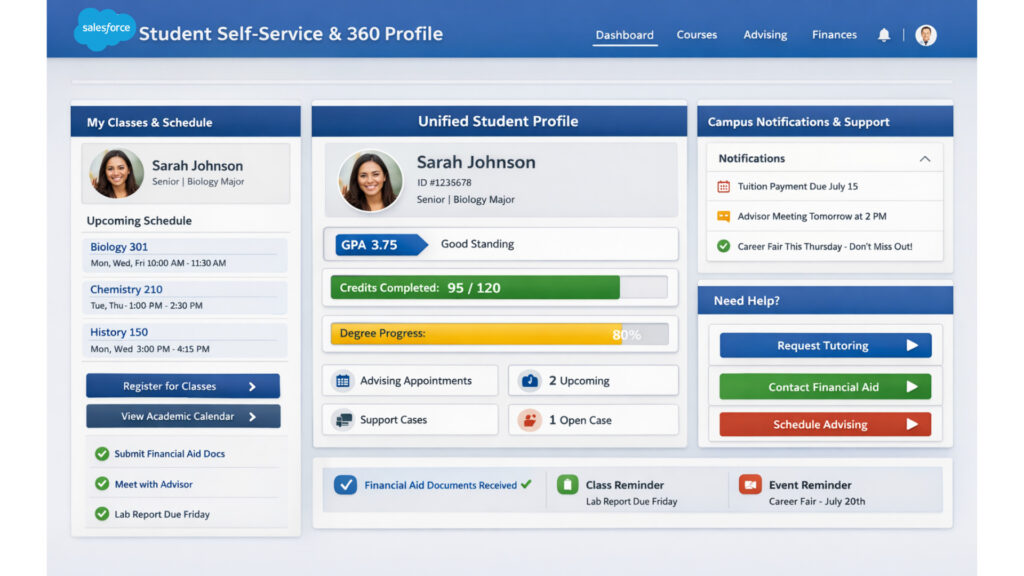
Salesforce SIS supports a student-first experience through self-service, unified profiles, and personalized communication, leading to greater clarity in their day-to-day engagements with your institutions.
A. Student Self-Service for Registration, Schedules, and Support
Students can register for courses, manage schedules, check key deadlines, and request help through a mobile-friendly portal.
B. A Unified Student Profile to Reduce Friction Points
A Student 360 view consolidates academic progress, engagement history, and support interactions so students don’t need to repeat themselves across departments.
C. Improving Student Satisfaction with Connected Services
With campus-wide communications and integrated service workflows, students receive the right message at the right time, reducing confusion and improving follow-through.

2. Admissions and Enrolment: Automating Recruitment, Applications, and Decision Workflows
Admissions is one of the most time-sensitive stages in the student lifecycle. For many admissions teams dealing with manual document tracking, inconsistent review processes, fragmented communication, and slow handoffs, delays are common. Every delay increases the chance that a student will disengage or enroll elsewhere.
Salesforce SIS enables a more responsive and measurable admissions process.
A. Reducing Application Cycle Time with Workflow Automation
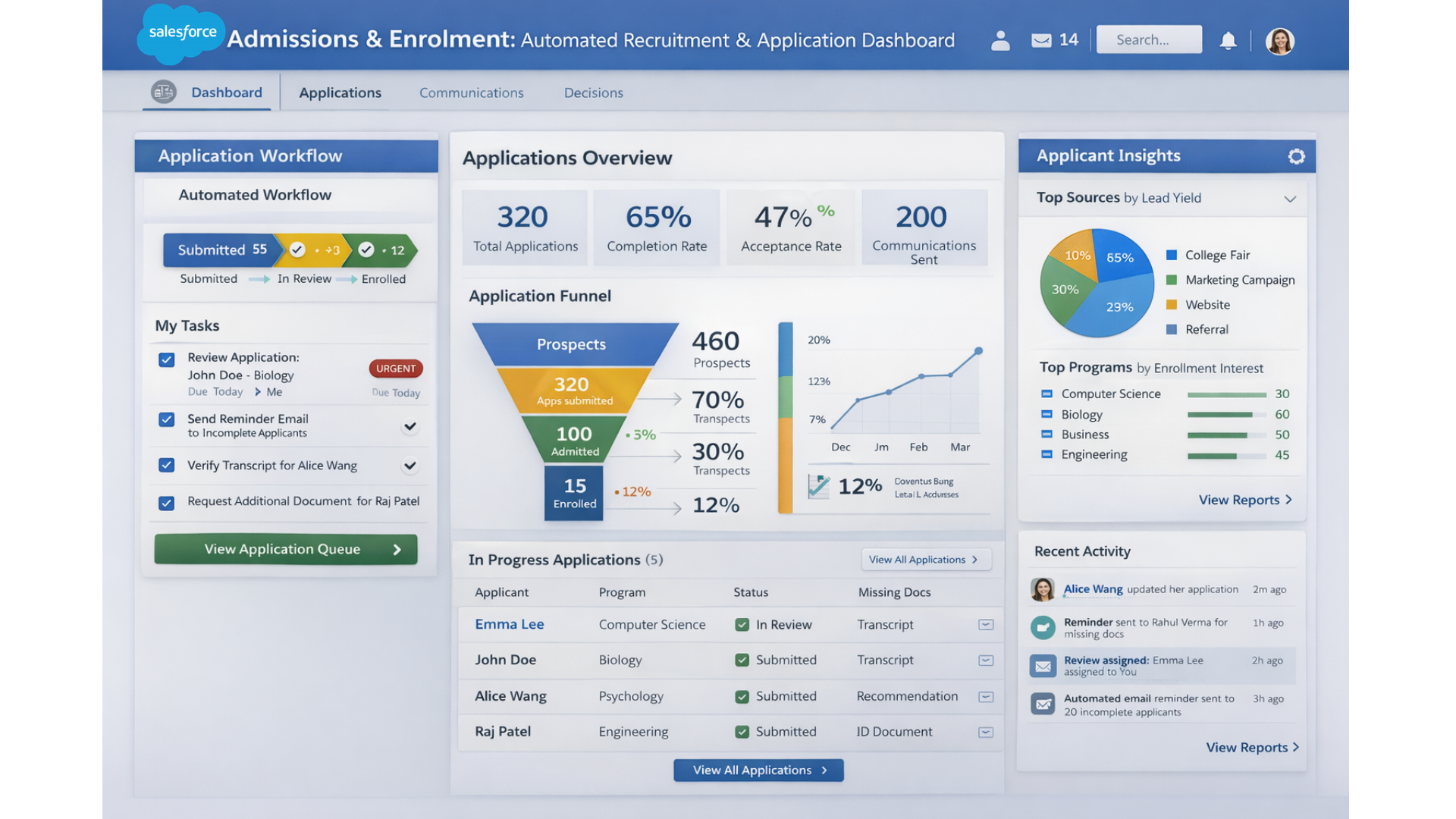
Admissions workflows can be automated, from application submission to document verification and reviewer assignment, reducing delays and improving efficiency.
B. Managing Documents, Reviews, and Applicant Communications
Teams can track required materials, manage program requirements, and deliver automated status updates to applicants. This loops students in for a connected onboarding experience.
C. Using Dashboards to Improve Yield and Enrollment Outcomes
Real-time analytics provide visibility into funnel performance, bottlenecks, and yield opportunities. With every issue resolution, quality and quantity markups are reflected in enrolment numbers.
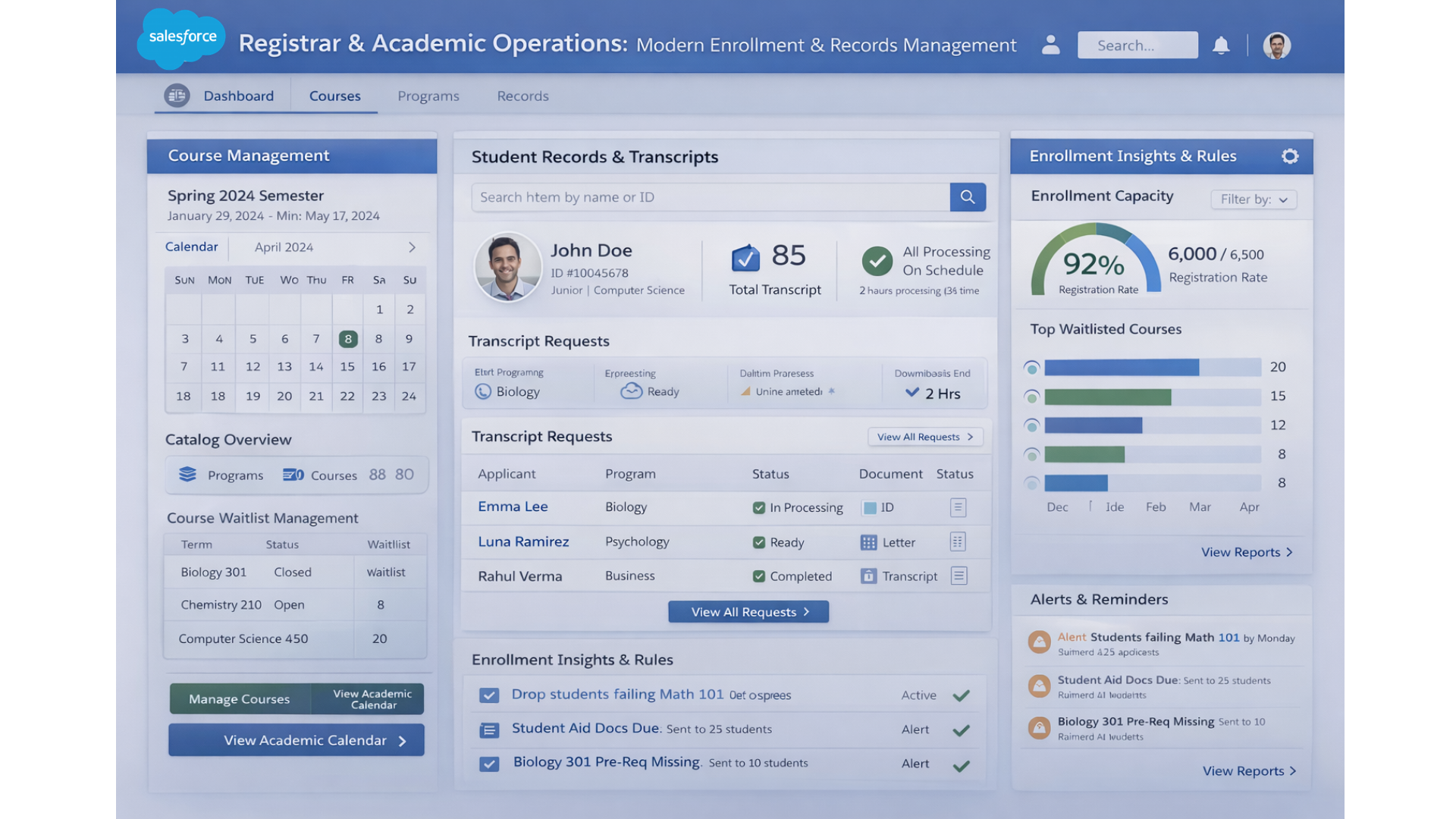
3. Registrar and Academic Operations: Modern Course Management, Enrolment Rules, and Transcripts
Registrar and academic operations teams manage the core institutional functions: course catalogs, enrolment rules, waitlists, prerequisites, and academic records.
Salesforce SIS supports these functions while enabling more agility and automation.
A. Course Catalog and Scheduling in a Modern SIS
Institutions can manage programs, courses, sections, and academic calendars with configurable rules that support evolving academic models. Offering greater flexibility in automation increases students’ interest in diverse curriculum options.
B. Automating Transcript Requests and Record Workflows
Transcript generation and document requests can be streamlined through workflow and automation tools, reducing turnaround time and increasing students’ optimism about the administration.
C. Supporting Academic Policy Enforcement with Configurable Rules
Rules engines and automated eligibility checks help enforce prerequisites, holds, and policy compliance. With a downtime in manual checks, quality assistance to people in need is delivered on time.
4. Advising and Student Success: Early Alerts, Intervention Workflows, and Retention Strategy
Student success is often a chain reaction: allotted assignments, course engagement, academic breakthroughs, evolving service requests, or financial checks.
Salesforce SIS enables institutions to identify risks earlier and coordinate interventions more effectively.
A. Identifying At-Risk Students Using Data and Engagement Signals
Using analytics and engagement insights, institutions can detect early warning signs and prioritize outreach. Parameters such as dropping scores or disengagement observations can trigger alerts for counselors to deliver personalized outreach.
B. Coordinating Interventions Across Departments
Advisors, student services, and support teams can work from the same student record to track actions, tasks, and outcomes. Reducing the number of sources to integrate a cohesive picture frees up more time for actionable outcomes.
C. Using Degree Planning Tools to Improve Time-to-Completion
Degree planning and audit tools help students stay on track while giving advisors better visibility into progress and options.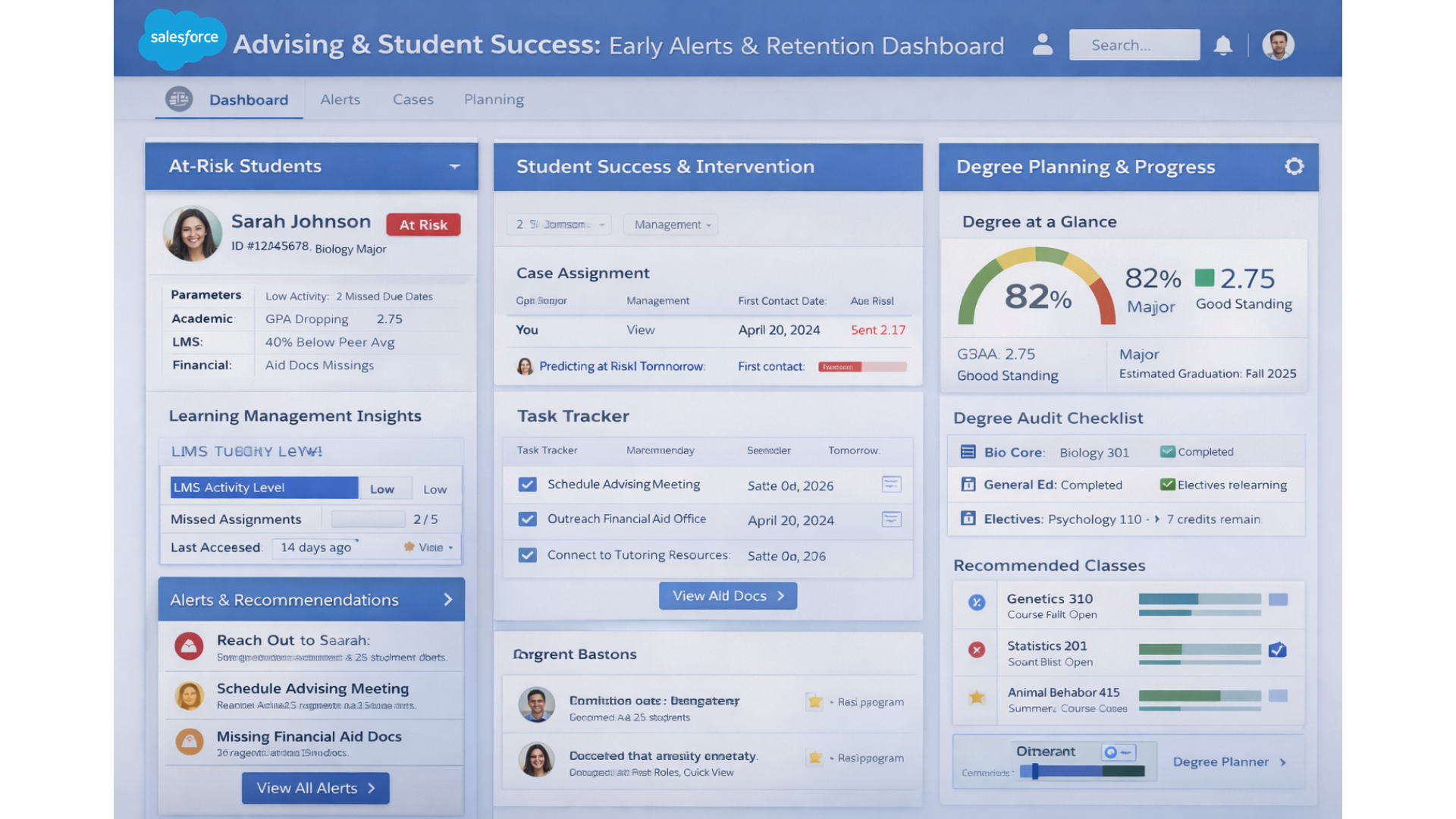
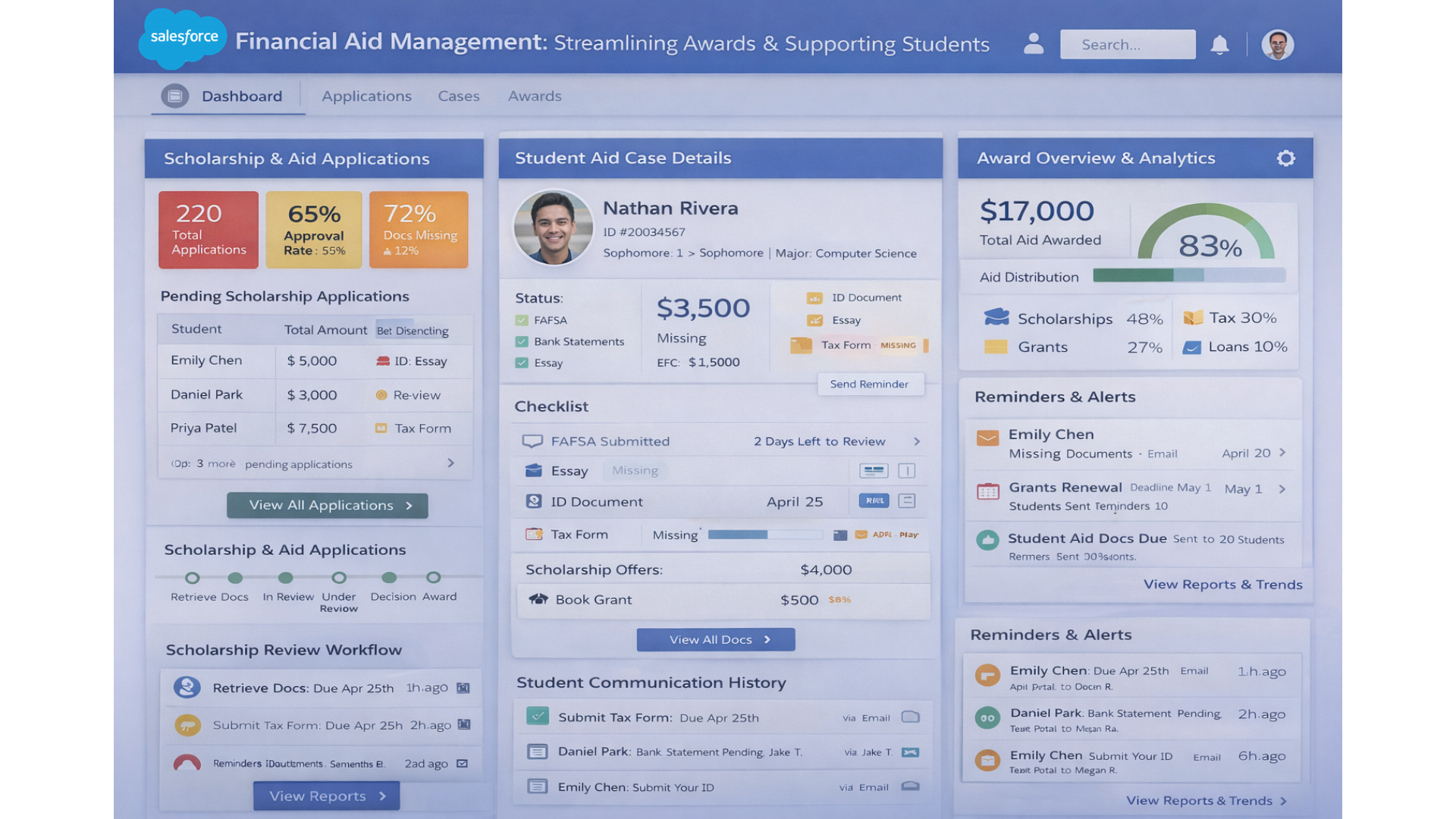
5. Financial Aid and Scholarships: Streamlining Award Workflows and Student Support
Financial aid determines whether a student can stay enrolled. Yet aid processes are often fragmented and stressful due to unclear requirements, missing documents, and limited visibility.
Salesforce SIS supports a more transparent and trackable aid experience.
A. Managing Scholarship Review and Approval Processes
Scholarships and awards can be tracked through review workflows with clear visibility for staff and students. With all information on a singular ecosystem, motivation and requirements on a need basis become easily accessible.
B. Reducing Missing Documentation Delays with Automation
Automated reminders and status updates reduce delays and help students complete financial aid requirements faster.
C. Improving Transparency and Trust in Financial Aid Services
Case management workflows ensure students receive consistent support without repeating information across multiple channels.
6. IT and Data Teams: SIS Integration, Security, and Scalable Architecture
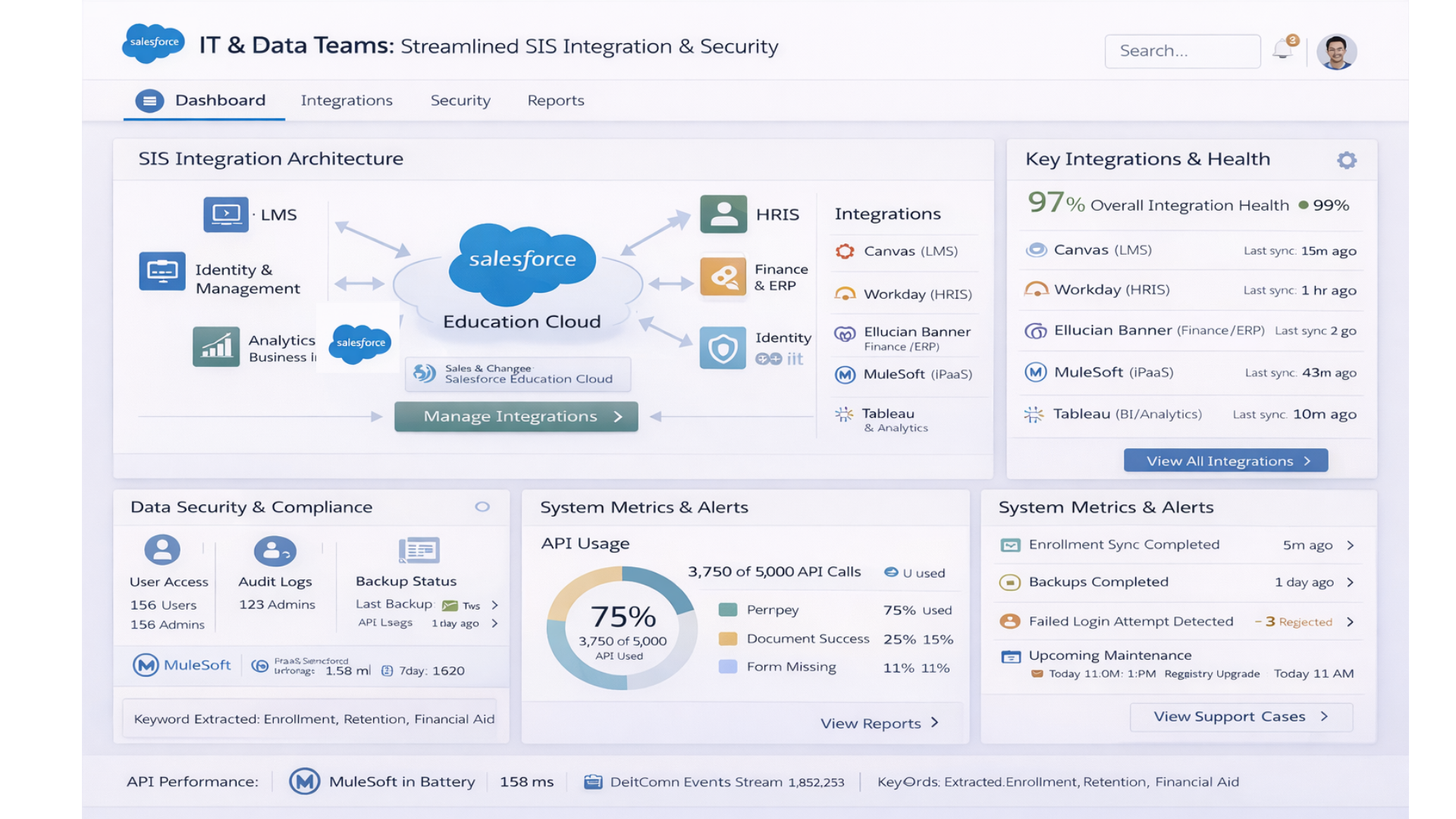
A modern SIS must integrate across the campus ecosystem. This includes the LMS, ERP, finance systems, HR systems, identity management, and analytics tools.
Salesforce SIS supports integration, governance, and scalable architecture.
A. Connecting SIS with LMS, ERP, and Finance Systems
Through integration tools and APIs, institutions can unify data across systems without manual uploads and duplicate records.
B. Data Governance and Compliance in Student Systems
Role-based access controls, audit trails, and compliance frameworks support the secure handling of sensitive student data.
C. Why API-First Design Matters for SIS Modernization
API-first architecture ensures institutions can adapt, expand, and modernize without being locked into rigid legacy environments.
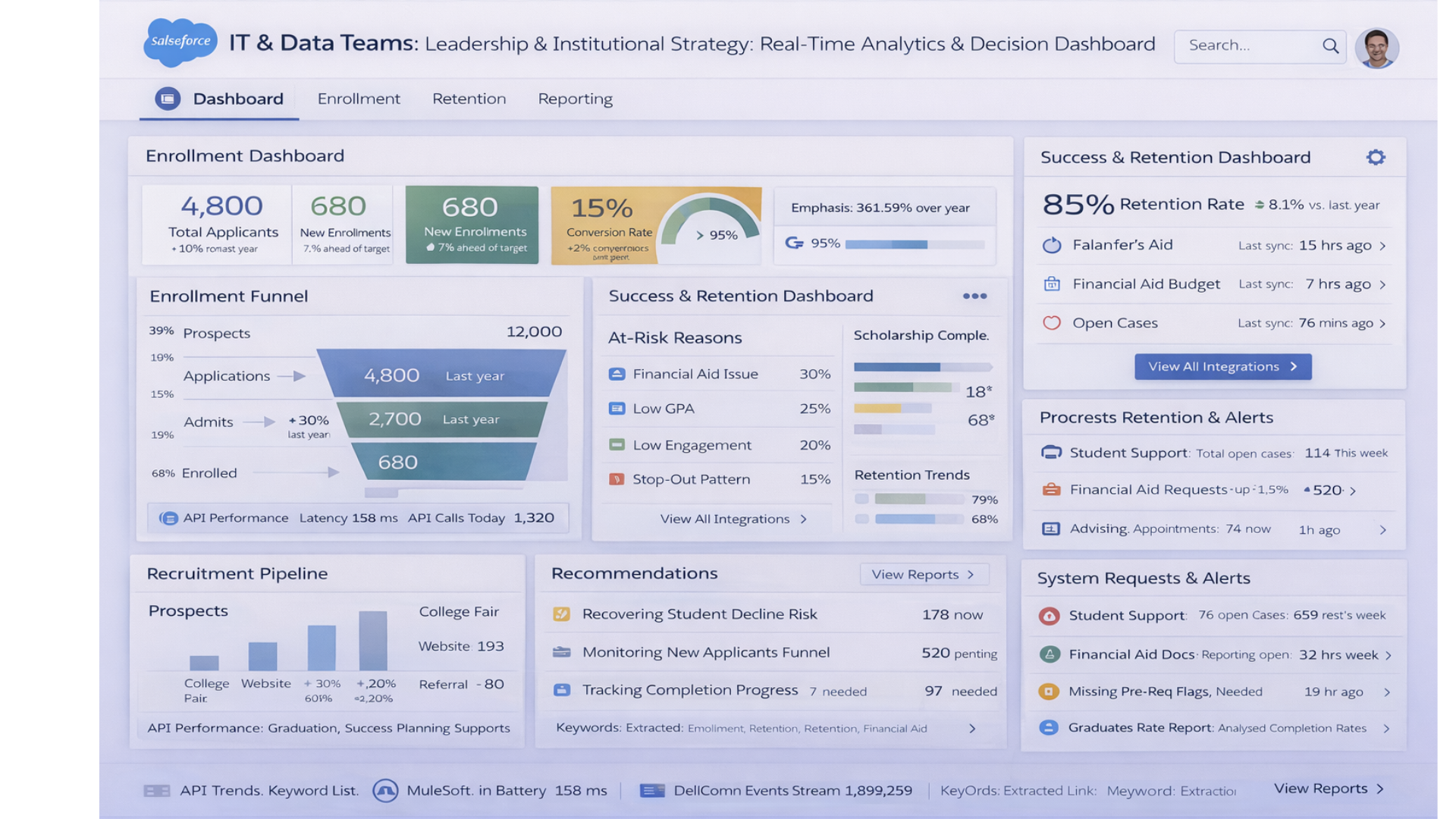
7. Leadership and Institutional Strategy: Real-Time Reporting, Predictive Analytics, and Decision Intelligence
Institutional leaders need insight that supports strategic decision-making. Salesforce SIS enables real-time visibility into enrolment, retention, student services, and operational health.
A. Enrollment Funnel Visibility and Operational Dashboards
Leaders can monitor funnel performance, identify bottlenecks, and understand service loads across departments. Future hiring options and marketing delivery get boosted with strategic alignment.
B. Turning Student Data into Actionable Insights
Dashboards and analytics help institutions connect data to outcomes, improving decision-making and planning. From onboarding to graduation, this platform carries a file that breathes Student Lifecycle and evolves with evolving needs.
C. Measuring Retention, Completion, and Student Success Initiatives
Institutions can track interventions, evaluate impact, and adjust strategies based on measurable results.
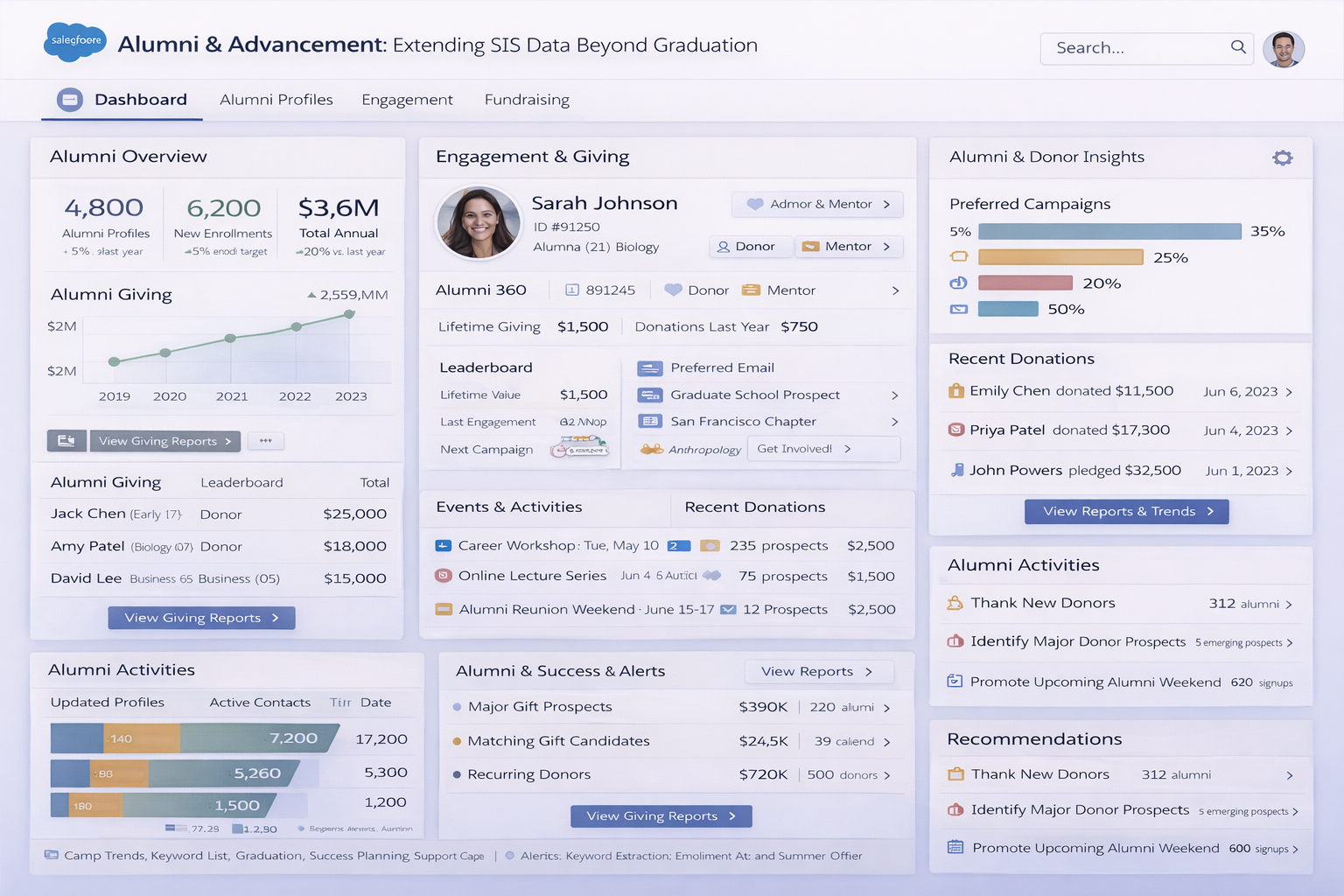
8. Alumni and Advancement: Extending SIS Data Beyond Graduation
Most SIS platforms stop at graduation. Salesforce doesn’t.
Because Salesforce is relationship-driven, SIS data can flow naturally into alumni engagement and advancement workflows.
A. Transitioning Students into Alumni Journeys Seamlessly
Graduates can be added to alumni profiles without losing history, context, or engagement data. This develops a two-way bridge to identify student success and organizational shortcomings with Alumni analysis. Additionally, such connections keep the sense of belonging alive.
B. Connecting Student Lifecycle Data to Engagement and Fundraising
Institutions can personalize alumni outreach based on academic history, interests, and engagement patterns.
C. Supporting Lifelong Learning and Alumni Communications
Salesforce supports ongoing relationships, driving community building, mentorship, and continued education engagement.
The Next SIS Isn’t a Database. It’s a Relationship Platform.
When institutions treat the SIS as the heart of student experience and success, everything changes.
Students get clarity rather than confusion, staff get workflows rather than manual chaos, advisors get insight rather than guesswork, and leaders get strategy rather than lagging reports.
Salesforce SIS, delivered through Agentforce Education, provides institutions with a foundation to build more connected experiences, more efficient operations, and more student-centered outcomes.
Because the future of SIS isn’t just managing information. It’s supporting student success, at scale.
Ready to Transform Your Student Experience with Salesforce SIS?
Modern higher education demands more than legacy systems; it requires a connected, intelligent platform that drives measurable student success.
Partner with Cloud for Good to reimagine your Student Information System with Salesforce. From strategy to implementation, our experts help institutions streamline operations, improve retention, and deliver exceptional student experiences at scale.
Connect with us today to start building a future-ready, student-first SIS.
Frequently Asked Questions About Salesforce SIS
What is Salesforce SIS?
Salesforce SIS refers to the Student Information System capabilities delivered through Agentforce Education, designed to manage student lifecycle operations, workflows, and engagement in one connected platform.
Can Agentforce Education replace a traditional SIS?
Salesforce Agentforce Education can function as a modern SIS for many institutions by supporting admissions, academic operations, advising, student services, analytics, and integrations.
What are the benefits of a CRM-powered Student Information System?
A CRM-powered SIS supports connected student journeys, unified student profiles, automation, personalized communications, and cross-department collaboration.
How does Salesforce SIS integrate with LMS and ERP systems?
Salesforce SIS supports integration through APIs and integration tools, enabling institutions to connect with LMS platforms, ERP systems, finance systems, HR systems, and identity management solutions.
Why is Salesforce SIS important for student success?
Salesforce SIS helps institutions improve student support by enabling early alerts, coordinated interventions, visibility into degree planning, and real-time analytics tied to retention and completion outcomes.
The post Salesforce SIS: The Future of Student Information Systems Prioritizes User Experience and AI, No Record Keeping appeared first on Cloud for Good.