
Generative AI is everywhere on social feeds right now, from LinkedIn influencers claiming it’s going to be the end of marketing as we know it, to genuinely interesting use cases for copy creation, data visualization and beyond. But there’s a tension in that ubiquity. While marketers are keen to make the most of generative AI to save time and increase efficiency, it does not align with what consumers actually want to see on social media.
Our 2026 Social Media Content Strategy Report highlights that while marketers are focused on producing AI-generated content, consumers report that they’re looking for more human-generated content in their feeds. This is hardly a surprise, given the broad AI adoption and explosion in the content generated by it. Much of that content has been AI slop, leading to consumer fatigue where they simply crave something more human.
While we shouldn’t completely rule out AI-generated content, teams need to strike the right balance between using AI to refine and scale content production, while retaining a human touch. And there are a number of other ways to use AI in marketing that more consistently build trust and increase efficiency. Plugging AI into manual workflows (like data analysis) can give your teams time back to use toward crafting stronger human-generated content.
3 AI use cases in marketing that help brands build trust
Marketers can use AI to better understand their audiences, create content that resonates and optimize their content for different distribution channels, all while keeping a human in the loop for the actual creation process.
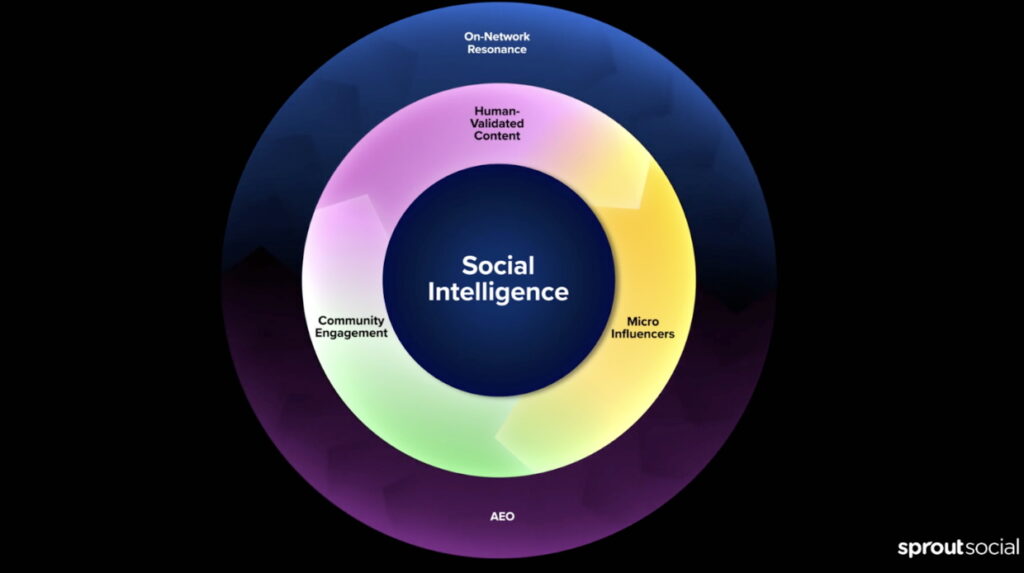
During our Q1 2026 Breaking Ground event, we shared how brands can incorporate AI in a way that actually builds trust with audiences, rather than alienating them. Think of it as a “Proof of Reality” flywheel for content optimization built off of social intelligence.
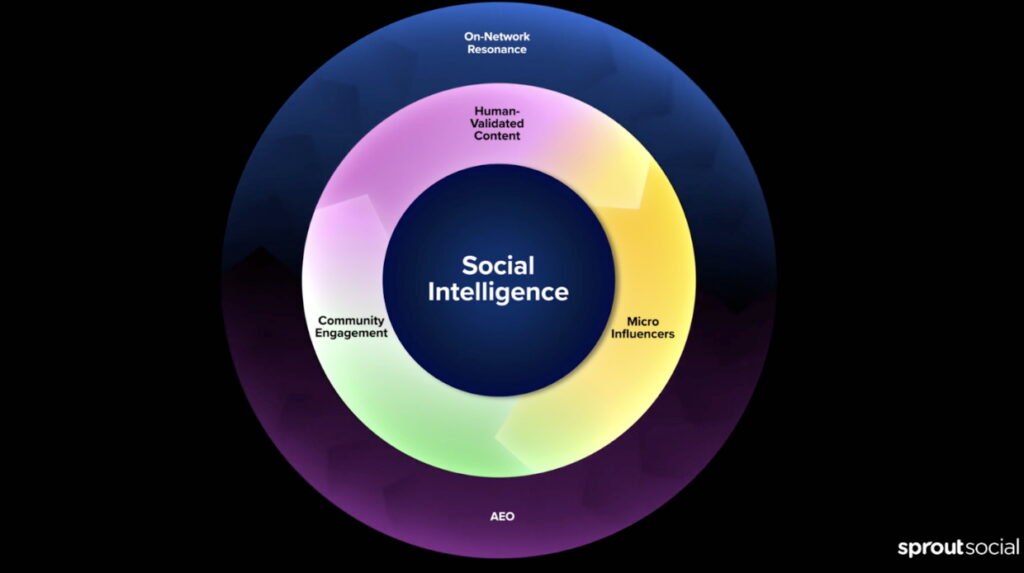
Using tools such as Sprout Listening, NewsWhip by Sprout Social and Sprout Social Influencer Marketing, your social team can use AI to determine exactly what your audience wants, create content that meets that need and then make sure it gets back to that audience.
Let’s take a closer look at what this flow looks like.
Better understand your audience with AI-powered social intelligence
The first step in improving the impact of your marketing strategies is to build an understanding of what your audience wants to see, interact with and share, and AI can help with that. Our Content Strategy Report found that real-time insights into what their audience wants to consume was the number one thing marketers said would be the most helpful for increasing the impact of their social media strategy.
AI removes the existing latency, with the ability to analyze large tranches of structured and unstructured data, and come back with answers in minutes rather than hours or days. This enables marketers to stop thinking reactively—working from past data—toward a predictive model of what their audience wants right now, or might want in the weeks to come.
Examples of where AI could be implemented here include social data analysis and sentiment analysis, among others.
Social media data is a treasure trove of brand and customer insights that AI tools effortlessly dig into to surface critical information. The State of Social Media Report found 95% of leaders look at social data to inform business decisions such as lead generation, product development and competitor analysis. Thus, social media data analysis is empowering not only marketing teams but also cross-functional ones.
AI tools can also extract competitor insights by using semantic search and other AI algorithms from social data. Sprout analyzes social data using named entity recognition (NER) to identify and analyze competing brands and their content, providing you with actionable insights that improve your brand performance.
Sprout digs into competitor content engagements, post frequency, hashtag usage and other key performance areas by using keywords and @mentions you determine, cutting through the noise of thousands of social conversations in seconds to give you actionable data.
Marketers have also long used sentiment analysis to assess the tone and sentiment expressed in comments, posts and conversations around their brand to determine whether they are positive, negative or neutral. This is a critical AI capability considering 44% of marketers, per The State of Social Media Report, use sentiment mining to understand customer feedback and improve how they respond to issues.
Analyzing sentiment in social chatter also helps brands spot early indications of negative sentiment and take proactive measures before a situation escalates.
Approaching audience analysis in this way, you can use the power of AI to understand what will resonate before you write it, and feed that into your content and social strategy.
Build human-validated content
Once you have an idea of what your audience wants, it’s time to create that content. But it’s important to not just hand this off to AI. Audiences are overloaded with AI-generated content, so creating something made by a human can have a positive impact on performance.
A lot of content at the moment feels too polished, and audiences want something that feels real, whether it’s a behind-the-scenes look, or a casual Q&A with a creator. They also might be searching for different things on different networks, so make sure you’re thinking about what’s resonant for traditional SEO, social SEO (SOSEO) and AI search (GEO/AEO).
AI search is encroaching on traditional search because of a fundamental behavior change. Instead of targeted keywords, users are now typing or speaking verbose, conversational questions, and search engines are pulling answers from real conversations on platforms like Reddit.
When someone asks, “Which skincare products are cruelty-free?”, the AI summary isn’t just pulled from a brand’s ‘About Us’ page. It cites real-time social conversations to form the recommendation.
Traditional search engine results are dominated by subreddits and YouTube videos. Whether it’s an AI overview or a list of links, the engine is increasingly prioritizing the ‘human signal’ over static web content to answer the prompt.
Showing up in those spaces with authentic content is far more likely to get you cited in search answers than AI content.
Tap into influence networks
AI can also help you amplify your campaigns, including doubling-down on influencer partnerships.
Authenticity matters more than follower count because influencers and brands no longer need millions of followers to reach audiences; relevancy is rewarded. As more social proof and videos pop up in search results, it has never been more important to find brand-safe partners who are naturally a good fit for your brand. But there are more creators than ever. AI-powered matchmaking helps you narrow that down.
You need to be able to identify creators based on the content they’re posting (and their performance), and not just the demographics of their followers.
This shift in matching with the right creators is crucial to your Proof of Reality strategy, because it’s only those creators who can show up authentically, add value and build trust. When creators weave your product into their content organically, it converts.
You can also use that social intelligence and data analysis strategy to better understand networks such as Reddit. It’s hugely influential in AEO answers and AI search, but Reddit has its own rules and norms of behavior on the platform. Reddit is all about utility, so if you can find a way for your brand to naturally add value without it feeling forced or spammy, then the strategy will naturally grow.
By implementing a social intelligence framework, you can understand how users show up in different communities, and figure out which ones make sense for your brand to join organically. This fits into the social-intelligence-driven flywheel strategy, as you can identify communities that are a good fit for your brand, and then also find influential voices to amplify within those communities.
How to start using AI more effectively
AI is a priority for leadership, but it doesn’t have to be intimidating. This three-step process can refresh how your company uses AI. First, audit your current usage, then optimize agentic workflows and finally retrain your team on how to get the most out of these new ways of working.
1. Audit AI usage
Churning out content at scale may seem efficient, but that’s only true if what you’re producing is resonating with your audience. There is little to no value in increasing output if it’s not having a tangible business impact, and it may even be masking a lack of audience insight as a result.
Marketers can use AI to make content better and smarter, not necessarily just faster. To do this, the first step is alignment. Often, teams have evolved their AI usage organically with no centralized guidance, so it’s important to understand where the gaps or potential points of failure are across the team.
Audit your processes and see where AI is currently being used and where improvements can be made. That might mean a change in process, in which human effort moves more towards refining content and ensuring resonance with your audience, while leaving AI to expedite analysis and research. Understand where it fits within your teams’ workflows, and make adjustments as necessary.
Once this audit is complete, you’ll know what processes to strip out and rebuild with AI and agentic workflows.
2. Invest in agentic AI workflows
AI agents function independently, working in the background on research, data analysis or alerting you when something has changed in a dashboard.
This is useful for marketing teams as it means they have an always-on teammate, alerting them to anything meaningful they might not otherwise have seen, including sudden spikes in readership, engagement or customer conversations.
It can also help with research tasks that would otherwise require continuous back and forth prompting or manual effort. With agentic AI, you can set the agent a task for research, whether on the open web or using proprietary data, and have it notify you when the task is complete.
This means less time spent on analyses and more time defining campaigns that will actually perform.
3. Training pivot
These new workflows will require training for your teams to use them effectively. Whereas the initial flurry of AI activity was about the best prompts for generating output, this new wave of AI leads us to more strategic thinking and cultivating a better sense of what good looks like. In a world of infinite creation, it’s better to spend more time refining an idea into new and better iterations, and to do that, it’s important to slow down and have time to think.
The teams that succeed in 2026 and beyond will have training in editing and prompt architecture, with a focus on incremental improvements and finding key insights that will have broader impact. Support your teams to achieve that goal by training them on how to best use agentic AI and the AI workflows being put in place.
Expand your horizons for AI use cases in marketing
The disconnect between leaders’ enthusiasm for AI efficiency and consumer fatigue with AI-generated content is a clear signal that we’ve been too short-sighted about AI use cases in marketing. By pivoting your AI approach from mass generation to strategic intelligence, you can build a “Proof of Reality” engine that fosters genuine trust.
Ultimately, the goal is to let AI handle the data-heavy backend of marketing that often gets deprioritized as we rush between tasks. This way your team can reclaim the time needed to craft the authentic, high-quality content your audience is actually searching for.
Ready to refine your team’s approach and build smarter workflows? Download our Social Media AI Prompts template to help your team move beyond basic generation and start using prompts that drive real business insights and impact.
The post Why the Best AI Use Cases in Marketing Start with Intelligence, Not Creation appeared first on Sprout Social.