Key Takeaways
When you’re looking for a new restaurant, a good contractor, or even a new app, what’s the first thing you do? Chances are, you check out the reviews. You ask a friend. You rely on the experiences of others to guide your decisions — and that reliance is called social proof.
Startups and small and medium business (SMBs) like you often work with limited marketing budgets, making every customer testimonial, positive review, and mention on social media a big lift for promotion. So, how can you maximize it in your marketing? We’ll show you how to identify, capture, and use the most impactful forms of social proof to help your business thrive.
What is social proof, really?
At its core, social proof is a psychological and community phenomenon where people mirror the actions of others in an attempt to reflect “correct” behavior. In business, it’s the external evidence that your product, service, or company is trustworthy and valuable.
For an SMB, this heavily influences the buying journey. When a prospect sees a testimonial that has successfully used your service, it shows them that others in their same situation have already succeeded. It’s proof. For a startup, every case study, review, or positive survey acts as a credibility builder.
Using the authenticity of real customer voices is the most direct way to speak to the heart of a prospect’s decision-making process. The goal is to use social proof not just as evidence, but as a narrative that illustrates how your solution solves real-world problems.
There are six main categories of social proof that growing businesses can use:
Market your SMB with Salesforce AI


- Expert social proof: Validation from recognized experts in your industry.
- Celebrity social proof: Endorsements from well-known public figures (even micro-influencers count here).
- User social proof: Testimonials, reviews, and ratings from everyday customers.
- ‘Wisdom of the crowd’: Seeing a large number of people using your product (like “3,000 users love this tool”).
- ‘Wisdom of your friends’: Referrals from people a prospect knows.
- Certification social proof: Trust seals, awards, and certifications.
Focusing on user social proof and the wisdom of the crowd is often the most accessible and impactful strategy to start with. These directly address any adoption of new technology hesitancy, showing them that a large community has already approved and adopted it.
Kickstart your SMB with Starter Suite
See results from day one with a CRM designed for SMBs — the all-in-one suite for productivity. It all starts with Starter Suite.
How do you strategically gather social proof?
Capturing social proof requires a proactive strategy, not just waiting for good reviews to appear. It begins with identifying your happiest customers — the ones who have achieved the greatest success using your portfolio of products.
Once you know who they are, you need a clear process for asking them to share their experiences. This can be as simple as sending a follow-up email after a major success or integrating a request into your regular customer communication cadence, all of which is easily managed within a customer relationship management (CRM) tool.
The method you use to request social proof should be tailored to the customer relationship and the type of proof you need. For example:
Case studies: Detailed stories that highlight a customer’s problem, how you solved it, and the results achieved.
Testimonials and reviews: Sharing feedback from satisfied customers in their own words, often repurposed for social media posts or emails.
User-generated content (UGC): Authentic content created by customers, such as photos of them using a product or unboxing videos.
Influencer marketing: Collaborating with influencers and content creators who show off your brand to their established audience.
Awards and accolades: Displaying industry awards, rankings, or badges to showcase excellence and professional recognition.
Logos of notable clients: Featuring the logos of well-known companies you have worked with builds instant credibility.
Customer base and followers: Highlighting large numbers, such as the total number of customers served; or having a large, engaged social media following.
Partnerships and integration: Showcasing collaborations with other respected brands or technical integrations with popular software.
Social media mentions: Highlighting and resharing organic shoutouts, tags, or casual mentions from people talking about your brand online.
What can you do with a CRM built to reach more prospects?
Automate your marketing campaigns with a CRM built to grow. It all starts with Starter Suite.

What are some tips on implementation?
Implementing social proof is about letting your customers’ voices do the selling for you. To get started effectively, focus on these four foundational areas:
1. Collect your first reviews and testimonials
Ask for feedback immediately after a positive milestone, like a successful project delivery or a few days after a product is received. Here are a few tips:
- Make it easy: Instead of a blank page, give customers a simple template or 2–3 guided questions, like “What is your main challenge that this product helped solve?”
- Find “hidden” proof: Look through your emails, DMs, and LinkedIn comments. If someone sent a quick “Thank you, this was great!” note, ask their permission to use it as a formal testimonial.
- Provide multiple options: Try offering different feedback request options and across multiple channels.
2. Launch a UGC strategy
A UGC strategy is a plan for encouraging, gathering, and using authentic content created by your customers or audience, such as photos, videos, reviews, and testimonials, to market your brand. The core objective is to use the credibility and trust inherent in peer-to-peer recommendations to influence purchasing decisions, increase engagement, and create a stronger community around the brand.
Encourage followers to post photos or videos of your product using a specific hashtag. Even if someone tags you, always reach out and ask, “We love this! Can we share it on our page?” It builds trust and keeps you legally safe.
Run a small contest where users who post a photo or video of your product are entered to win a gift card or a discount on their next purchase. Make it fun!
3. Start small with influencer marketing
When seeking influencer partnerships, focus on micro and nano-influencers, who have between 1,000 to 50,000 followers, as they typically offer higher engagement rates and are more cost-effective, sometimes even accepting free product in exchange for promotion. And, look for “in-house” fans by checking your own followers and tagged posts to identify creators already discussing your brand, as these organic supporters often make the most authentic partners.
Finally, before starting any collaboration, set clear goals upfront, determining whether the influencer’s primary objective is to fuel sales (which can be tracked with a unique discount code) or to generate high-quality content that you can repurpose for your own advertising campaigns.
4. Display proof where it matters most
Using your digital real estate to show off your social proof is a quick and easy way to show impact. Place a “Featured In” logo or a “What our customers are saying” section near the top of your website to build immediate credibility. Add specific reviews or “Verified Buyer” badges right next to the “Buy Now” button to reduce last-minute hesitation. And, create a “Customer Love” highlight on Instagram, if you use it, to archive and showcase positive shoutouts.
Pro Tip: Start with numbers. If you don’t have many reviews yet, use “crowd” data (“Join 500+ subscribers”). It builds the “everyone is doing it” effect while you wait for detailed testimonials to come in.
Join millions in the growing Salesforce ecosystem
Trailblazers are free to reinvent themselves, free to dream bigger.

How do you optimize social proof across the customer journey?
Using social proof the right way means using the right content at the right time. For an SMB looking to grow, this means aligning the proof with the customer journey through sales, marketing, service, commerce, and operations. A smart CRM tracks customer interactions and success metrics, helping you identify happy customers for testimonial requests.
Marketing and sales social proof integration tips
In the early marketing phase, short, impactful testimonials and aggregated statistics (like “Rated 5 stars by small businesses”) should be front and center. As a prospect moves into the sales cycle, the proof should become more in-depth. A sales representative should share industry-specific case studies to address their specific pain points. The SMB Sales Guide provides more strategies on how to use customer stories in this process.
Service and analytics social proof integration tips
Social proof isn’t just for sales; it builds loyalty and trust after the purchase. Sharing positive customer service stories or high customer satisfaction scores (CSAT) demonstrates reliability. And, when you use artificial intelligence (AI) to simplify support, a positive case study can show that the technology is effective and easy to use — and this is reflected in your metrics.
Seeing is believing. Try Salesforce for free with a 30 day trial.
See how small businesses are using Salesforce CRM to scale fast. No credit card required, no software to install. It all starts with Starter Suite.
Enter a valid e-mail address
Enter a valid e-mail address
Enter a valid e-mail address
Enter a valid e-mail address
Enter a valid e-mail address
Enter a valid e-mail address
Employees
1-20 employees
21-200 employees
201-10,000 employees
10,001+ employees
Select the number of employees
Industry
Automotive
Communications
Financial Services
Healthcare
Tech
Education
Life Sciences
Manufacturing
Media
Nonprofit
Public Sector
Retail & Consumer Goods
Energy & Utilities
Other
Select your industry.
Country/Region
United States
Afghanistan
Albania
Algeria
American Samoa
Andorra
Anguilla
Antarctica
Antigua And Barbuda
Argentina
Armenia
Aruba
Australia
Austria
Azerbaijan
Bahamas, The
Bahrain
Bangladesh
Barbados
Belarus
Belize
Belgium
Benin
Bermuda
Bhutan
Bolivia
Bouvet Is
Bosnia and Herzegovina
Botswana
Brazil
British Indian Ocean Territory
Brunei
Bulgaria
Burkina Faso
Burundi
Cambodia
Cameroon
Canada
Cape Verde
Cayman Is
Central African Republic
Chad
Chile
China
Hong Kong
Macau
Christmas Is
Cocos (Keeling) Is
Colombia
Comoros
Cook Islands
Costa Rica
Cote D’Ivoire (Ivory Coast)
Croatia (Hrvatska)
Cyprus
Czech Republic
Democratic Republic of the Congo
Denmark
Dominica
Dominican Republic
Djibouti
Ecuador
Egypt
El Salvador
Equatorial Guinea
Eritrea
Estonia
Ethiopia
Falkland Is (Is Malvinas)
Faroe Islands
Fiji Islands
Finland
France
French Guiana
French Polynesia
French Southern Territories
F.Y.R.O. Macedonia
Gabon
Gambia, The
Georgia
Germany
Ghana
Gibraltar
Greece
Greenland
Grenada
Guadeloupe
Guam
Guatemala
Guinea
Guinea-Bissau
Guyana
Haiti
Heard and McDonald Is
Honduras
Hungary
Iceland
India
Indonesia
Ireland
Israel
Italy
Jamaica
Japan
Jordan
Kazakhstan
Kenya
Kiribati
Korea, South
Kuwait
Kyrgyzstan
Laos
Latvia
Lebanon
Lesotho
Liberia
Liechtenstein
Lithuania
Luxembourg
Madagascar
Malawi
Malaysia
Maldives
Mali
Malta
Marshall Is
Mauritania
Mauritius
Martinique
Mayotte
Mexico
Micronesia
Moldova
Monaco
Mongolia
Montserrat
Morocco
Mozambique
Myanmar
Namibia
Nauru
Nepal
Netherlands, The
Netherlands Antilles
New Caledonia
New Zealand
Nicaragua
Niger
Nigeria
Niue
Norway
Norfolk Island
Northern Mariana Is
Oman
Pakistan
Palau
Panama
Papua new Guinea
Paraguay
Peru
Philippines
Pitcairn Island
Poland
Portugal
Puerto Rico
Qatar
Republic of the Congo
Reunion
Romania
Russia
Rwanda
Saint Helena
Saint Kitts And Nevis
Saint Lucia
Saint Pierre and Miquelon
Saint Vincent And The Grenadines
Samoa
San Marino
Sao Tome and Principe
Saudi Arabia
Senegal
Serbia
Seychelles
Sierra Leone
Singapore
Slovakia
Slovenia
Solomon Islands
Somalia
South Africa
South Georgia & The S. Sandwich Is
Spain
Sri Lanka
Suriname
Svalbard And Jan Mayen Is
Swaziland
Sweden
Switzerland
Taiwan
Tajikistan
Tanzania
Thailand
Timor-Leste
Togo
Tokelau
Tonga
Trinidad And Tobago
Tunisia
Turkey
Turks And Caicos Is
Turkmenistan
Tuvalu
Uganda
Ukraine
United Arab Emirates
United Kingdom
United States Minor Outlying Is
Uruguay
Uzbekistan
Vanuatu
Vatican City State (Holy See)
Venezuela
Vietnam
Virgin Islands (British)
Virgin Islands (US)
Wallis And Futuna Islands
Western Sahara
Yemen
Zambia
Zimbabwe
Select your Country
State/province
北海道 – Hokkaido
青森県 – Aomori
岩手県 – Iwate
宮城県 – Miyagi
秋田県 – Akita
山形県 – Yamagata
福島県 – Fukushima
茨城県 – Ibaraki
栃木県 – Tochigi
群馬県 – Gunma
埼玉県 – Saitama
千葉県 – Chiba
東京都 – Tokyo
神奈川県 – Kanagawa
新潟県 – Niigata
富山県 – Toyama
石川県 – Ishikawa
福井県 – Fukui
山梨県 – Yamanashi
長野県 – Nagano
岐阜県 – Gifu
静岡県 – Shizuoka
愛知県 – Aichi
三重県 – Mie
滋賀県 – Shiga
京都府 – Kyoto
大阪府 – Osaka
兵庫県 – Hyogo
奈良県 – Nara
和歌山県 – Wakayama
鳥取県 – Tottori
島根県 – Shimane
岡山県 – Okayama
広島県 – Hiroshima
山口県 – Yamaguchi
徳島県 – Tokushima
香川県 – Kagawa
愛媛県 – Ehime
高知県 – Kochi
福岡県 – Fukuoka
佐賀県 – Saga
長崎県 – Nagasaki
熊本県 – Kumamoto
大分県 – Oita
宮崎県 – Miyazaki
鹿児島県 – Kagoshima
沖縄県 – Okinawa
Select a state/province
State/province
Alberta
British Columbia
Manitoba
New Brunswick
Newfoundland
Northwest Territories
Nova Scotia
Nunavut
Ontario
Prince Edward Island
Quebec
Saskatchewan
Yukon
Select a state/province
State/province
Alabama
Alaska
Arizona
Arkansas
California
Colorado
Connecticut
Delaware
District of Columbia
Florida
Georgia
Hawaii
Idaho
Illinois
Indiana
Iowa
Kansas
Kentucky
Louisiana
Maine
Maryland
Massachusetts
Michigan
Minnesota
Mississippi
Missouri
Montana
Nebraska
Nevada
New Hampshire
New Jersey
New Mexico
New York
North Carolina
North Dakota
Ohio
Oklahoma
Oregon
Pennsylvania
Rhode Island
South Carolina
South Dakota
Tennessee
Texas
Utah
Vermont
Virginia
Washington
West Virginia
Wisconsin
Wyoming
Select a state/province
We value your privacy. To learn more, visit our Privacy Statement.
Thank you!
How can you automate social proof?
The landscape of social proof is changing fast, driven by technology like artificial intelligence (AI). Growing businesses can now use their existing data to create personalized social proof experiences that go beyond a testimonial. Here are a few ways this is happening:
Integrated CRM: Advanced CRM and AI platforms can analyze a prospective customer’s industry, company size, and stated pain points, then automatically present them with the most relevant piece of social proof — a testimonial from a business identical to theirs.
AI agents: The rise of AI agents for growing businesses means that digital labor agents aren’t just processing customer requests; they’re also a source of social proof. A startup can showcase the speed and accuracy of their customer service powered by AI agents, demonstrating service excellence.
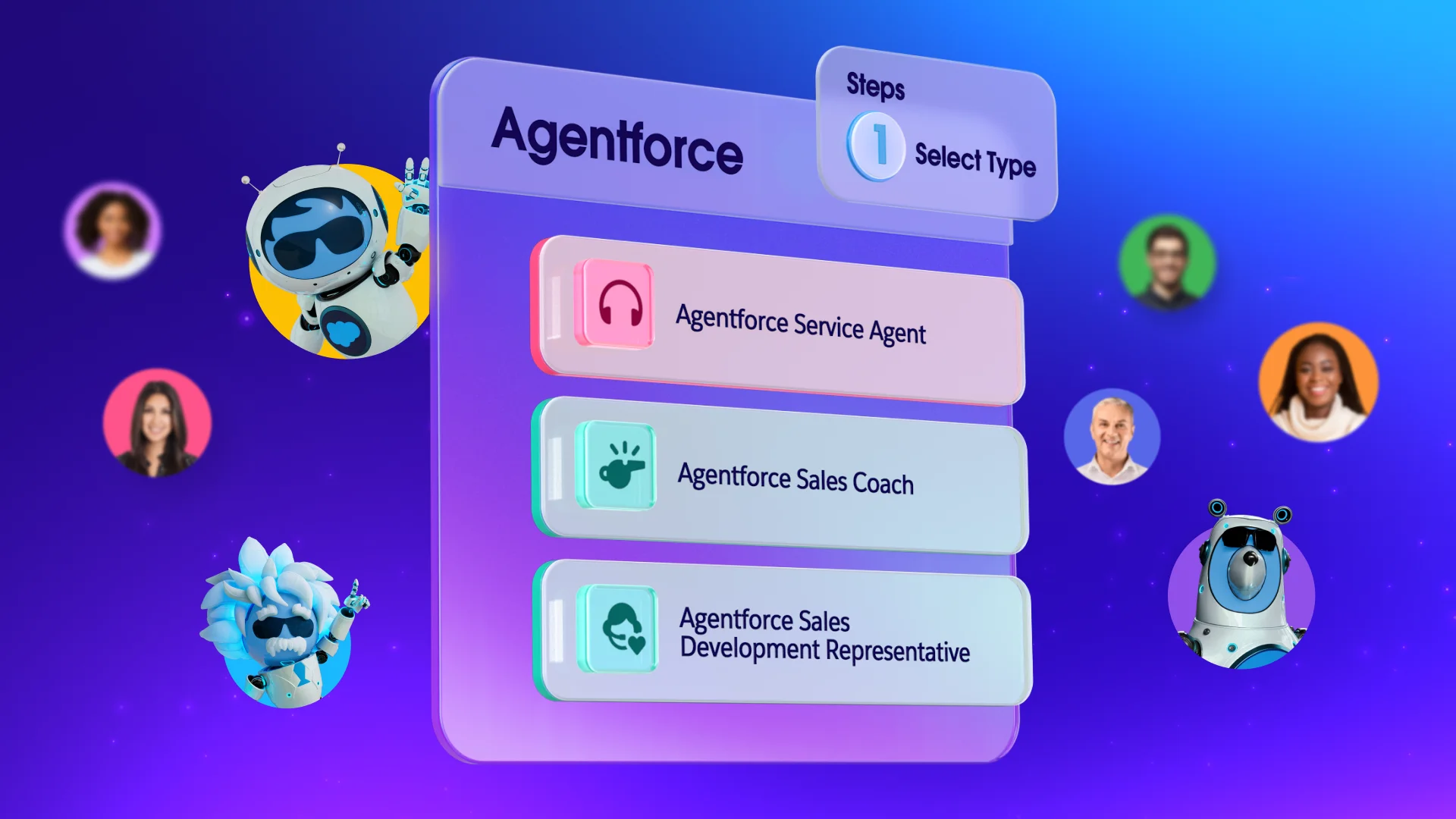
Agentforce 360 can also automatically summarize customer feedback from service interactions, providing real-time data on satisfaction that can be used to generate instant, data-backed social proof.
Examples of social proof — brought to you by Salesforce
Here are some instances of social proof coming alive for the Salesforce community, across small business and more organizations:
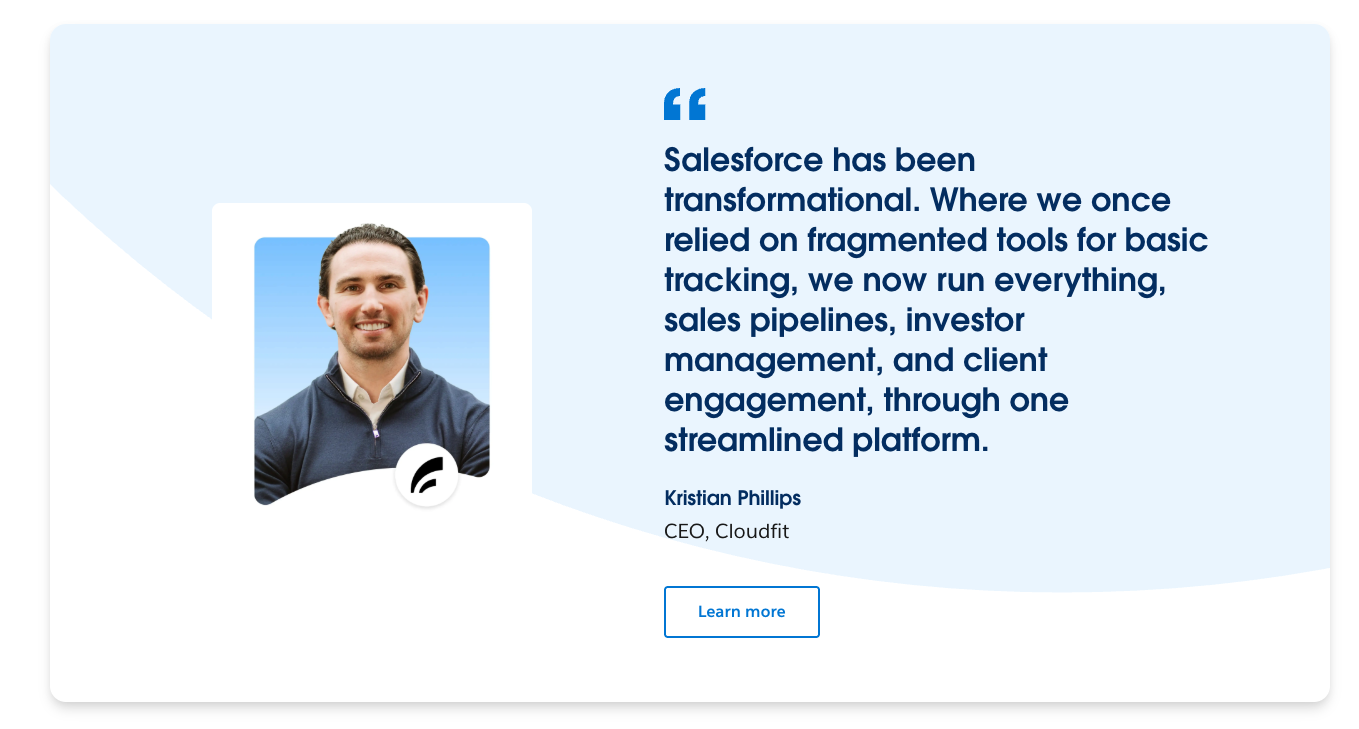
User testimonial (quote): “Salesforce has been transformational. Where we once relied on fragmented tools for basic tracking, we now run everything, sales pipelines, investor management, and client engagement, through one streamlined platform.” Kristian Phillips, CEO, Cloudfit
Context: Featured on a landing page for Starter Suite, often near the ‘Try for Free’ CTA.
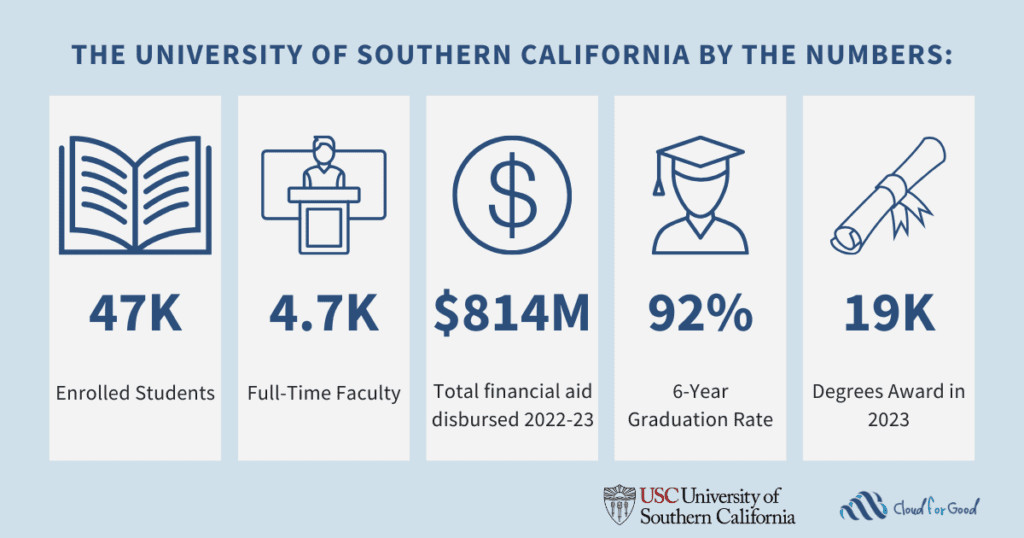
Wisdom of the crowd (data): 50,000+ small and medium businesses worldwide rely on Salesforce to unify their sales, service, and marketing efforts and drive growth.
Context: Display partner logos on the main CRM for small business page.
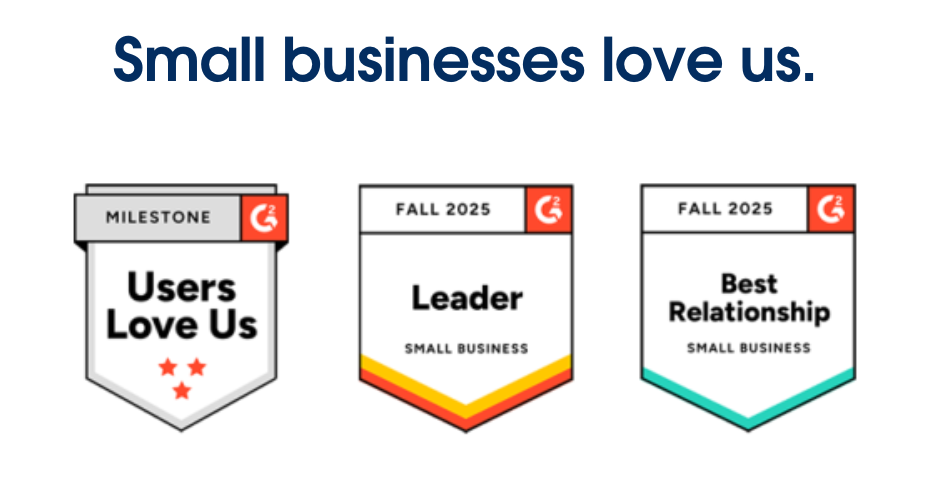
Expert endorsement (award): Named a Leader in the 2025 Gartner Magic Quadrant for Salesforce Automation for the 18th consecutive time.
Context: Used in marketing materials to showcase professional industry validation.
The proof is in the social pudding (that’s the saying, right?)
The future of social proof for small businesses lies in making it immediate, personalized, and data-driven. Using your own social proof to highlight the customer experience you deliver is the most effective way to stand out. And, we’re here for it.
Start your journey with the Free or Starter Suite today. Looking for more customization? Explore Pro Suite. Already a Salesforce customer? Activate Foundations to try out Agentforce 360 today.
AI supported the writers and editors who created this article.
What is the most effective type of social proof for a new startup?
User Social Proof (customer testimonials, reviews) and Wisdom of the Crowd (aggregated user numbers) are the most accessible and effective types for a new startup, as they build immediate credibility with everyday buyers.
Where should I put social proof on my website?
Social proof should be integrated across every touchpoint: on your homepage, product pages, landing pages (especially near the call to action), and in your email campaigns.
How can an SMB automate the collection of customer testimonials?
By using a modern CRM to track customer success metrics, you can automatically identify happy, high-value customers and trigger personalized email requests for a testimonial or review after a successful milestone.
Is ‘Celebrity’ social proof only for major brands?
No. For SMBs, “celebrity” social proof can include endorsements from smaller, recognized industry experts or influential micro-influencers whose audience aligns directly with your target customer.
How does AI help with social proof?
AI and advanced CRM can personalize social proof by automatically showing a prospect the most relevant testimonial (e.g., from a company in the same industry/size) and can summarize real-time customer feedback from service interactions.