You have 847 contacts in your database. You sent the same email to all of them last Tuesday. Three people bought something. The other 844? Silence. Sound familiar? The problem isn’t a lack of data — it’s a lack of signal. You’re collecting information every day through your website, your emails, your forms, and your customer relationship management (CRM) system, but without a way to rank that information, it all looks equally important.
Audience (or people) scoring changes that. It assigns a value to every contact based on who they are and how they behave, so your team always knows who to reach first, who to nurture, and who to let rest. Here are ten tips to help your people get some high scores.
What’s audience scoring and why is it important for your SMB?
Audience scoring, sometimes called people scoring, is a sales strategy used to rank every contact in your database based on value. By assigning “points” based on demographic fit and interaction signals, you can determine a prospect’s genuine readiness to buy.
People scoring offers a crystal-clear picture of intent, helping lean teams apply a mathematical value to every prospect interaction, allowing them to instantly separate casual window shoppers from serious buyers who are ready for a sales conversation.
Scoring acts as an automatic triage system, making sure your team and budget are always focused on the highest-value actions. It provides the certainty needed to automate nurturing for low-scoring contacts and dedicate personal attention to those who are most likely to convert, enabling you to scale your impact without scaling your budget.
The marketing CRM for small business is here.
Automate your marketing campaigns with a connected tool built for growing businesses.

1. Start with your best existing customers, instead of a blank model
Before you build your first audience scoring model, look backward. Pull a list of your ten best customers — the ones who bought quickly, spent the most, or referred others — and find out what they had in common. What pages did they visit before converting? What emails did they open? What role or industry did they work in?
Those patterns become the foundation of your scoring criteria, and they’re far more reliable than anything you could guess from scratch. Salesforce’s lead scoring guide walks through exactly this approach for building a model rooted in real customer behavior rather than assumptions.
2. Separate engagement score from fit score
One of the most common mistakes small and medium businesses (SMBs) make with audience scoring is treating all data the same way. There are actually two distinct types of signals worth tracking separately:
- Engagement score: Points earned or lost based on behavior — email opens, link clicks, page visits, form fills, webinar attendance
- Fit score: Points assigned based on profile attributes — industry, company size, job title, location, or how closely someone matches your ideal customer profile
Running them separately lets you quickly spot the contacts who look great on paper but never engage, and the highly engaged contacts who may not yet be the right fit for your core offer. A CRM dedicated to marketing supports both engagement and fit scoring natively, giving SMBs a ready-made framework without custom setup.
3. Use negative scoring — it’s just as important as positive scoring
Most people think of audience scoring as adding points. The smarter move is also subtracting them. A contact who has unsubscribed from one list but stayed on another — these are signals that can help influence your audience score.
Negative scoring keeps your high-priority list clean and prevents stale contacts from inflating your pipeline. According to the latest State of Marketing Report, 84% of marketers still run generic campaigns — and outdated, inflated contact lists are one of the main reasons why.
4. Align your sales and marketing teams on what a “high score” actually means
Audience scoring only works if the number means the same thing to everyone using it. A contact hitting a score of 80 should trigger the same action whether it’s your marketing automation tool, your sales rep, or your service team seeing it. Before you go live with any people scoring model, get your sales and marketing leads in the same room and agree on:
- What score threshold moves a contact from marketing to sales
- What score drop triggers a re-engagement campaign
- What score range flags a customer as at-risk for churn
This alignment is especially valuable for startups where one person may be covering both functions. The takeaways from the State of Marketing Report highlight how teams that connect their data across functions are seeing dramatically stronger conversion rates than those that keep it siloed.
5. Don’t score everyone the same way
A first-time newsletter subscriber and a returning customer who just visited your upgrade page aren’t the same kind of contact — and your audience scoring model should not treat them as such. Prospects, active customers, lapsed buyers, and referral partners each have different behavioral signals that matter.
For example, a startup selling software might score a prospect heavily on product page visits and demo requests, while scoring an existing customer on support ticket frequency and feature adoption. These content personalization resources offer practical guidance on how segmentation and scoring work together to power relevant, timely outreach across every stage of the customer lifecycle.
6. Let automation handle the patterns you can’t see
Manual scoring models are a strong starting point — but they only capture what you already know to look for. Automated audience scoring analyzes the full history of your contact database, identifies patterns that correlate with conversion, and weights signals automatically based on actual outcomes rather than educated guesses.
According to our research, only 13% of marketers are currently using agentic AI — which means SMBs that adopt AI-driven people scoring early are building a real competitive edge before most of their peers even get started. Predictive audience scoring is one of the most accessible entry points into AI-powered marketing for lean teams.
7. Connect your scoring data across every team
A contact’s score should not live only in your marketing tool. When audience scoring data flows into your full CRM — visible to your sales team in their pipeline, triggering service follow-ups, or informing a commerce promotion — that’s when it becomes a true business advantage.
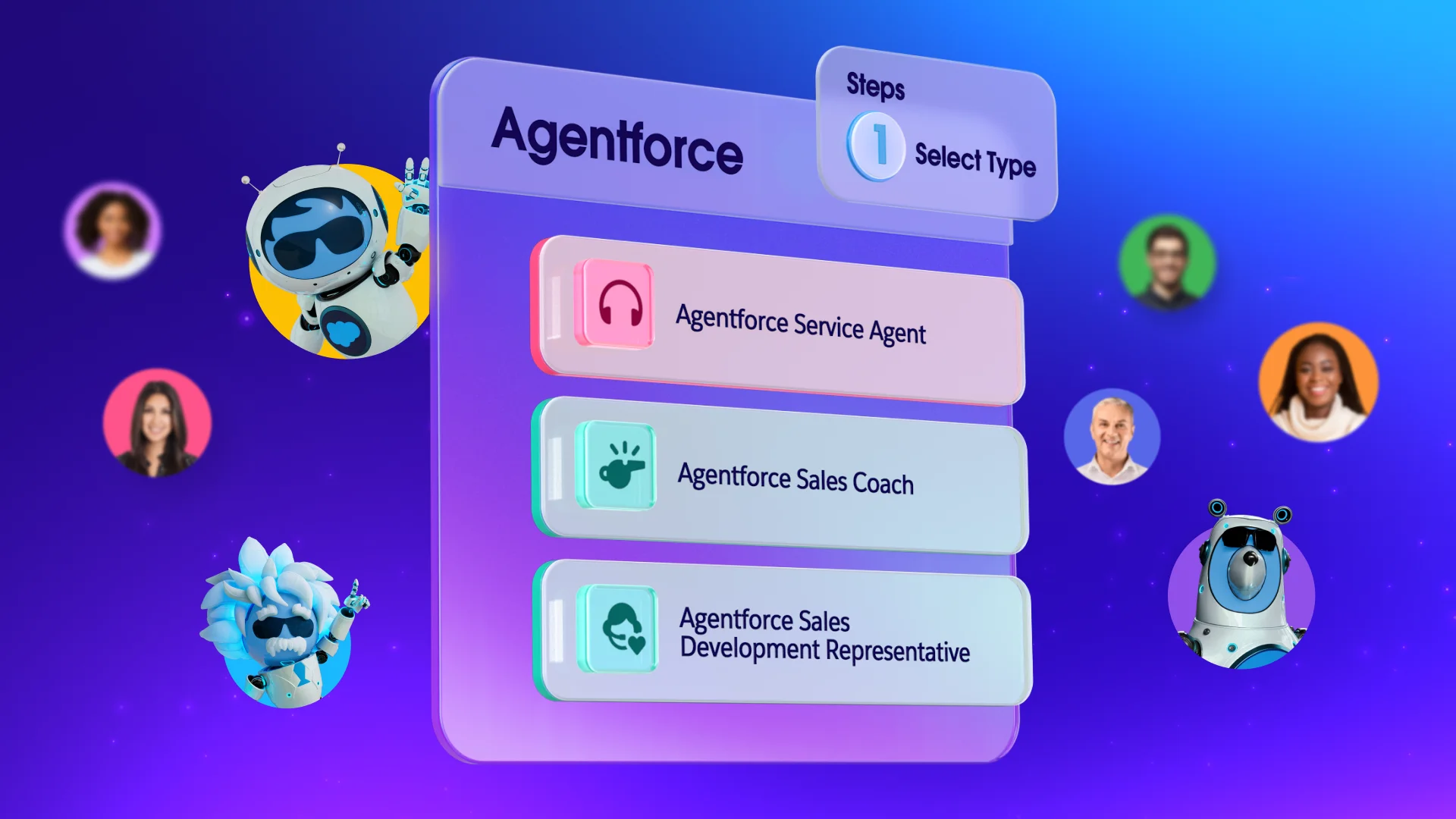
If you’re running a lean operation across sales, marketing, service, and commerce, this kind of connected intelligence means the right action happens automatically, no manual work. And now, Agentforce brings AI-powered scoring data to life across every customer touchpoint, so the full picture of a contact’s engagement informs every interaction — not just the welcome email.
8. Review and recalibrate your model every quarter
Audience scoring isn’t a set-it-and-forget-it tool. Customer behavior shifts, your product evolves, and the signals that predicted a purchase six months ago may no longer be the strongest indicators today. Build a quarterly review into your calendar to check whether high-scoring contacts are converting at the rate you expected — and adjust your criteria if they aren’t.
A good place to start is Trailhead, Salesforce’s free online learning platform. Trailhead’s grading module, which walks through how to test and refine your scoring rules in Salesforce before making live changes that affect your pipeline.
9. Use scoring to trigger automated actions, not just reports
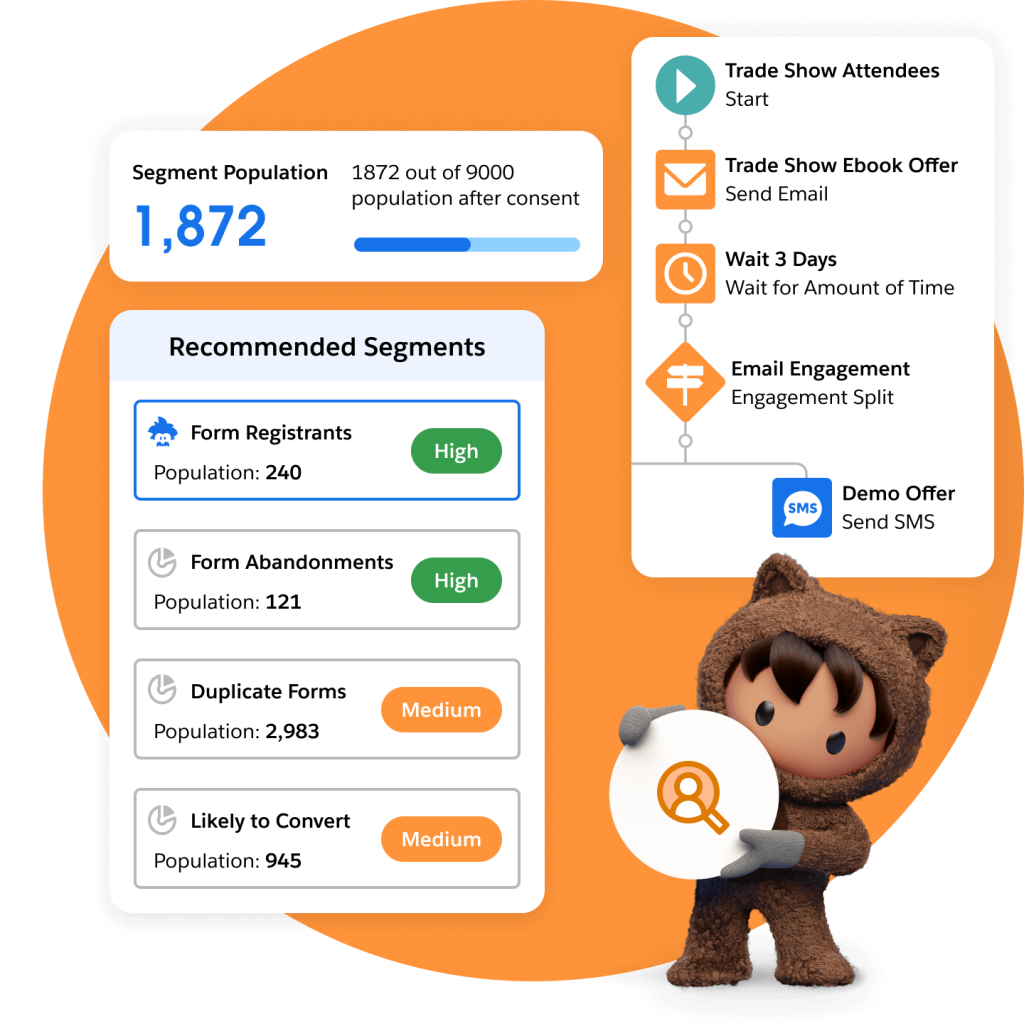
The real value of people scoring isn’t the number itself — it’s what happens when a contact reaches it. The most effective SMBs use scoring thresholds to trigger actions: Routing a hot lead to a sales rep, or enrolling a quiet contact in a re-engagement journey — it’s all a part of the people scoring strategy tailored to fit your business.
10. Use audience scoring to improve every channel, not just email
Email is the most common use case for audience scoring — but it’s far from the only one. High-scoring contacts can be synced to paid ad audiences to reduce wasted spend. Low-scoring contacts can be excluded from your next big promotion to protect your sending reputation. Mid-range contacts can be targeted with personalized web content that meets them where they’re in the buying journey.
When you treat audience scoring as a cross-channel strategy rather than just a list-ranking tool, it becomes one of the most powerful levers an SMB or startup has for making every marketing dollar work harder.
Get Salesforce Marketing CRM for small business.
No credit card required, no software to install.

Get more from your audience scoring with Salesforce
Audience scoring works best when it’s connected, automated, and informed by AI — and that’s exactly what Salesforce Suites is built to deliver for your lean team. Whether you’re building your first scoring model or looking to make your existing people scoring smarter, Salesforce gives you the tools to act on every signal, across every channel, without a large team to manage it.
Start your people scoring journey with Salesforce Suites today or activate Foundations today to try Agentforce 360.
AI supported the writers and editors who created this article.
What is audience scoring?
Audience scoring (also called people scoring) is the practice of assigning a numeric value to each contact in your database based on their behavior and profile data. The score helps your team prioritize outreach, personalize campaigns, and automate actions based on where each person sits in the customer journey.
How is people scoring different from lead scoring?
Lead scoring focuses specifically on ranking prospects by their likelihood to become a paying customer. People scoring is broader — it applies to your entire contact database, including existing customers, lapsed buyers, and subscribers, giving you a fuller view of engagement across every stage of the relationship, not just the sales funnel.
How many scoring signals do I need to get started?
You can start with as few as three to five signals. Most SMBs begin with email engagement (opens and clicks), and one or two profile attributes like company size or job title. As your CRM data grows and you learn which signals best predict conversion for your business, you can add more criteria over time.
Can I use audience scoring if I have a small contact list?
Yes — in fact, a smaller list often makes it easier to see scoring patterns quickly. Even with a few hundred contacts, scoring helps you identify who’s most engaged, who needs nurturing, and who has gone cold. The principles scale up as your list grows, so starting small is a smart way to build the habit before your database becomes harder to manage manually.
Does audience scoring work for service-based small businesses, not just product companies?
Absolutely. Service businesses can score contacts based on consultation requests, content downloads, event attendance, and referral activity — all strong indicators of intent and loyalty. A scoring model built around your specific service journey helps you focus on the prospects most likely to book and the existing clients most likely to expand their relationship with you. The customer engagement score guide has examples of how scoring applies across both product and service business models.