The browser has changed significantly. Rather than just a window to the web, it serves as an AI workspace and central operating environment for the modern enterprise. With knowledge workers spending over 56% of their workday in the browser, it is a key gateway for daily work, complex workflows, and direct interaction with autonomous AI agents (Omdia, 2026). To keep pace with threat actors, organizations need a browser strategy that places browser telemetry at the center of their security architecture.
The rise of shadow AI and agentic risk
As enterprises adopt AI, new vulnerabilities have emerged. Shadow AI —the unauthorized use of public generative AI tools—can expose sensitive corporate IP through prompt sharing and autonomous agent actions. Ninety-two percent of organizations express concern around potential data leakage through these channels. Leaving this unmonitored creates significant risk (Omdia, 2026).
Legacy security stacks, including traditional endpoint detection and response (EDR) and perimeter firewalls, are fundamentally blind to in-browser interactions. They completely miss high-risk threat vectors unique to AI-driven workflows, such as:
- Malicious extensions that “read” sensitive financial data or “write” keyloggers onto sign-in pages.
- “Living off the land” (LOTL) tactics and session hijacking.
- State-sponsored threat actors leveraging AI to accelerate the attack lifecycle.
Chrome Enterprise Premium: Your high-fidelity telemetry engine
Chrome Enterprise Premium addresses this visibility gap by capturing browser telemetry. Rather than relying on external observation after the fact, Chrome Enterprise records signals directly at the point of user interaction.
Core Capabilities for Modern Defense
- Real-time signals: Continuous telemetry for network events, high-risk user behaviors, and suspicious domain access.
- Extension telemetry: Granular visibility into side-loaded extensions and extension-to-domain communications that traditional EDR might miss.
- GenAI and SaaS app reporting: A dedicated capability to discover and govern sanctioned versus unsanctioned AI tools across the fleet.
- Evidence locker: The ability to capture files and content that violate DLP policies, providing a crucial trail for forensic analysis, root cause determination, and detection rule refinement.
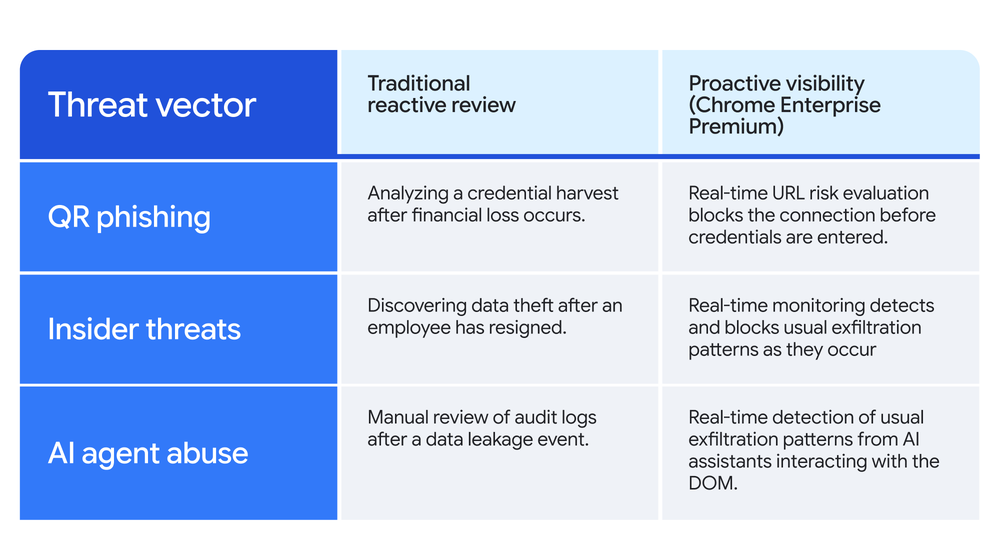
Transforming reactive review into proactive mitigation
Transitioning to proactive defense allows security teams to mitigate threats early. By streaming browser signals into security operations platforms such as Google Security Operations, teams can automate responses and reduce manual investigation time, lowering incident response costs.
Insights from the frontlines: Mandiant case studies
Mandiant observations reveal the practical impact of browser visibility. These cases show how browser telemetry helps detect attacks that bypass standard controls:
- RMM Software Download: Chrome Enterprise Premium flagged a legitimate Remote Monitoring and Management (RMM) executable because it originated from a newly registered domain—a key indicator of social engineering that network tools often miss.
- Credential Harvesting: Chrome Enterprise Premium evaluated URL risks and navigation parameters at the precise moment of interaction, disrupting a phishing attempt before the user could submit credentials.
- Malvertising: Integration with Google Threat Intelligence allowed for immediate identification of a malicious ad click, containing the threat before the actor gained hands-on-keyboard access.
Closing the security gap starts with recognizing that the browser is a key resource for enterprise security. With Google telemetry spanning billions of protected devices, organizations can maintain defensive visibility alongside emerging AI usage to drive a proactive security strategy (Google Safe Browsing).
Ready to transform your security posture?
Avoid leaving a blind spot in your security strategy. Learn more about web defense options by reading our digital paper, “Securing the Browser: How telemetry brings web defense into the next frontier.“
This resource outlines a framework for modern defense, detailing adversary tactics, infection vectors, and threat trends. Read the digital paper to evaluate your organization’s browser security strategy.