Many development teams are familiar with the hesitation that comes right before pushing a new feature live. As AI helps developers write code faster, the gap between rapid code generation and safe production deployment continues to grow.
Feature flags offer a practical way to manage this risk by separating the act of deploying code from the act of releasing a feature to users. Instead of a single, high-risk launch event that affects all users simultaneously, teams can ship code to production with new features hidden by default in a controlled manner.
To help teams adopt this workflow, we are announcing the public preview of AppLifecycle Manager Feature Flags (ALM FF). This service provides a rule-based solution to manage software behavior across Google Cloud, helping you support rapid development without sacrificing production stability.
Read on to learn four ways these feature flags will help accelerate your deployment.
1. Decouple for safety and velocity
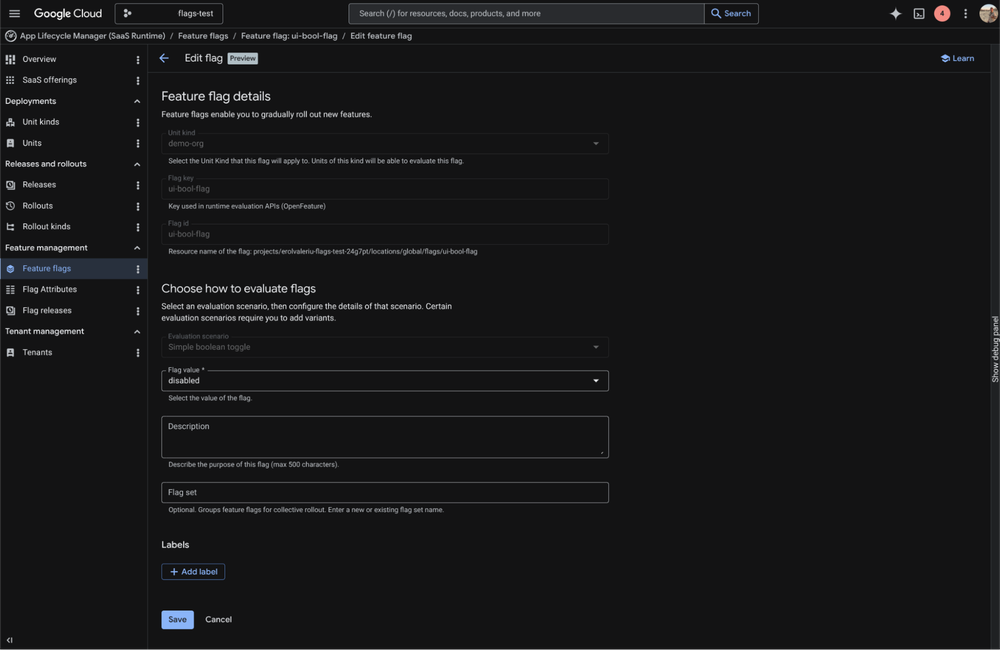
The core mission of ALM FF is to increase development velocity by decoupling your feature releases from your code deployments. Traditionally, releasing a feature requires a binary deployment — a high-risk event that affected all users simultaneously.
With ALM FF, you can ship code to production with new features disabled by default. This allows your team to move faster, deploying code continuously while choosing the exact moment to enable a feature via a toggle. If an issue is detected, the flag acts as an instant kill switch, disabling the problematic feature immediately without the need for a full, time-consuming code rollback.

2. Gradual enablement with precise targeting
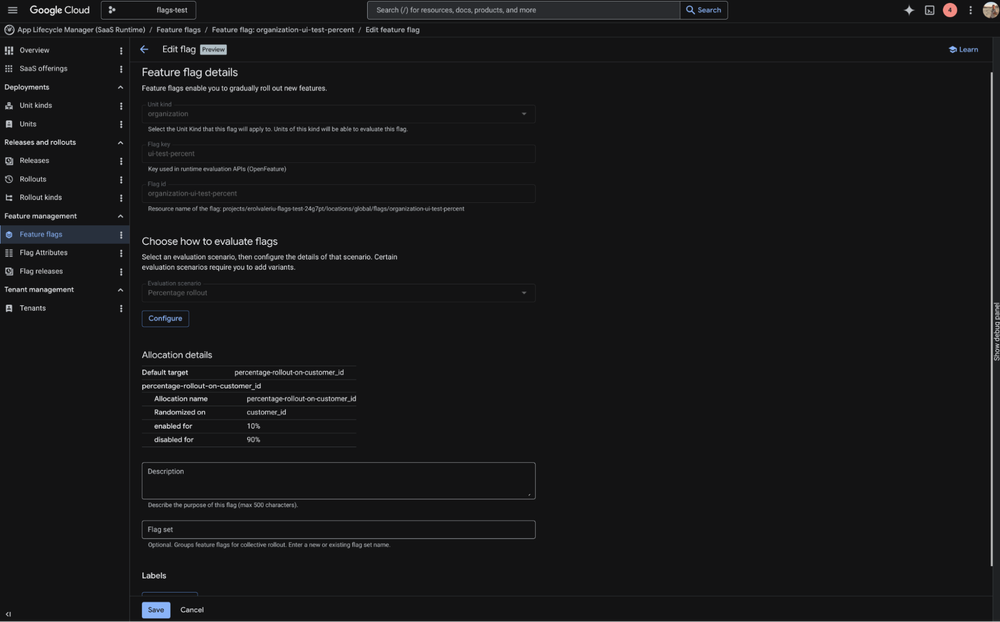
Safety is about precision. ALM FF leverages the Common Expression Language (CEL) to implement sophisticated logic for gradual feature enablement.
-
Percentage feature enablement: Instead of a global launch, you can ramp up a feature to 1%, 5%, or 50% of your traffic. This allows you to monitor system health and performance metrics incrementally, ensuring stability before reaching your entire user base.
- Precise allowlisting: You can target specific internal teams, beta testers, or early-access customers by allowlisting their identifiers. This ensures that only the intended audience sees a feature during its initial validation phase.
3. Dynamic configuration for the AI era
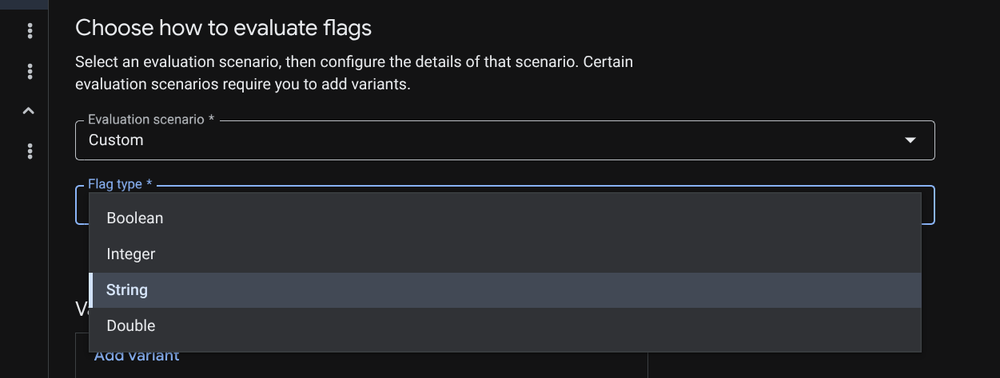
Beyond simple toggles, ALM FF offers a dynamic way to inject configuration into your applications. By using string-type flags, you can update application behavior — such as system prompts for LLM integrations—in real-time. This allows product managers and business owners to tweak AI responses and application logic without requiring any code changes or infrastructure rollouts.
4. Built on open standards
We believe safety should not mean lock-in. ALM FF is built on the OpenFeature standard, utilizing industry-standard SDKs and the flagd evaluation engine. This ensures your feature management patterns are portable and follow best practices without adding Google-specific dependencies to your core application code.
Get started
ALM FF is now in public preview. To take control of your releases, you can:
-
Review the docs: Public Documentation
-
Onboard today: Quickstart Guide
- Give us feedback: Help us shape the future of feature management