As AI workloads transition from experimental prototypes to production-grade services, the infrastructure supporting them faces a growing utilization gap. Enterprises today typically face a binary choice: build for high-concurrency, low-latency real-time requests, or optimize for high-throughput, “async” processing.
In Kubernetes environments, these requirements are traditionally handled by separate, siloed GPU and TPU accelerator clusters. Real-time traffic is over-provisioned to handle bursts, which can lead to significant idle capacity during off-peak hours. Meanwhile, async tasks are often relegated to secondary clusters, resulting in complex software stacks and fragmented resource management.
For AI serving workloads, Google Kubernetes Engine (GKE) addresses this “cost vs. performance” trade-off with a unified platform for the full spectrum of inference patterns: GKE Inference Gateway. By leveraging an OSS-first approach, we’ve developed a stack that treats accelerator capacity as a single, fluid resource pool that can serve workloads that require serving both deterministic latency and high throughput.
In this post, we explore the two primary inference patterns that drive modern AI services and the problems and current solutions available for each. By the end of this blog, you will see how GKE supports these patterns via GKE Inference Gateway.
Two inference patterns: Real-time and async
We will cover two types of AI inference workloads in this blog: real-time and async. For real-time inference, these are high-priority, synchronous requests—such as a chatbot interaction where a customer is waiting for an immediate response from an LLM. In contrast, async traffic, such as documenting indexing or product categorization in retail is typically latency-tolerant, meaning the traffic is often queued and processed with a delay.
1. Real-time inference: 0 second latency-sensitive requests
For high-priority, synchronous traffic, latency is the most critical metric. However, traditional load balancing often ignores accelerator-specific metrics like KV cache utilization that indicate high latency, leading to suboptimal performance.
The solution: GKE Inference Gateway
The solution for this problem is Inference Gateway, which performs latency-aware scheduling by predicting model server performance based on real-time metrics (e.g., KV cache status), minimizing time-to-first-token. This also reduces queuing delays and helps ensure consistent performance even under heavy load.
2. Async (near-real time) inference: 0 minute latency
Latency-tolerant tasks operate with minute-scale service-level objectives (SLOs) rather than millisecond requirements. In a traditional setup, teams often run these requests on separate, dedicated infrastructure to prevent resource contention with real-time traffic. This static partitioning can lead to fragmented utilization and inflated hardware costs. Furthermore, custom-built async pollers typically lack the sophisticated scheduling logic required to multiplex workloads onto the same accelerators, forcing engineers to manage two disparate and complex software stacks.
The solution : The Async Processor Agent + Inference Gateway
A “plug-and-play” architecture that integrates Inference Gateway with Cloud Pub/Sub. A Batch Processing Agent pulls requests from configured Topics and routes them to the Inference Gateway as “sheddable” traffic. The system treats batch tasks as “filler,” using idle accelerator (GPU/TPU) capacity between real-time spikes. This minimizes resource fragmentation and helps reduce hardware costs.
Key capabilities:
-
Support for real-time traffic: Real-time inference traffic is handled by Inference Gateway
-
Persistent messaging: Reliable request handling occurs via Pub/Sub.
-
Intelligent retries: Leverage the configurable retry logic built into the queue architecture based on real-time monitoring of the queue depth.
-
Strict priority: Real-time traffic always takes precedence over batch traffic at the gateway level.
- Tight integration: Users simply “plug in” a Pub/Sub topic; the agent handles the routing logic to the shared accelerator pool.
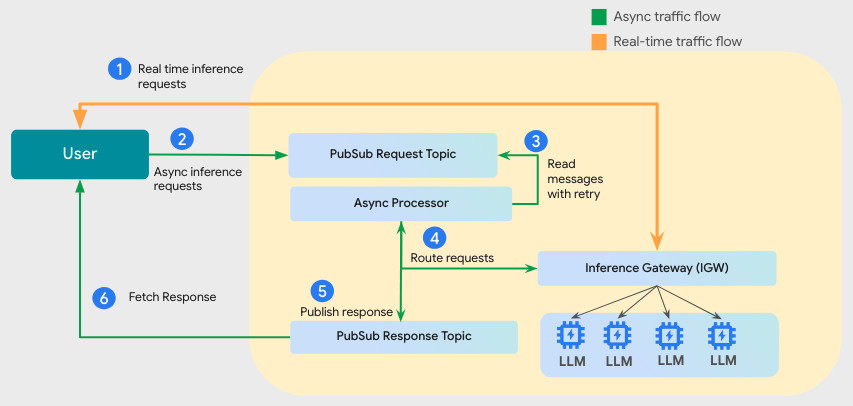
Figure1 : High-level integrated architecture for solving real-time and async inference traffic.
The request flow as depicted in the picture above is as following:
-
Users submit real-time requests, which Inference Gateway schedules first.
-
Users can publish Async inference requests via a configured Pub/Sub Topic.
-
The Async Processor reads from the queue based on available capacity.
-
The Async Processor routes the requests through the Inference Gateway utilizing the same accelerator (GPU/TPU) resources. Real-time requests are prioritized; async requests fill the unused accelerators (see the above image) in compute cycles.
-
The Async Processor writes the responses to an output Topic.
-
Users get the responses for async requests from a Response Topic.
By consolidating these real-time and async workloads onto shared accelerators, GKE solves the “cost vs. performance” paradox. You no longer need to manage fragile, custom queue-pollers or maintain separate, underutilized clusters. Furthermore, all this work is available in open source, which means you can use these products across multiple clouds and environments.
Consolidated workloads in action
The idea of running real-time and async workloads on shared infrastructure sounds great in theory, but how does it perform in the real world? We analyzed the efficacy of serving high-priority, real-time workloads alongside latency-tolerant batch requests within the unified resource pool, and results were promising.
The real-time traffic is characterized by unpredictable spikes. To maintain low-latency responses, the system must ensure that during peaks, 100% of the pool’s capacity is available for real-time traffic. Conversely, latency-tolerant tasks should remain in pending state until capacity becomes available.
Our initial testing demonstrated the risks of unmanaged multiplexing. When low-priority, latency-tolerant requests were submitted directly to Inference Gateway without using the Async Processor Agent, the resource contention led to 99% message drop. However, with the Async Processor, 100% of latency-tolerant requests were served during available cycles!
Figure2 : Showing higher utilization for real-time + latency tolerant batch traffic.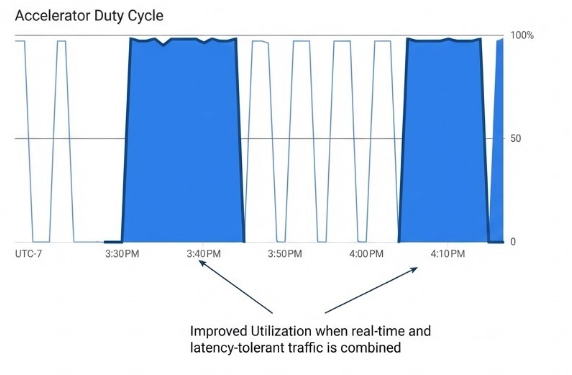
Next steps
Interested in running both real-time and batch AI workloads on the same infrastructure? To get started, check out Quickstart Guide for Async Inference with Inference Gateway. You can also contribute to the work by joining the OSS Project on GitHub. Our next phase of development focuses on deadline-aware scheduling, allowing users to set “soft limits” for batch completion windows, further optimizing how the system balances filler traffic against real-time demand. We look forward to working with the community on this important work!