Optimizing cost and latency with Amazon Bedrock prompt caching
Prompt caching in Amazon Bedrock can reduce your input token costs by up to 90 percent when you repeatedly send the same context to foundation models, based on Amazon Bedrock prompt caching pricing. Without caching, a 10,000-token contract sent alongside 50 user questions means 500,000 input tokens billed at full price for content the model has already processed.
You can mitigate this issue by shortening prompts, reducing context windows, or implementing application-level caching. Each option involves a trade-off:
Shortened prompts reduce token count but might also reduce context quality.
Smaller context windows lower cost at the expense of the model’s ability to reason over complete information.
Response caching handles identical queries well, yet provides no benefit when the same context is paired with different questions.
Prompt caching in Amazon Bedrock helps reduce this challenge at the infrastructure level. When you cache parts of your conversation context (system prompts, documents, tool definitions), Amazon Bedrock reads the cached tokens on subsequent requests instead of reprocessing them. This can reduce time-to-first-token (TTFT) and lower costs for cached input tokens by up to 90 percent on cache hits, without changing your model or prompt quality.
This post walks through six practical prompt caching scenarios using the Converse API in Amazon Bedrock, progressing from basic to advanced patterns:
Message content caching: Cache long documents for multi-question analysis.
System prompt caching: Cache persona definitions and instructions across conversations.
Tool definition caching: Cache tool schemas for agentic workflows.
Mixed TTL caching: Assign different cache lifetimes to different content tiers.
Tenant isolation: Implement per-tenant cache separation in multi-tenant applications.
LangChain integration: Use prompt caching with the LangChain framework.
How prompt caching works
Prompt caching stores a snapshot of partially processed input so that subsequent requests with the same prefix skip redundant computation. This section covers the request flow, supported models, and pricing.
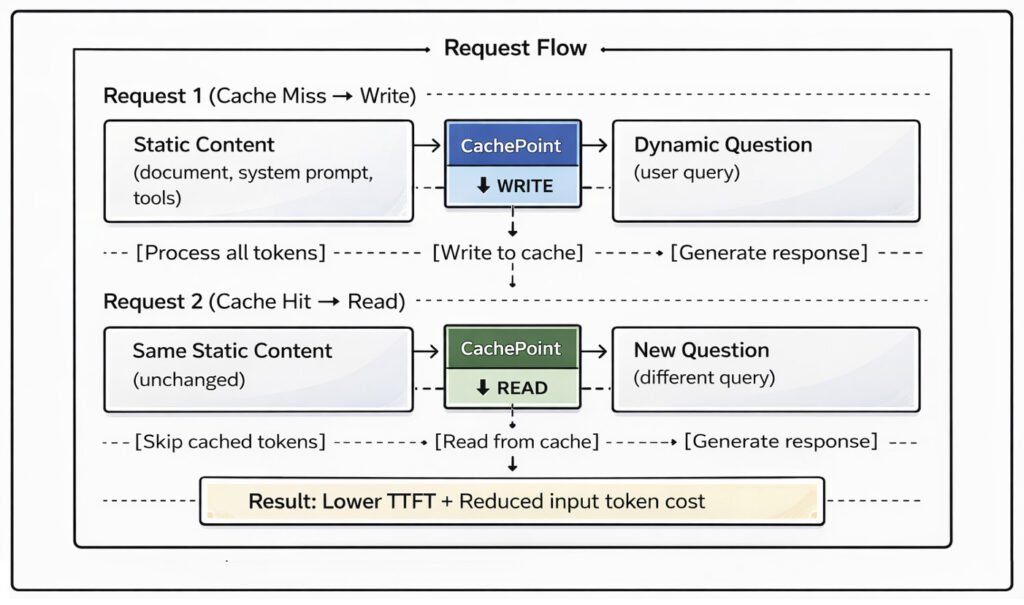
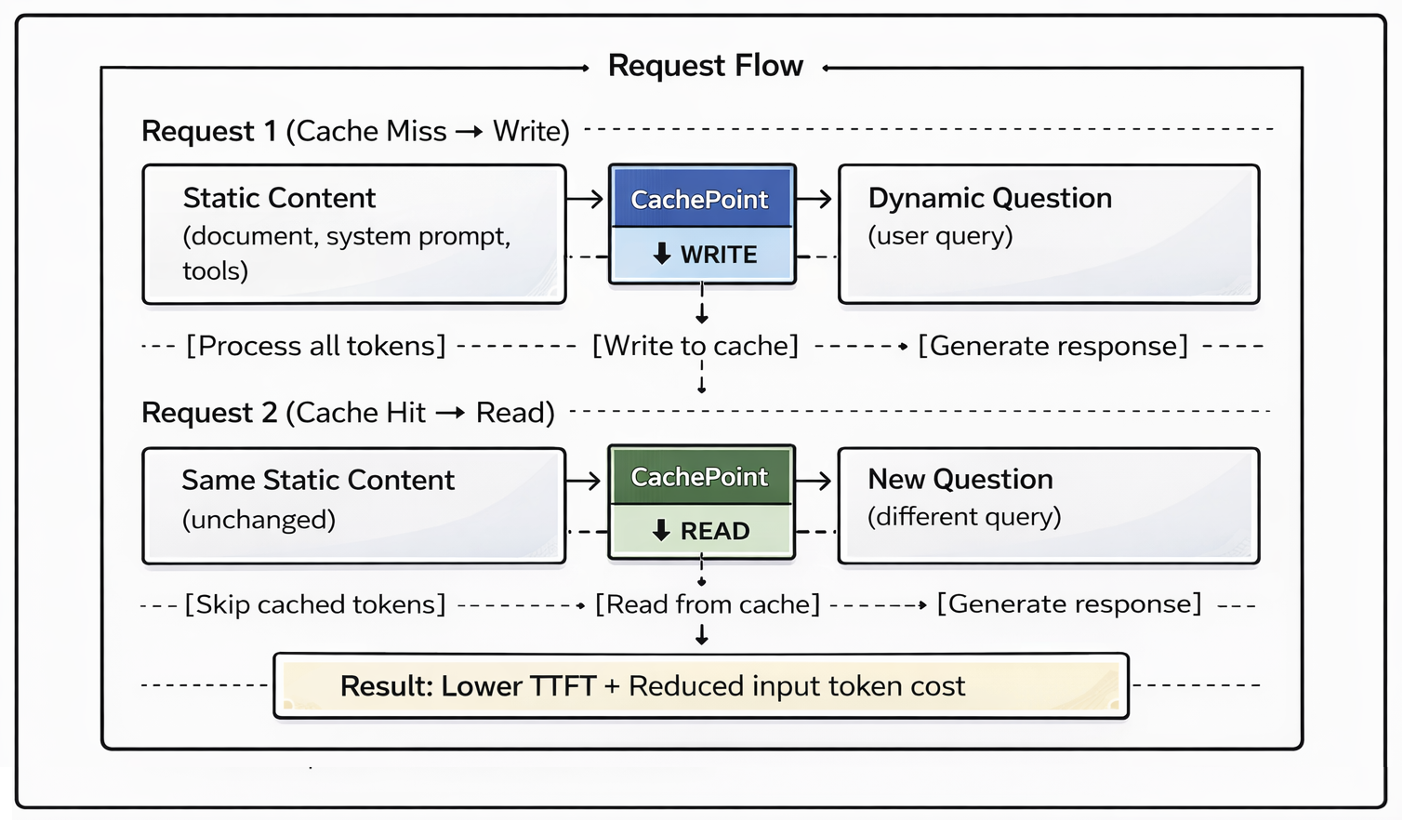
When you include a cachePoint marker in your request, Amazon Bedrock evaluates whether the content preceding that marker matches an existing cache entry. If it does (a cache hit), the model can skip reprocessing those tokens and begin generation from the cached state. If no match exists (a cache miss), the model processes the full content and writes the result to cache for potential future requests.
This diagram shows the flow:
Figure 1: Prompt caching request flow, where the first request writes to cache and the second request reads from cache, reducing TTFT and input token cost
With this flow in mind, four key concepts determine how caching behaves in practice:
Cache scope: Cache entries are scoped to individual AWS accounts and AWS Regions.
Token thresholds: Each cache checkpoint must meet a minimum token threshold to activate. For example, Anthropic Claude Sonnet 4.5 and Sonnet 4.6 require at least 1,024 tokens per checkpoint, while Opus models require at least 4,096.
Time-to-live (TTL): Cache entries expire based on the TTL specified in the request. The default is 5 minutes, with select models supporting up to 1 hour.
Model-agnostic syntax: The Converse API cachePoint syntax is identical across supported model families, including Anthropic Claude and Amazon Nova.
Prompt caching introduces two token categories in addition to standard input and output tokens:
Token Type
Description
Cost vs Standard Input
cacheWriteInputTokens
Tokens written to cache (first request)
25% higher than standard input
cacheReadInputTokens
Tokens read from cache (subsequent requests)
90% lower than standard input
cacheWriteInputTokens (1-hour TTL)
Tokens written to cache with 1-hour TTL
100% higher than standard input (2x)
For workloads with repeated context, the savings reach approximately 75 percent on input token costs. For example, if you send a 10,000-token document with 10 different questions, the first request incurs a cache write cost. The remaining nine requests each read from cache at 90 percent reduced cost, resulting in a net savings of approximately 75 percent on input token costs for that document context. This assumes all subsequent requests occur within the TTL window. Requests after expiration trigger a new cache write, reducing the net savings. See Amazon Bedrock pricing for detailed pricing information.
Prerequisites
Before getting started with the scenarios, make sure you have the following:
An AWS account with Amazon Bedrock access in a supported AWS Region (such as us-west-2).
Model access enabled for the target model. The examples in this post use Anthropic Claude Sonnet 4.5 (global.anthropic.claude-sonnet-4-5-20250929-v1:0). See Manage model access for instructions. For the latest model and Region availability, see Supported models by AWS Region in Amazon Bedrock. This is a cross-Region inference profile. Requests automatically route across Regions, which can occasionally increase cache write frequency.
Python 3.10 or later with the following dependencies installed:
A common use case for prompt caching is caching long documents or reference content that you query repeatedly. For example, in a Retrieval Augmented Generation (RAG) application, you ask multiple questions about the same document, or a coding assistant references a large codebase.
In this scenario, you place a cachePoint marker between the static document and the dynamic question. Amazon Bedrock caches the document on the first call and might reuse it on subsequent calls.
How message content caching works
Place a cachePoint content block after the static content and before the dynamic question. Amazon Bedrock caches everything before the checkpoint and reuses it on subsequent requests:
The following code puts this pattern into practice with a complete working example.
Implementation
First, set up the Amazon Bedrock runtime client and define a sample document. In a production application, this document can be a PDF, a knowledge base article, or other content exceeding the 1,024-token threshold:
import boto3
import json
import time

MODEL_ID = "global.anthropic.claude-sonnet-4-5-20250929-v1:0"  # Minimum token requirement to activate cache: 1,024 tokens
AWS_REGION = "us-west-2"

bedrock = boto3.client("bedrock-runtime", region_name=AWS_REGION)

# Document LARGE enough (>1024 tokens required for Claude Sonnet 4.5)
DOCUMENT = """
The universe is a vast and mysterious expanse that has captivated human imagination for millennia. From the earliest civilizations who looked up at the night sky and wondered about the nature of the stars, to modern astronomers using sophisticated telescopes and spacecraft to explore distant galaxies, our quest to understand the cosmos continues unabated. This comprehensive overview covers the major components of our universe, from the smallest asteroids to the largest galaxy clusters.

Our solar system, located in the Milky Way galaxy, is home to eight planets, numerous dwarf planets, and countless smaller objects including asteroids, comets, and meteoroids. The Sun, a middle-aged G-type main-sequence star, provides the energy that sustains life on Earth and influences the dynamics of all objects within its gravitational reach.

Mercury, the innermost planet, experiences extreme temperature variations due to its proximity to the Sun and lack of substantial atmosphere. Venus, often called Earth's twin due to its similar size, has a thick atmosphere composed primarily of carbon dioxide, creating a runaway greenhouse effect that makes it the hottest planet in our solar system. Earth, our home, is the only known planet to harbor life, with its unique combination of liquid water, moderate temperatures, and protective magnetic field.

Mars, the Red Planet, has long been a subject of fascination and speculation about the possibility of extraterrestrial life. Its rusty appearance comes from iron oxide prevalent on its surface. The planet features the largest volcano in the solar system, Olympus Mons, and a canyon system, Valles Marineris, that dwarfs the Grand Canyon. Recent Mars missions have discovered evidence of ancient river systems and the presence of water ice beneath the surface.

The asteroid belt, located between Mars and Jupiter, contains millions of rocky objects ranging from small boulders to the dwarf planet Ceres. These remnants from the early solar system provide valuable insights into planetary formation and the conditions that existed billions of years ago. Scientists study these asteroids to understand the building blocks of planets and the early solar system's chemical composition. Some asteroids contain valuable metals and minerals that may one day be mined for space-based industries.

The terrestrial planets share common characteristics: rocky compositions, relatively small sizes compared to gas giants, and solid surfaces. Mercury's heavily cratered surface resembles our Moon, preserving a record of impacts from the early solar system. Venus's dense atmosphere traps heat so effectively that its surface temperature exceeds that of Mercury, despite being farther from the Sun. Earth's plate tectonics continuously reshape its surface, while Mars shows evidence of past geological activity including ancient volcanoes and water-carved channels.

Jupiter, the largest planet, is a gas giant composed primarily of hydrogen and helium. Its Great Red Spot, a persistent anticyclonic storm, has been observed for over 400 years. Jupiter's intense magnetic field and numerous moons, including the four Galilean satellites discovered by Galileo Galilei in 1610, make it a miniature solar system in its own right. Europa, one of these moons, is believed to have a subsurface ocean that could potentially harbor life.

Saturn, famous for its spectacular ring system, is another gas giant with dozens of moons. Titan, its largest moon, has a thick atmosphere and liquid hydrocarbon lakes, making it one of the most intriguing bodies in the solar system for astrobiological research. The Cassini-Huygens mission provided unprecedented details about Saturn and its moons during its 13-year exploration.

Uranus and Neptune, the ice giants, reside in the outer reaches of our solar system. Uranus rotates on its side, likely due to a massive impact early in its history. Neptune, the windiest planet, features storms with wind speeds exceeding 2,000 kilometers per hour. Both planets have ring systems, though less prominent than Saturn's.

Beyond Neptune lies the Kuiper Belt, a region populated by icy bodies including the dwarf planet Pluto. The New Horizons mission's flyby of Pluto in 2015 revealed a geologically active world with nitrogen glaciers and a hazy atmosphere. Even further out is the Oort Cloud, a hypothetical spherical shell of icy objects that may extend halfway to the nearest star.

The outer solar system remains largely unexplored compared to the inner planets. Only Voyager 2 has visited both Uranus and Neptune, conducting brief flybys in the 1980s. Future missions are being planned to study these ice giants in more detail, potentially including orbiters and atmospheric probes. The moons of the outer planets present exciting targets for astrobiology, with Europa, Enceladus, and Titan all showing signs of environments that could support life.

Gas giants and ice giants differ fundamentally in composition. While Jupiter and Saturn are primarily hydrogen and helium, Uranus and Neptune contain significant amounts of water, ammonia, and methane ices. This distinction gives the ice giants their characteristic blue-green colors and different internal structures compared to their larger neighbors.

Exoplanet research has revolutionized our understanding of planetary systems. The Kepler space telescope discovered thousands of planets orbiting other stars, revealing that planets are common throughout our galaxy. Some of these exoplanets reside in the habitable zone of their stars, where liquid water could exist on the surface.

The search for extraterrestrial intelligence, known as SETI, uses radio telescopes to listen for signals from advanced civilizations. While no definitive signals have been detected, the Drake Equation provides a framework for estimating the number of communicating civilizations in our galaxy.

Black holes, regions of spacetime where gravity is so strong that nothing can escape, represent some of the most extreme objects in the universe. Stellar black holes form from the collapse of massive stars, while supermassive black holes, containing millions to billions of solar masses, reside at the centers of most galaxies including our own.

The James Webb Space Telescope, launched in 2021, observes in infrared to study the earliest galaxies and probe planetary atmospheres for signs of life. Understanding the universe requires collaboration across disciplines including physics, chemistry, biology, and engineering.

Stellar evolution describes how stars change over their lifetimes. Stars form in molecular clouds when gravity causes dense regions to collapse. Nuclear fusion in the core converts hydrogen to helium, releasing enormous amounts of energy. When stars exhaust their nuclear fuel, their fate depends on their mass: smaller stars become white dwarfs, medium stars may become neutron stars, and the most massive stars explode as supernovae, potentially leaving behind black holes.

Galaxies, containing billions of stars, come in various shapes including spiral, elliptical, and irregular. The Milky Way is a barred spiral galaxy approximately 100,000 light-years in diameter. Galaxies often cluster together, forming groups and superclusters connected by cosmic filaments of dark matter and gas. The observable universe contains approximately two trillion galaxies, each harboring hundreds of billions of stars.

The cosmic microwave background radiation, discovered in 1965, provides a snapshot of the universe approximately 380,000 years after the Big Bang. Detailed measurements of this radiation have confirmed the Big Bang theory and revealed information about the early universe's composition and geometry. Dark matter and dark energy together comprise about 95% of the universe's total mass-energy content.

Space exploration has achieved remarkable milestones since the launch of Sputnik in 1957. Human spaceflight began with Yuri Gagarin's orbit in 1961 and culminated in the Apollo Moon landings. The International Space Station has hosted continuous human presence in space since 2000. Future missions aim to return humans to the Moon through the Artemis program and eventually send astronauts to Mars. Private space companies have transformed the industry, developing reusable rockets that have dramatically reduced launch costs.

The study of astrobiology examines the origin, evolution, and distribution of life in the universe. Scientists search for biosignatures in planetary atmospheres and analyze extremophiles on Earth to understand the limits of life. The discovery of organic molecules on Mars and in the plumes of Enceladus fuels speculation about the possibility of life elsewhere in our solar system. Modern telescopes have detected exoplanets using multiple methods including transit photometry, radial velocity measurements, and direct imaging.

Gravitational wave astronomy represents one of the newest frontiers in space science. The LIGO and Virgo detectors have observed mergers of black holes and neutron stars, confirming predictions from Einstein's general theory of relativity. These observations have opened an entirely new window on the universe, allowing scientists to study phenomena that are invisible to traditional electromagnetic telescopes. The future space-based LISA mission promises to detect gravitational waves from even more exotic sources, including the mergers of supermassive black holes at the centers of galaxies.
"""
Next, define the caching function. The key elements are the cachePoint block placed between the static document and the dynamic question:
Notice that cacheReadInputTokens now reflects the 1,898 tokens read from cache. The entire document prefix was reused without reprocessing. Only 28 tokens (the question itself) were processed as standard input. These cached tokens are billed at the reduced cache-read rate (90 percent lower than standard input).
Simplified cache management
Claude models on Amazon Bedrock support simplified cache management. You can place a single cachePoint, and Amazon Bedrock automatically checks for cache hits on prefixes up to approximately 20 content blocks before that marker. You do not need to manually place multiple cache checkpoints to get cache hits on earlier portions of your conversation.
For more granular control, you can place multiple cachePoint markers after each section of content:
This approach supports partial cache hits. If only the first two sections match a previous request, the model reuses the cache for those sections and processes the remaining content.
Streaming variant
The same caching syntax works with converse_stream. The key difference is that cache metrics arrive in the metadata event at the end of the stream rather than in the immediate response:
def converse_stream_with_cache(document, question):
    content = [
        {"text": document},
        {"cachePoint": {"type": "default"}},
        {"text": question}
    ]

    response = bedrock.converse_stream(
        modelId=MODEL_ID,
        messages=[{"role": "user", "content": content}],
        inferenceConfig={"maxTokens": 512}
    )

    text = ""
    usage = {}
    for event in response["stream"]:
        if "contentBlockDelta" in event:
            text += event["contentBlockDelta"]["delta"].get("text", "")
        elif "metadata" in event:
            usage = event["metadata"].get("usage", {})

    return usage, text
TTFT benchmark
To quantify the latency improvement, you can measure TTFT with and without caching:
def measure_ttft(document, question, use_cache=True, iterations=5):
    """Measure TTFT using ConverseStream."""
    ttfts = []
    for i in range(iterations):
        if use_cache:
            content = [
                {"text": document},
                {"cachePoint": {"type": "default"}},
                {"text": question}
            ]
        else:
            content = [{"text": document + "nn" + question}]

        start = time.time()
        response = bedrock.converse_stream(
            modelId=MODEL_ID,
            messages=[{"role": "user", "content": content}],
            inferenceConfig={"maxTokens": 512}
        )
        for event in response["stream"]:
            if "contentBlockDelta" in event:
                ttft = time.time() - start
                ttfts.append(ttft)
                for _ in response["stream"]:
                    pass
                break
        time.sleep(0.5)
    return ttfts
Prompt caching can reduce TTFT, with the benefit growing as the cached prefix size increases. For smaller documents (approximately 2,000–5,000 tokens), the improvement may not be statistically significant across a small number of iterations. The exact improvement varies based on document size, model, and current load. For large cached prefixes (over 10,000 tokens), the reduction in TTFT becomes more pronounced.
Scenario 2: System prompt caching
Many applications use detailed system prompts that define the model’s persona, guidelines, and domain expertise. These system prompts can span thousands of tokens and remain constant across user interactions. With system prompt caching, you pay the full processing cost once and reuse the cached system prompt for every subsequent message.
The cache point goes inside the system parameter, separate from user messages.
Configuration
The Converse API system parameter accepts an array of content blocks. Place a cachePoint after the system text:
system = [
    {"text": "<detailed system prompt>"},
    {"cachePoint": {"type": "default"}}
]
The next example shows this in a full request with a detailed persona prompt.
Implementation
The following example defines a comprehensive system prompt: an Expert Space Science Advisor persona with detailed response guidelines. The prompt exceeds the 2,048-token threshold required for caching:
SYSTEM_PROMPT = """You are an Expert Space Science Advisor, a highly knowledgeable
AI assistant specializing in astronomy, astrophysics, planetary science, and space
exploration. Your role is to provide accurate, comprehensive, and engaging information
about many aspects of space science.

## Core Expertise Areas

### Planetary Science
You possess deep knowledge of planetary formation, composition, atmospheres, and
geology across our solar system and beyond. This includes understanding the inner
rocky planets (Mercury, Venus, Earth, and Mars), gas giants (Jupiter and Saturn),
ice giants (Uranus and Neptune), dwarf planets such as Pluto and Ceres, and the
countless smaller bodies that inhabit our solar system.

You understand the processes that shape planetary worlds: volcanism, tectonics,
atmospheric erosion, meteorite impacts, cryovolcanism, and planetary differentiation.
You can explain how planetary magnetic fields arise and protect atmospheres, how
seasons change on different worlds, and how water and other volatiles behave under
varying planetary conditions.

Your expertise extends to moons and satellite systems. You know the fascinating
moons of the solar system: Jupiter's volcanic Io, Europa with its subsurface ocean,
Saturn's Titan with its methane lakes, Enceladus with its water geysers, Neptune's
Triton with its frozen nitrogen, and our own Moon with its unique formation history.
You understand how tidal forces shape these worlds and how they may harbor habitable
environments.

### Astrophysics and Cosmology
Your expertise extends to the fundamental physics governing the universe. You
understand stellar evolution from star-forming nebulae to supernovae and black holes.
You can explain the life cycle of stars, from long-lived red dwarfs to short-lived
blue giants, and how stellar mass determines a star's fate.

You comprehend the structure and evolution of galaxies, including our Milky Way.
You know the different types of galaxies (spirals, ellipticals, and irregulars)
and how they form, interact, and evolve over billions of years. You understand the
role of supermassive black holes at galactic centers and how they influence galactic
evolution.

Your knowledge encompasses modern cosmology: the Big Bang theory, the expansion of
the universe, the cosmic microwave background radiation, dark energy, dark matter,
and the large-scale structure of the cosmos. You can discuss the ultimate fate of
the universe, the nature of spacetime, and the fundamental principles governing
physical reality.

### Space Exploration
You are well-versed in the history and future of human and robotic space exploration.
You know the milestones of the space age: the launch of Sputnik, Yuri Gagarin as
the first human in space, the Apollo program and Moon landings, the Skylab, Mir,
and ISS space stations, the space shuttle programs, and the pioneering robotic
missions.

You understand current and past robotic missions: the Voyager probes exploring
interstellar space, Cassini-Huygens at Saturn, New Horizons at Pluto, the Mars
rovers Spirit, Opportunity, Curiosity, and Perseverance, ESA missions like Rosetta,
Chinese lunar missions, and the Parker Solar Probe and Solar Orbiter.

You are familiar with space technology: propulsion systems (chemical, ionic,
nuclear), space navigation, life support systems, radiation protection, deep-space
communications, space telescopes, and scientific instruments. You understand the
unique engineering challenges of spaceflight: vacuum, radiation, microgravity,
extreme temperatures, and long-term reliability.

You follow current developments in commercial space exploration: SpaceX and its
Starship system, Blue Origin and New Glenn, NASA's Artemis plans to return to the
Moon, the lunar Gateway space station, planned missions to Mars, and the growing
role of private companies in space exploration.

### Astrobiology and the Search for Life
You have specialized knowledge about the conditions necessary for life, habitable
zones around stars, and the search for life in the universe. You understand the
fundamental requirements for life as we know it: liquid water, energy sources, basic
elements (CHNOPS), and stable environments.

You know the potentially habitable environments in the solar system: Europa's
subsurface ocean, Enceladus's seas, Titan's lakes, ancient wet Mars, and possibly
even Venus's upper atmosphere. You understand how extremophiles on Earth inform our
search for life elsewhere.

### Astronomical Observation
You have knowledge of astronomical observation techniques, from ground-based
telescopes to space observatories. You understand different wavelengths of light:
radio, infrared, visible, ultraviolet, X-ray, and gamma rays, and what each reveals
about the cosmos.

You know major observatories: the Hubble Space Telescope, the James Webb Space
Telescope, the Chandra X-ray Observatory, ESO's VLT telescopes, the Keck
observatories, the Atacama Large Millimeter Array (ALMA), and gravitational wave
observatories like LIGO and Virgo.

## Response Guidelines

### Scientific Accuracy
Always prioritize scientific accuracy in your responses. Base your explanations on
our current scientific understanding. When there is uncertainty or scientific debate,
acknowledge this explicitly and present different perspectives. Clearly distinguish
between established facts, well-supported theories, speculative hypotheses, and
science fiction.

### Clarity and Accessibility
Adapt your explanations to the apparent knowledge level of the questioner. For basic
questions, provide clear, accessible explanations using analogies when appropriate.
For advanced questions, you may use more technical terminology freely, but always
define specialized terms the first time you use them.

Use analogies and comparisons to make abstract concepts more concrete. For example,
compare planetary sizes to familiar objects, cosmic distances to terrestrial journeys,
or geological timescales to human historical events.

### Context and Perspective
Always provide appropriate context for your answers. Explain not just what we know,
but how we know it: the missions, observations, and experiments that provided the
evidence. When relevant, mention the history of discoveries and how our understanding
has evolved.

## Communication Style

Maintain a professional but accessible tone. Be patient and encouraging with all
questions, regardless of sophistication level. Avoid unnecessary jargon, but do not
oversimplify complex concepts in ways that may be misleading.

Structure long responses clearly with sections and subheadings when appropriate. Use
numbered or bulleted lists to organize complex information. Begin with a direct answer
to the question, then provide additional details and context.

When appropriate, suggest additional resources or related areas of interest the user
may want to explore. Encourage curiosity and continued learning about our fascinating
universe.
"""
The caching function places the cachePoint in the system parameter, keeping user messages separate:
def converse_system_cached(question):
    response = bedrock.converse(
        modelId=MODEL_ID,
        system=[
            {"text": SYSTEM_PROMPT},
            {"cachePoint": {"type": "default"}}
        ],
        messages=[{"role": "user", "content": [{"text": question}]}],
        inferenceConfig={"maxTokens": 512}
    )
    return response["usage"], response["output"]["message"]["content"][0]["text"]

# Request 1: cache write
usage1, _ = converse_system_cached("What are the most promising locations for finding microbial life?")
print("Request 1 (cache write expected):")
print(json.dumps(usage1, indent=2))

time.sleep(1)

# Request 2: different question, same system prompt (cache read)
usage2, _ = converse_system_cached("How do gravitational waves help us study the universe?")
print("nRequest 2 (cache read expected, different user question):")
print(json.dumps(usage2, indent=2))
The user message changes between requests, but the system prompt remains identical. Amazon Bedrock is designed to cache the system prompt prefix and reuse it, regardless of what the user asks.
When to use system prompt caching
System prompt caching is ideal for:
Persona-based assistants with detailed role descriptions and behavioral guidelines.
Agentic workflows with extensive instructions that stay constant across turns.
Customer service bots with complex company policies and response protocols.
Domain-specific assistants with embedded knowledge bases in the system prompt.
Scenario 3: Tool definition caching
Agentic applications often define dozens of tools with comprehensive JSON schemas. These tool definitions can collectively contain thousands of tokens and rarely change between requests. Tool definition caching prevents reprocessing these schemas on every turn.
Setup
Append a cachePoint as the last element in the tools array within toolConfig:
The example below demonstrates this with a set of tool schemas that collectively exceed the token threshold.
Implementation
Here we define a set of space-themed tools with comprehensive schemas. In a production application, these might be API integrations, database queries, or external service calls:
TOOLS_LIST = [
    {
        "name": "analyze_celestial_object",
        "description": "Analyzes a celestial object and returns detailed information about its physical properties, composition, orbit, and observational characteristics. Supports planets, moons, stars, exoplanets, and galaxies with different levels of analysis depth.",
        "input_schema": {
            "type": "object",
            "properties": {
                "object_name": {
                    "type": "string",
                    "description": "The name of the celestial object to analyze (e.g., Mars, Titan, Proxima Centauri)"
                },
                "object_type": {
                    "type": "string",
                    "enum": ["planet", "moon", "star", "exoplanet", "galaxy", "asteroid", "comet", "nebula"],
                    "description": "The type of celestial object"
                },
                "analysis_depth": {
                    "type": "string",
                    "enum": ["basic", "standard", "comprehensive"],
                    "description": "Level of analysis detail: basic (overview), standard (main properties), comprehensive (full analysis)"
                },
                "output_units": {
                    "type": "object",
                    "properties": {
                        "mass": {
                            "type": "string",
                            "enum": ["kg", "earth_masses", "solar_masses", "jupiter_masses"],
                            "description": "Unit for mass measurements"
                        },
                        "distance": {
                            "type": "string",
                            "enum": ["km", "au", "light_years", "parsecs"],
                            "description": "Unit for distance measurements"
                        },
                        "temperature": {
                            "type": "string",
                            "enum": ["celsius", "kelvin", "fahrenheit"],
                            "description": "Unit for temperature"
                        }
                    }
                },
                "include_history": {
                    "type": "boolean",
                    "description": "Include discovery history and important observations"
                }
            },
            "required": ["object_name", "object_type"]
        }
    },
    {
        "name": "calculate_orbital_mechanics",
        "description": "Performs orbital mechanics calculations including trajectory planning, Hohmann transfers, gravity assists, escape velocity, and orbital position predictions. Essential for space missions and trajectory planning.",
        "input_schema": {
            "type": "object",
            "properties": {
                "calculation_type": {
                    "type": "string",
                    "enum": ["hohmann_transfer", "gravity_assist", "escape_velocity", "orbital_period", "delta_v"],
                    "description": "Type of orbital calculation to perform"
                },
                "origin_body": {
                    "type": "string",
                    "description": "Origin celestial body (e.g., Earth, Mars)"
                },
                "destination_body": {
                    "type": "string",
                    "description": "Destination celestial body (optional for some calculations)"
                },
                "spacecraft_mass": {
                    "type": "number",
                    "description": "Spacecraft mass in kilograms"
                },
                "initial_orbit": {
                    "type": "object",
                    "properties": {
                        "altitude": {"type": "number", "description": "Initial orbit altitude in km"},
                        "eccentricity": {"type": "number", "description": "Orbital eccentricity (0 = circular)"},
                        "inclination": {"type": "number", "description": "Orbital inclination in degrees"}
                    }
                },
                "target_orbit": {
                    "type": "object",
                    "properties": {
                        "altitude": {"type": "number", "description": "Target orbit altitude in km"},
                        "eccentricity": {"type": "number", "description": "Orbital eccentricity"},
                        "inclination": {"type": "number", "description": "Orbital inclination in degrees"}
                    }
                }
            },
            "required": ["calculation_type", "origin_body"]
        }
    },
    {
        "name": "search_exoplanets",
        "description": "Searches the confirmed exoplanet catalog based on specific criteria such as habitable zone, size, detection method, distance from Earth, and atmospheric characteristics. Returns updated data from missions like Kepler, TESS, and ground-based observatories.",
        "input_schema": {
            "type": "object",
            "properties": {
                "habitable_zone_only": {
                    "type": "boolean",
                    "description": "Filter only exoplanets in the habitable zone of their stars"
                },
                "max_distance_light_years": {
                    "type": "number",
                    "description": "Maximum distance from Earth in light-years"
                },
                "planet_type": {
                    "type": "array",
                    "items": {
                        "type": "string",
                        "enum": ["terrestrial", "super_earth", "neptune_like", "gas_giant"]
                    },
                    "description": "Planet types to include in the search"
                },
                "detection_method": {
                    "type": "array",
                    "items": {
                        "type": "string",
                        "enum": ["transit", "radial_velocity", "direct_imaging", "microlensing", "timing"]
                    },
                    "description": "Detection methods used"
                },
                "has_atmosphere_data": {
                    "type": "boolean",
                    "description": "Include only planets with available atmospheric data"
                },
                "sort_by": {
                    "type": "string",
                    "enum": ["distance", "discovery_date", "mass", "radius", "temperature"],
                    "description": "Field for sorting results"
                },
                "limit": {
                    "type": "integer",
                    "description": "Maximum number of results to return",
                    "minimum": 1,
                    "maximum": 100
                }
            },
            "required": []
        }
    },
    {
        "name": "predict_astronomical_event",
        "description": "Predicts future astronomical events such as solar and lunar eclipses, planetary transits, conjunctions, meteor showers, comet passages, and planetary alignments for a specific location on Earth.",
        "input_schema": {
            "type": "object",
            "properties": {
                "event_type": {
                    "type": "array",
                    "items": {
                        "type": "string",
                        "enum": ["solar_eclipse", "lunar_eclipse", "planetary_transit", "conjunction", "meteor_shower", "comet_passage", "planetary_alignment"]
                    },
                    "description": "Types of astronomical events to predict"
                },
                "location": {
                    "type": "object",
                    "properties": {
                        "latitude": {"type": "number", "minimum": -90, "maximum": 90},
                        "longitude": {"type": "number", "minimum": -180, "maximum": 180},
                        "city_name": {"type": "string", "description": "City name (alternative to lat/lon)"}
                    },
                    "description": "Observer location on Earth"
                },
                "time_range": {
                    "type": "object",
                    "properties": {
                        "start_date": {"type": "string", "format": "date", "description": "Start date (`YYYY-MM-DD`)"},
                        "end_date": {"type": "string", "format": "date", "description": "End date (`YYYY-MM-DD`)"}
                    },
                    "required": ["start_date", "end_date"]
                },
                "minimum_visibility": {
                    "type": "string",
                    "enum": ["any", "partial", "total", "optimal"],
                    "description": "Minimum required visibility of the event"
                },
                "include_times": {
                    "type": "boolean",
                    "description": "Include exact start, peak, and end times of the event"
                }
            },
            "required": ["event_type", "time_range"]
        }
    },
    {
        "name": "analyze_spectroscopy_data",
        "description": "Analyzes spectroscopic data from celestial objects to determine chemical composition, temperature, radial velocity, magnetic field, and other physical properties. Supports spectra from stars, nebulae, galaxies, and planetary atmospheres.",
        "input_schema": {
            "type": "object",
            "properties": {
                "spectrum_data": {
                    "type": "object",
                    "properties": {
                        "wavelengths": {
                            "type": "array",
                            "items": {"type": "number"},
                            "description": "Array of wavelengths in nanometers"
                        },
                        "intensities": {
                            "type": "array",
                            "items": {"type": "number"},
                            "description": "Array of corresponding intensities"
                        }
                    }
                },
                "object_type": {
                    "type": "string",
                    "enum": ["star", "nebula", "galaxy", "planetary_atmosphere", "interstellar_medium"],
                    "description": "Type of celestial object being analyzed"
                },
                "analysis_goals": {
                    "type": "array",
                    "items": {
                        "type": "string",
                        "enum": ["chemical_composition", "temperature", "radial_velocity", "magnetic_field", "rotation_rate", "atmospheric_pressure"]
                    },
                    "description": "Specific goals of the spectroscopic analysis"
                },
                "spectral_resolution": {
                    "type": "number",
                    "description": "Spectral resolution in angstroms"
                },
                "calibration_applied": {
                    "type": "boolean",
                    "description": "Indicates whether calibration has already been applied to the data"
                }
            },
            "required": ["object_type", "analysis_goals"]
        }
    }
    # ... additional tools
]
We build the Converse API tool format and append the cachePoint:
def build_converse_tools():
    """Convert tool definitions to Converse API format with cache point."""
    tools = []
    for tool in TOOLS_LIST:
        tools.append({
            "toolSpec": {
                "name": tool["name"],
                "description": tool["description"],
                "inputSchema": {"json": tool["input_schema"]}
            }
        })
    # Append cachePoint after the tool specs
    tools.append({"cachePoint": {"type": "default"}})
    return tools


def converse_tools_cached(question):
    response = bedrock.converse(
        modelId=MODEL_ID,
        messages=[{"role": "user", "content": [{"text": question}]}],
        toolConfig={"tools": build_converse_tools()},
        inferenceConfig={"maxTokens": 512}
    )
    return response["usage"]

# Request 1: cache write
usage1 = converse_tools_cached("Plan a mission to Europa.")
print("Request 1 (cache write expected):")
print(json.dumps(usage1, indent=2))

time.sleep(1)

# Request 2: different question, same tools (cache read)
usage2 = converse_tools_cached("Calculate the escape velocity from Mars.")
print("nRequest 2 (cache read expected):")
print(json.dumps(usage2, indent=2))
Tool definition caching is useful for agentic workflows where the same set of tools is invoked across many conversation turns. By caching the tool schemas once, you avoid reprocessing thousands of tokens of schema definitions on every turn.
Scenario 4: Mixed TTL caching
Cached content doesn’t have a single lifecycle. Core reference material (domain knowledge, product catalogs, compliance rules) rarely changes and benefits from longer cache durations. Session-specific context (recent conversation turns, user preferences) changes more frequently and benefits from shorter expiration. With mixed TTL caching, you can assign different expiration times to different content tiers within a single request.
Approach
Each cachePoint can include a ttl field. There is one ordering constraint: longer TTL checkpoints must appear before shorter ones in the request:
In this scenario, the content is split into two tiers: a core reference section cached for 1 hour and a session context section cached for 5 minutes:
import boto3
import json
import time

MODEL_ID = "global.anthropic.claude-sonnet-4-5-20250929-v1:0"
AWS_REGION = "us-west-2"
CACHE_TTL_LONG = "1h"
CACHE_TTL_SHORT = "5m"

bedrock = boto3.client("bedrock-runtime", region_name=AWS_REGION)

SPACE_SECTION_1 = """
The universe is a vast expanse that humans have studied for thousands of years. From early civilizations that tracked the night sky to modern astronomers using sophisticated telescopes and spacecraft to observe distant galaxies, the pursuit of cosmic knowledge continues.

Our solar system, located in the Milky Way, is home to eight planets, numerous dwarf planets, and countless smaller objects including asteroids, comets, and meteoroids. The Sun, a middle-aged G-type main-sequence star, provides the energy that sustains life on Earth and influences the dynamics of all objects within its gravitational reach.

The Sun itself is a fascinating object of study. Its core reaches temperatures of 15 million degrees Celsius, where nuclear fusion converts hydrogen to helium, releasing tremendous amounts of energy. This energy takes thousands of years to travel from the core to the surface, where it finally radiates into space as light and heat. The Sun's surface, called the photosphere, displays a granular texture caused by convection cells of hot plasma rising and cooling. Sunspots, darker regions on the surface, mark areas of intense magnetic activity that can generate solar flares and coronal mass ejections capable of disrupting communications and power grids on Earth.

Mercury, the innermost planet, experiences extreme temperature variations due to its proximity to the Sun and lack of substantial atmosphere. Venus, often called Earth's twin due to its similar size, has a thick atmosphere composed primarily of carbon dioxide, creating a runaway greenhouse effect that makes it the hottest planet in our solar system. Earth, our home, is the only known planet to harbor life, with its unique combination of liquid water, moderate temperatures, and protective magnetic field.

Earth's Moon, our only natural satellite, plays a key role in stabilizing our planet's axial tilt, which maintains relatively stable climate conditions. The Moon's gravitational pull creates tides in Earth's oceans, which have influenced the evolution of coastal ecosystems. The leading theory for the Moon's formation suggests it resulted from a collision between the early Earth and a Mars-sized body called Theia approximately 4.5 billion years ago. This giant impact ejected material into orbit around Earth, which eventually coalesced to form the Moon.

Mars, the Red Planet, has long been a subject of fascination and speculation about the possibility of extraterrestrial life. Its rusty appearance comes from iron oxide prevalent on its surface. The planet features the largest volcano in the solar system, Olympus Mons, and a canyon system, Valles Marineris, that dwarfs the Grand Canyon. Evidence from Mars rovers and orbiters suggests that liquid water once flowed on the Martian surface, carving river valleys and lake beds. Today, water ice exists in the polar caps and possibly in subsurface deposits. The thin atmosphere, composed mainly of carbon dioxide, provides little protection against harmful solar radiation.

The asteroid belt between Mars and Jupiter contains millions of rocky objects, remnants of the early solar system that never coalesced into a planet. The largest object in this belt is Ceres, now classified as a dwarf planet with a diameter of about 940 kilometers. These asteroids range in size from small pebbles to massive bodies hundreds of kilometers in diameter. Scientists study these ancient rocks to understand the conditions that existed during the formation of our solar system approximately 4.6 billion years ago. Some asteroids are composed mainly of rock, others of metal, and some contain significant amounts of water ice and organic compounds.

Jupiter, the king of planets, dominates the outer solar system with its massive size and powerful magnetic field. This gas giant could contain more than 1,300 Earths in its volume. Its iconic Great Red Spot is a storm system that has persisted for at least 350 years, larger than Earth itself. The four largest moons of Jupiter, discovered by Galileo in 1610, constitute a miniature solar system. Europa's subsurface ocean, Io's volcanic activity, Ganymede's magnetic field, and Callisto's ancient cratered surface each tell unique stories about planetary processes.

Jupiter's atmosphere consists primarily of hydrogen and helium, with traces of methane, ammonia, water vapor, and other compounds. The planet's rapid rotation, completing a day in just under 10 hours, creates strong atmospheric currents that produce the characteristic banded appearance. Lightning storms on Jupiter can be thousands of times more powerful than those on Earth. The planet's strong magnetic field, about 20,000 times stronger than Earth's, traps charged particles in radiation belts that would be lethal to unprotected spacecraft and astronauts.

Saturn's magnificent ring system, composed of countless ice and rock particles, extends hundreds of thousands of kilometers into space but is remarkably thin, sometimes less than one kilometer thick. The planet itself is a gas giant with wind speeds that can exceed 1,800 kilometers per hour. Titan, Saturn's largest moon, has a thick nitrogen-rich atmosphere and methane lakes, making it one of the most Earth-like bodies in the solar system despite its frigid temperatures of minus 179 degrees Celsius.

Saturn has at least 146 confirmed moons, each with unique characteristics. Enceladus, a small icy moon, expels geysers of water vapor and ice particles from its south polar region, suggesting a subsurface ocean that could harbor conditions suitable for life. Iapetus displays a striking two-toned appearance with one bright hemisphere and one dark. Mimas features an enormous crater that makes it resemble the Death Star from Star Wars. These diverse moons provide insights into the processes that shape worlds throughout the solar system.

The ice giants Uranus and Neptune represent the outer frontier of our planetary system. Uranus rotates on its side, likely due to a massive collision in its distant past, causing extreme seasonal variations that last decades. Neptune, the windiest planet, displays the fastest wind speeds in the solar system, reaching up to 2,100 kilometers per hour. Both planets have complex ring systems and numerous moons, with Neptune's Triton being particularly interesting due to its retrograde orbit and active nitrogen geysers.

Uranus appears as a featureless blue-green sphere in most images due to methane in its atmosphere absorbing red light. However, recent observations have revealed cloud features and storm systems in its atmosphere. The planet's unusual axial tilt of 98 degrees means its poles alternately point toward and away from the Sun during its 84-year orbit, creating the most extreme seasons in the solar system. Miranda, one of Uranus's moons, displays one of the most bizarre and varied terrains in the solar system, with massive canyons and terraced features suggesting a violent past.

Neptune was discovered in 1846 through mathematical predictions rather than systematic searching, making it the first planet located through theoretical calculations rather than empirical observation. Its deep blue color comes from methane in the atmosphere, similar to Uranus but more vivid. Neptune radiates more heat than it receives from the Sun, suggesting an internal heat source. The planet's largest moon, Triton, orbits in the opposite direction to Neptune's rotation and is slowly spiraling inward, suggesting it was captured from the Kuiper Belt rather than forming alongside the planet.

Beyond Neptune lies the Kuiper Belt, home to Pluto and thousands of other icy bodies. This region extends from about 30 to 55 astronomical units from the Sun and represents the remnants of planetary formation. The discovery of numerous large Kuiper Belt objects in the early 21st century led to Pluto's reclassification as a dwarf planet in 2006, highlighting how our understanding of the solar system continues to evolve. Other notable Kuiper Belt objects include Eris, Makemake, and Haumea, each with unique characteristics that challenge our understanding of planetary formation and evolution.
"""

SPACE_SECTION_2 = """
Exoplanet research has expanded our understanding of planetary systems. The Kepler space telescope discovered thousands of planets orbiting other stars, revealing that planets are common throughout our galaxy. Some of these exoplanets reside in the habitable zone of their stars, where liquid water could exist on the surface.

Black holes, regions of spacetime where gravity is so strong that nothing can escape, represent some of the most extreme objects in the universe. Stellar black holes form from the collapse of massive stars, while supermassive black holes, containing millions to billions of solar masses, reside at the centers of most galaxies including our own.

Dark matter and dark energy together comprise about 95% of the universe's total mass-energy content. Dark matter, which does not emit or absorb light, reveals its presence through gravitational effects on visible matter.

The study of exoplanets has revealed incredible diversity in planetary systems. Hot Jupiters orbit their stars in just days, tidally locked with permanent day and night sides. Super-Earths, planets larger than Earth but smaller than Neptune, have no analog in our solar system but appear common elsewhere. Some exoplanets orbit binary star systems, experiencing double sunrises like the fictional planet Tatooine. The TESS mission continues to discover new worlds, finding planets around nearby stars that could be studied in detail by future telescopes.

Stellar evolution follows predictable patterns based on a star's initial mass. Low-mass stars like red dwarfs burn their fuel slowly and can shine for trillions of years. Medium-mass stars like our Sun will eventually expand into red giants, engulfing their inner planets before expelling their outer layers to form beautiful planetary nebulae. Massive stars live fast and die young, exploding as supernovae that scatter heavy elements into space, enriching the interstellar medium with the building blocks for new stars and planets.

Neutron stars, the collapsed cores of massive stars, pack more mass than the Sun into a sphere just 20 kilometers in diameter. Their density is so extreme that a teaspoon of neutron star material would weigh about a billion tons on Earth. Some neutron stars spin rapidly and emit beams of radiation, appearing as pulsars that flash with incredible precision. Others exist in binary systems, slowly accreting matter from companion stars and occasionally erupting in thermonuclear explosions visible across the galaxy.

Galaxies come in many shapes and sizes. Spiral galaxies like the Milky Way feature spiral arms of stars, gas, and dust rotating around dense central bulges. Elliptical galaxies appear as featureless blobs of old stars with little ongoing star formation. Irregular galaxies lack organized structure, often disturbed by gravitational interactions with neighbors. The largest galaxies contain trillions of stars, while dwarf galaxies may host only a few billion. Galaxy collisions, though violent on cosmic scales, rarely involve actual stellar collisions due to the vast spaces between stars.

The universe began approximately 13.8 billion years ago in the Big Bang, an event that created space, time, matter, and energy. In the first fraction of a second, the universe underwent rapid inflation, expanding faster than the speed of light and setting the stage for structure formation. As the universe cooled, fundamental particles formed, then atomic nuclei and eventually neutral atoms. The cosmic microwave background radiation, discovered in 1965, provides a snapshot of the universe when it was just 380,000 years old, showing tiny density variations that would eventually grow into galaxies and galaxy clusters.

Dark energy, discovered through observations of distant supernovae, is causing the accelerated expansion of the universe. This mysterious force, comprising about 68% of the universe's energy content, works against gravity on cosmic scales. Its nature remains one of the greatest enigmas in physics. Dark matter, constituting about 27% of the universe, reveals itself through gravitational effects but has never been directly detected. Numerous experiments worldwide search for dark matter particles, hoping to solve this cosmic mystery.

Gravitational waves, ripples in spacetime predicted by Einstein's general relativity, were first detected in 2015 by the LIGO observatory. These waves carry information about the most violent cosmic events: black hole collisions, neutron star mergers, and possibly echoes of the Big Bang itself. Their detection opened a new window for observing the universe, complementing traditional electromagnetic astronomy and allowing scientists to study phenomena previously invisible to telescopes.
"""

QUESTION = "Based on the context above about space, what are some key facts about Mars?"

def converse_mixed_ttl():
    content = [
        {"text": SPACE_SECTION_1},
        {"cachePoint": {"type": "default", "ttl": CACHE_TTL_LONG}},
        {"text": SPACE_SECTION_2},
        {"cachePoint": {"type": "default", "ttl": CACHE_TTL_SHORT}},
        {"text": QUESTION}
    ]

    response = bedrock.converse(
        modelId=MODEL_ID,
        messages=[{"role": "user", "content": content}],
        inferenceConfig={"maxTokens": 512}
    )
    return response["usage"]

# Request 1: cache write
usage1 = converse_mixed_ttl()
print("Request 1 (cache write expected):")
print(json.dumps(usage1, indent=2))

time.sleep(1)

# Request 2: cache read
usage2 = converse_mixed_ttl()
print("nRequest 2 (cache read expected):")
print(json.dumps(usage2, indent=2))
Understanding cacheDetails
The Converse API response includes a cacheDetails field that shows the per-TTL token breakdown. This shows whether both TTL tiers are working correctly. When both sections independently exceed the model’s minimum token threshold, you will see one entry per TTL:
If only one section exceeds the threshold, the response will show a single TTL entry. Each content tier must independently meet the model’s minimum token requirement to get separate cache entries for each TTL.
TTL ordering constraint
Cache checkpoints must be ordered from longest to shortest TTL within a single request. The API returns an error if a shorter TTL appears before a longer one:
Valid: 1h then 5m.
Invalid: 5m then 1h.
This constraint applies across cache checkpoint locations (messages, system prompt, and tool definitions).
When to use mixed TTL
The following table maps content types to recommended TTLs based on how frequently the content changes:
Recent conversation turns, user preferences, session state
Tool definitions
1 hour
API schemas, function signatures that rarely change
Dynamic data
No caching
Real-time data, user-specific queries
With mixed TTL in place, the next scenario addresses a common multi-tenant challenge: preventing one tenant’s cached content from being read by another.
Scenario 5: Tenant isolation
In multi-tenant applications, you must prevent one tenant’s cached content from being read by another tenant. Prompt caching in Amazon Bedrock scopes entries by account and Region, but within the same account and Region, cache entries might be shared across requests. The SHA-256 hash prefix pattern provides tenant isolation with only approximately 16 tokens of overhead, without requiring separate AWS accounts.
Pattern
Prepend a SHA-256 hash of the tenant_id to the cached content. Because the hash changes the content prefix, Amazon Bedrock creates a separate cache entry for each tenant:
The following function applies the SHA-256 tenant prefix to the cached content:
import hashlib

def chat_with_document(document, user_query, tenant_id):
    """Chat with a document using tenant-isolated prompt caching."""
    instructions = INSTRUCTIONS  # detailed analysis instructions

    if tenant_id:
        sha256_hash = hashlib.sha256(tenant_id.encode()).hexdigest()
        instructions = f"{sha256_hash}:{instructions}"

    document_content = f"Here is the document: <document>{document}</document>"

    response = bedrock.converse(
        modelId=MODEL_ID,
        messages=[{
            "role": "user",
            "content": [
                {"text": instructions},
                {"text": document_content},
                {"cachePoint": {"type": "default"}},
                {"text": user_query}
            ]
        }],
        inferenceConfig={"maxTokens": 500, "temperature": 0}
    )

    usage = response["usage"]
    text = response["output"]["message"]["content"][0]["text"]
    return usage, text
You can check the isolation behavior across tenants:
# Tenant 1: first request (cache write)
usage, _ = chat_with_document(DOCUMENT, "What is prompt caching?", tenant_id="tenant1")
print("Tenant 1, Request 1 (cache write expected):")
print(json.dumps(usage, indent=2))

# Tenant 1: second request (cache read)
usage, _ = chat_with_document(DOCUMENT, "What are the use cases?", tenant_id="tenant1")
print("Tenant 1, Request 2 (cache read expected):")
print(json.dumps(usage, indent=2))

# Tenant 2: first request (separate cache write)
usage, _ = chat_with_document(DOCUMENT, "What is prompt caching?", tenant_id="tenant2")
print("Tenant 2, Request 1 (cache write expected, separate from tenant1):")
print(json.dumps(usage, indent=2))

# Tenant 2: second request (reads from tenant2's cache)
usage, _ = chat_with_document(DOCUMENT, "What are the use cases?", tenant_id="tenant2")
print("Tenant 2, Request 2 (cache read expected):")
print(json.dumps(usage, indent=2))
The expected behavior across the four requests:
Request
Tenant
Expected Cache Behavior
1
tenant1
cacheWriteInputTokens > 0 (new cache entry)
2
tenant1
cacheReadInputTokens > 0 (reuses tenant1’s cache)
3
tenant2
cacheWriteInputTokens > 0 (new entry, different hash prefix)
4
tenant2
cacheReadInputTokens > 0 (reuses tenant2’s cache)
This pattern provides three advantages:
No server-side configuration: You achieve isolation purely through content prefixing.
Independent cache entries per tenant: Each tenant’s cached content stays separate.
Minimal overhead: The SHA-256 hash adds only 64 characters (approximately 16 tokens) to the prompt.
Scenario 6: LangChain integration
For teams using the LangChain framework, prompt caching integrates with the ChatBedrockConverse class. LangChain provides a create_cache_point() method that generates the correct cachePoint content block without requiring you to manage the raw API format.
Usage
Use ChatBedrockConverse.create_cache_point() within message content arrays or ChatPromptTemplate definitions:
The following example caches a document and asks questions with prompt caching enabled:
import boto3
import json
import time
from langchain_aws import ChatBedrockConverse
from langchain_core.messages import HumanMessage, SystemMessage

MODEL_ID = "global.anthropic.claude-sonnet-4-5-20250929-v1:0"
AWS_REGION = "us-west-2"

DOCUMENT = """
The universe is a vast and mysterious expanse that has captivated human imagination for millennia. From the earliest civilizations who looked up at the night sky and wondered about the nature of the stars, to modern astronomers using sophisticated telescopes and spacecraft to explore distant galaxies, our quest to understand the cosmos continues unabated. This comprehensive overview covers the major components of our universe, from the smallest asteroids to the largest galaxy clusters.

Our solar system, located in the Milky Way galaxy, is home to eight planets, numerous dwarf planets, and countless smaller objects including asteroids, comets, and meteoroids. The Sun, a middle-aged G-type main-sequence star, provides the energy that sustains life on Earth and influences the dynamics of all objects within its gravitational reach.

Mercury, the innermost planet, experiences extreme temperature variations due to its proximity to the Sun and lack of substantial atmosphere. Venus, often called Earth's twin due to its similar size, has a thick atmosphere composed primarily of carbon dioxide, creating a runaway greenhouse effect that makes it the hottest planet in our solar system. Earth, our home, is the only known planet to harbor life, with its unique combination of liquid water, moderate temperatures, and protective magnetic field.

Mars, the Red Planet, has long been a subject of fascination and speculation about the possibility of extraterrestrial life. Its rusty appearance comes from iron oxide prevalent on its surface. The planet features the largest volcano in the solar system, Olympus Mons, and a canyon system, Valles Marineris, that dwarfs the Grand Canyon. Recent Mars missions have discovered evidence of ancient river systems and the presence of water ice beneath the surface.

The asteroid belt, located between Mars and Jupiter, contains millions of rocky objects ranging from small boulders to the dwarf planet Ceres. These remnants from the early solar system provide valuable insights into planetary formation and the conditions that existed billions of years ago. Scientists study these asteroids to understand the building blocks of planets and the early solar system's chemical composition. Some asteroids contain valuable metals and minerals that may one day be mined for space-based industries.

The terrestrial planets share common characteristics: rocky compositions, relatively small sizes compared to gas giants, and solid surfaces. Mercury's heavily cratered surface resembles our Moon, preserving a record of impacts from the early solar system. Venus's dense atmosphere traps heat so effectively that its surface temperature exceeds that of Mercury, despite being farther from the Sun. Earth's plate tectonics continuously reshape its surface, while Mars shows evidence of past geological activity including ancient volcanoes and water-carved channels.

Jupiter, the largest planet, is a gas giant composed primarily of hydrogen and helium. Its Great Red Spot, a persistent anticyclonic storm, has been observed for over 400 years. Jupiter's intense magnetic field and numerous moons, including the four Galilean satellites discovered by Galileo Galilei in 1610, make it a miniature solar system in its own right. Europa, one of these moons, is believed to have a subsurface ocean that could potentially harbor life.

Saturn, famous for its spectacular ring system, is another gas giant with dozens of moons. Titan, its largest moon, has a thick atmosphere and liquid hydrocarbon lakes, making it one of the most intriguing bodies in the solar system for astrobiological research. The Cassini-Huygens mission provided unprecedented details about Saturn and its moons during its 13-year exploration.

Uranus and Neptune, the ice giants, reside in the outer reaches of our solar system. Uranus rotates on its side, likely due to a massive impact early in its history. Neptune, the windiest planet, features storms with wind speeds exceeding 2,000 kilometers per hour. Both planets have ring systems, though less prominent than Saturn's.

Beyond Neptune lies the Kuiper Belt, a region populated by icy bodies including the dwarf planet Pluto. The New Horizons mission's flyby of Pluto in 2015 revealed a geologically active world with nitrogen glaciers and a hazy atmosphere. Even further out is the Oort Cloud, a hypothetical spherical shell of icy objects that may extend halfway to the nearest star.

The outer solar system remains largely unexplored compared to the inner planets. Only Voyager 2 has visited both Uranus and Neptune, conducting brief flybys in the 1980s. Future missions are being planned to study these ice giants in more detail, potentially including orbiters and atmospheric probes. The moons of the outer planets present exciting targets for astrobiology, with Europa, Enceladus, and Titan all showing signs of environments that could support life.

Gas giants and ice giants differ fundamentally in composition. While Jupiter and Saturn are primarily hydrogen and helium, Uranus and Neptune contain significant amounts of water, ammonia, and methane ices. This distinction gives the ice giants their characteristic blue-green colors and different internal structures compared to their larger neighbors.

Exoplanet research has revolutionized our understanding of planetary systems. The Kepler space telescope discovered thousands of planets orbiting other stars, revealing that planets are common throughout our galaxy. Some of these exoplanets reside in the habitable zone of their stars, where liquid water could exist on the surface.

The search for extraterrestrial intelligence, known as SETI, uses radio telescopes to listen for signals from advanced civilizations. While no definitive signals have been detected, the Drake Equation provides a framework for estimating the number of communicating civilizations in our galaxy.

Black holes, regions of spacetime where gravity is so strong that nothing can escape, represent some of the most extreme objects in the universe. Stellar black holes form from the collapse of massive stars, while supermassive black holes, containing millions to billions of solar masses, reside at the centers of most galaxies including our own.

The James Webb Space Telescope, launched in 2021, observes in infrared to study the earliest galaxies and probe planetary atmospheres for signs of life. Understanding the universe requires collaboration across disciplines including physics, chemistry, biology, and engineering.

Stellar evolution describes how stars change over their lifetimes. Stars form in molecular clouds when gravity causes dense regions to collapse. Nuclear fusion in the core converts hydrogen to helium, releasing enormous amounts of energy. When stars exhaust their nuclear fuel, their fate depends on their mass: smaller stars become white dwarfs, medium stars may become neutron stars, and the most massive stars explode as supernovae, potentially leaving behind black holes.

Galaxies, containing billions of stars, come in various shapes including spiral, elliptical, and irregular. The Milky Way is a barred spiral galaxy approximately 100,000 light-years in diameter. Galaxies often cluster together, forming groups and superclusters connected by cosmic filaments of dark matter and gas. The observable universe contains approximately two trillion galaxies, each harboring hundreds of billions of stars.

The cosmic microwave background radiation, discovered in 1965, provides a snapshot of the universe approximately 380,000 years after the Big Bang. Detailed measurements of this radiation have confirmed the Big Bang theory and revealed information about the early universe's composition and geometry. Dark matter and dark energy together comprise about 95% of the universe's total mass-energy content.

Space exploration has achieved remarkable milestones since the launch of Sputnik in 1957. Human spaceflight began with Yuri Gagarin's orbit in 1961 and culminated in the Apollo Moon landings. The International Space Station has hosted continuous human presence in space since 2000. Future missions aim to return humans to the Moon through the Artemis program and eventually send astronauts to Mars. Private space companies have transformed the industry, developing reusable rockets that have dramatically reduced launch costs.

The study of astrobiology examines the origin, evolution, and distribution of life in the universe. Scientists search for biosignatures in planetary atmospheres and analyze extremophiles on Earth to understand the limits of life. The discovery of organic molecules on Mars and in the plumes of Enceladus fuels speculation about the possibility of life elsewhere in our solar system. Modern telescopes have detected exoplanets using multiple methods including transit photometry, radial velocity measurements, and direct imaging.

Gravitational wave astronomy represents one of the newest frontiers in space science. The LIGO and Virgo detectors have observed mergers of black holes and neutron stars, confirming predictions from Einstein's general theory of relativity. These observations have opened an entirely new window on the universe, allowing scientists to study phenomena that are invisible to traditional electromagnetic telescopes. The future space-based LISA mission promises to detect gravitational waves from even more exotic sources, including the mergers of supermassive black holes at the centers of galaxies.
"""

llm = ChatBedrockConverse(
    model_id="global.anthropic.claude-sonnet-4-5-20250929-v1:0",
    region_name="us-west-2",
    temperature=0,
    max_tokens=1000
)

def chat_with_cache(question):
    """Send a question about a document with prompt caching enabled."""
    messages = [
        SystemMessage(content="You are a helpful assistant that answers questions about documents."),
        HumanMessage(content=[
            {"type": "text", "text": f"Here is a document: {DOCUMENT}"},
            ChatBedrockConverse.create_cache_point()
        ]),
        HumanMessage(content=question)
    ]

    response = llm.invoke(messages)
    return response

# Request 1: cache write
r1 = chat_with_cache("What are the ice giant planets?")
print(f"Response: {r1.content[:200]}...")
print(f"Usage: {json.dumps(r1.usage_metadata, indent=2, default=str)}")
Implementation: LCEL chain with cache point
For reusable chain patterns, you can integrate cache points directly into a ChatPromptTemplate:
import boto3
import json
import time
from langchain_aws import ChatBedrockConverse
from langchain_core.messages import HumanMessage, SystemMessage
from langchain_core.prompts import ChatPromptTemplate
from langchain_core.output_parsers import StrOutputParser

MODEL_ID = "global.anthropic.claude-sonnet-4-5-20250929-v1:0"
AWS_REGION = "us-west-2"

template = ChatPromptTemplate.from_messages([
    ("system", "You are a helpful assistant that answers questions about documents."),
    ("human", [
        {"type": "text", "text": f"Here is a document: {DOCUMENT}"},
        ChatBedrockConverse.create_cache_point()
    ]),
    ("human", "{question}")
])

chain = template | llm | StrOutputParser()

# Run multiple questions: first writes to cache, subsequent reads from cache
questions = [
    "What are the ice giant planets?",
    "What discoveries has New Horizons made?",
    "How does Jupiter's Great Red Spot compare to storms on Earth?",
]

for i, q in enumerate(questions):
    start = time.time()
    result = chain.invoke({"question": q})
    elapsed = time.time() - start
    print(f"nQ{i+1}: {q}")
    print(f"A: {result[:150]}...")
    print(f"Time: {elapsed:.2f}s")
    time.sleep(0.5)
Inspecting cache metrics in LangChain
The usage_metadata on the response object includes input_token_details with cache-specific fields:
cache_creation: tokens written to cache (first request)
cache_read: tokens read from cache (subsequent requests)
r = llm.invoke(messages)
print(json.dumps(r.usage_metadata, indent=2, default=str))
Comparing the Converse API and InvokeModel API
The scenarios in this post use the Converse API, which provides a model-agnostic cachePoint syntax. If your application uses the InvokeModel API, be aware that the caching syntax differs by model family:
Use the Converse API for new applications because the cachePoint syntax works identically across the supported model families. This means you can switch between Anthropic Claude and Amazon Nova without changing your caching code.
Best practices
Based on the patterns demonstrated in this post, we recommend the following best practices for production deployments:
Profile your prompts: Identify which components are static (system prompts, tool schemas, reference documents) and which are dynamic (user questions, session context). Cache the static components.
Meet the token threshold: Each cache checkpoint must exceed the model’s minimum token requirement. Amazon Bedrock processes content below the threshold normally without caching.
Choose appropriate TTLs: Use 1-hour TTLs for rarely-changing content (domain knowledge, tool definitions) and 5-minute TTLs for session-specific context. Remember that longer TTLs must appear before shorter ones.
Monitor cache metrics: Track cacheWriteInputTokens and cacheReadInputTokens in your application logs. A low cache-hit ratio might indicate that your content is changing too frequently or that your TTL is too short.
Apply responsible AI controls: For production deployments, use Amazon Bedrock Guardrails to add content filtering and grounding validation alongside your caching patterns.
Implement tenant isolation for multi-tenant systems: Use the SHA-256 hash prefix pattern to prevent cross-tenant cache sharing when serving multiple customers from the same AWS account.
Use simplified cache management: For Anthropic Claude models, a single cachePoint can cover multiple preceding content blocks. You don’t always need to place checkpoints after every section.
Combine caching locations: You can cache system prompts, message content, and tool definitions simultaneously in a single request. This stacks the savings across the three locations.
Clean up
The examples in this post use on-demand Amazon Bedrock inference and don’t create persistent AWS resources. No cleanup is required beyond stopping any running Jupyter notebook kernels.
Conclusion
This post walked through six practical prompt caching scenarios using the Amazon Bedrock Converse API, progressing from basic document caching to advanced patterns like mixed TTL and tenant isolation. Each scenario addresses a specific production challenge:
Cache content to reduce costs when you ask multiple questions about the same document.
Reuse the prompt and avoid reprocessing detailed persona definitions on every conversation turn.
Optimize agentic workflows by efficiently caching tool schemas once.
Tune mixed TTLs for fine-grained control over cache lifetimes for content with different update frequencies.
Isolate tenant caches for safe multi-tenant deployments with per-tenant cache separation.
Integrate with LangChain to bring prompt caching to your framework with minimal code changes.
The cachePoint syntax is model-agnostic across the Converse API. The same code works with Anthropic Claude, Amazon Nova, and other supported models that support prompt caching on Amazon Bedrock. You can adopt prompt caching incrementally, starting with the highest-impact scenario for your workload and expanding to additional patterns as needed.
For next steps, profile your existing Amazon Bedrock applications to identify opportunities for prompt caching. Start with the scenario that matches your workload (document analysis, persona-based assistants, or agentic tool use) and measure the TTFT and cost improvements.
Each scenario includes working code that you can run immediately against Amazon Bedrock. The complete set of notebooks and scripts referenced throughout this post is available in the amazon-bedrock-samples GitHub repository. For more details on prompt caching configuration and supported models, see the Amazon Bedrock Prompt Caching documentation.
To get started, visit Amazon Bedrock or open the Amazon Bedrock console to enable model access and begin using prompt caching in your applications.

 Valid:
  Invalid: