Migrating your existing application load balancer infrastructure from an on-premises hardware solution to Cloud Load Balancing offers substantial advantages in scalability, cost-efficiency, and tight integration within the Google Cloud ecosystem. Yet, a fundamental question often arises: “What about our current load balancer configurations?”
Existing on-premises load balancer configurations often contain years of business-critical logic for traffic manipulation. The good news is that not only can you fully migrate existing functionalities, but this migration also presents a significant opportunity to modernize and simplify your traffic management.
This guide outlines a practical approach for migrating your existing load balancer to Google Cloud’s Application Load Balancer. It addresses common functionalities, leveraging both its declarative configurations and the innovative, event-driven Service Extensions edge compute capability.
A simple, phased approach to migration
Transitioning from an imperative, script-based system to a cloud-native, declarative-first model requires a structured plan. We recommend a straightforward, four-phase approach.
Phase 1: Discovery and mapping
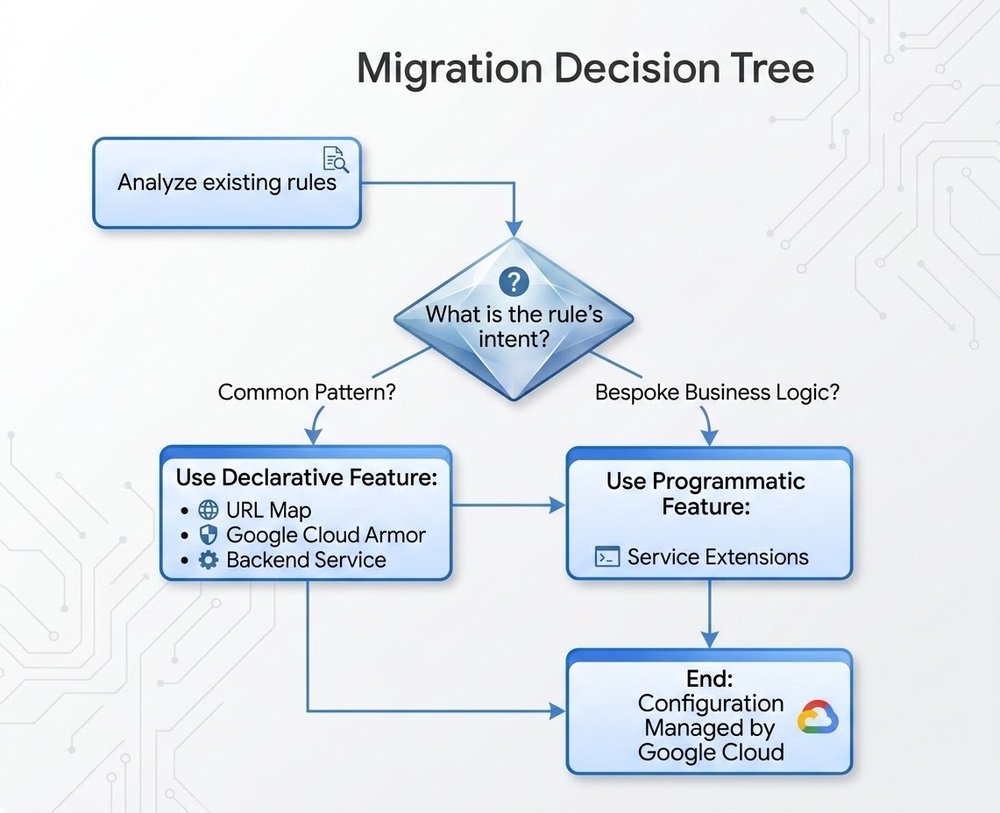
Before commencing any migration, you must understand what you have. Analyze and categorize your current load balancer configurations. What is each rule’s intent? Is it performing a simple HTTP-to-HTTPS redirect? Is it engaged in HTTP header manipulation (addition or removal)? Or is it handling complex, custom authentication logic?
Most configurations typically fall into two primary categories:
-
Common patterns: Logic that is common to most web applications, such as redirects, URL rewrites, basic header manipulation, and IP-based access control lists (ACLs).
-
Bespoke business logic: Complex logic unique to your application, like custom proprietary token authentication, advanced header extraction / replacement, dynamic backend selection based on HTTP attributes, or HTTP response body manipulation.
Phase 2: Choose your Google Cloud equivalent
Once your rules are categorized, the next step involves mapping them to the appropriate Google Cloud feature. This is not a one-to-one replacement; it’s a strategic choice.
Option 1: the declarative path (for ~80% of rules)
For the majority of common patterns, leveraging the Application Load Balancer’s built-in declarative features is usually the best approach. Instead of a script, you define the desired state in a configuration file. This is simpler to manage, version-control, and scale.
Common patterns to declarative feature mapping:
-
Redirects/rewrites -> Application Load Balancer URL maps
-
ACLs/throttling -> Google Cloud Armor security policies
-
Session persistence -> backend service configuration
Option 2: The programmatic path (for complex, bespoke rules)
When dealing with complex, bespoke business logic, you have a programmatic equivalent: Service Extensions, a powerful edge compute capability that allows you to inject custom code (written in Rust, C++ or Go) directly into the load balancer’s data path. This approach gives you flexibility in a modern, managed, and high-performance framework.
This flowchart helps you decide the appropriate Google Cloud feature for each configuration
Phase 3: Test and validate
Once you’ve chosen the appropriate path for your configurations, you are ready to deploy your new Application Load Balancer configuration in a staging environment that mirrors your production setup. Thoroughly test all application functionality, paying close attention to the migrated logic. Use a combination of automated testing and manual QA to validate the redirects, security policies, and that the custom Service Extensions logic are behaving as expected.
Phase 4: Phased cutover (canary deployment)
Don’t flip a single switch for all your traffic; instead, implement a phased migration strategy. Start the transitioning process by routing a small percentage of production traffic (e.g., 5-10%) to your new Google Cloud load balancer. During this initial period, be sure to monitor key metrics like latency, error rates, and application performance. As you gain confidence, you can progressively increase the percentage of traffic routed to the Application Load Balancer. Always have a clear rollback plan to revert back to the legacy infrastructure in the event you encounter critical issues.
Best practices for a smooth migration
Drawing from our practical experience, we have compiled the following recommendations to assist you in planning your load balancer migrations.
-
Analyze first, migrate second: A thorough analysis of your existing configurations is the most critical step. Don’t “lift and shift” logic that is no longer needed.
-
Prefer declarative: Always default to Google Cloud’s managed, declarative features (URL Maps, Cloud Armor) first. They are simpler, more scalable, and require less maintenance.
-
Use Service Extensions strategically: Reserve Service Extensions for the complex, bespoke business logic that declarative features cannot handle.
-
Monitor everything: Continuously monitor both your existing load balancers and Google Cloud load balancers during the migration. Watch key metrics like traffic volume, latency, and error rates to detect and address issues instantly.
-
Train your team: Ensure your team is trained on Cloud Load Balancing concepts. This will empower them to effectively operate and maintain the new infrastructure.
Migrating from the existing on-premises load balancer infrastructure is more than just a technical task, it’s an opportunity to modernize your application delivery. By thoughtfully mapping your current load balancing configurations and capabilities to either declarative Application Load Balancer features or programmatic Service Extensions, you can build a more scalable, resilient, and cost-effective infrastructure destined for future demands.
To get started, review the Application Load Balancer and Service Extensions features and advanced capabilities to come up with the right design for your application. For more guidance and complex use cases, contact your Google Cloud team.