Editor’s note: Fastweb + Vodafone, a leading telecommunications provider in Italy, created its Customer 360 platform to support faster and more personalized customer experiences across channels. By rebuilding serving layers and governance with Google Cloud services like Spanner, BigQuery, and Gemini, the company simplified its architecture and introduced AI-assisted engineering workflows. Fastweb + Vodafone now delivers real-time insights across the organization and is preparing for expanded AI agent use cases in the future.
Following the acquisition of Vodafone Italy by Swisscom in 2025, and looking toward our official merger in January 2026, we saw an opportunity to rethink how we serve our customers.
As a leading telecommunications provider in Italy, we aim to deliver timely, personalized experiences across mobile, broadband, and digital channels. Our team’s job is to give everyone at our business access to the customer insights they need, when they need them. Those insights rely on a robust Customer 360 platform where data from thousands of sources is unified and made available in real-time.
Both companies had already begun modernizing these customer data workflows on Google Cloud, especially with BigQuery. However, combining ecosystems exposed the limits of our existing setup. The architecture required more upkeep than we wanted and didn’t offer the flexibility our unified organization needed. It was time for us to rethink how we served and governed customer data.
Choosing a connected platform, not a single tool
When we stepped back and looked at what Fastweb + Vodafone needed, it was clear we weren’t searching for a single tool. We wanted a connected suite of products that could support real-time serving, stronger governance, and new AI-assisted workflows without adding operational weight.
Figure 1: Architecture diagram for the Customer 360 Serving Layer
We were covered on the warehouse side: BigQuery was already in place and handling core analytical workloads. What we lacked was a serving layer that could match BigQuery’s speed and flexibility while simplifying our architecture. We also wanted tighter integration across the stack so we could more easily surface insights and begin incorporating AI.
Google Cloud brought all these capabilities together in a unified way. With native integrations between products, it was the right choice. We could spend less time connecting systems and more time building the features our business actually needs.
Spanner accelerates serving without the overhead
Giving every channel real-time access to accurate customer data meant finding a serving layer that kept pace with telecom traffic. Spanner was the answer. Spanner delivers low-latency reads, horizontal scalability, high availability, and a fully managed environment with zero ops overhead.
Spanner’s native integration with BigQuery was the real game-changer. Before Spanner, we relied on several custom layers built solely to move warehouse data into downstream systems. But the direct interoperability between Spanner and BigQuery has made most of that complexity disappear. With Spanner as the front-end serving layer, we were able to migrate ten applications in two weeks.
Spanner also transformed how we monitor and maintain our workflows. Four separate monitoring processes collapsed into a single view, making troubleshooting and optimization far faster. And with Apigee exposing Spanner data to the call center, digital channels, and partner systems, the improvements were felt across the entire organization — not just within engineering.
Making sense of thousands of data flows
With Spanner in place as our serving layer, the next challenge was making sense of the thousands of batch and real-time ingestion flows that power Fastweb + Vodafone Data platform. Understanding how data moves across these pipelines is essential for quality, compliance, and day-to-day engineering. We needed something faster and far more intuitive than our previous solution.
Spanner’s multi model capabilities gave us that foundation.
Spanner Graph allowed us to map lineage in a way that reflects how our platform actually works: which tables drive specific jobs, how transformations cascade, and where dependencies sit. From there, vector search and full-text search added a richer discovery layer. This made it easier to surface results quickly, even in a large and complex ecosystem.
Together, these features gave us the governance experience we wanted — not only more accurate, but much easier for engineers and analysts to work with.
Figure 2: Spanner’s Graph model allowed us to rapidly build a scalable, easy-to-navigate visualization of complex data lineage for improved Data Governance
Effortless documentation
We also wanted to make development smoother across our organization’s large and varied codebase. Many services had limited documentation, especially older systems that had evolved over time. Gemini helped us close those gaps.
With Gemini, our teams can generate clear documentation directly from the code, which saves hours of manual work. We store this output in Spanner as vector embeddings, which creates a searchable knowledge base that grows alongside our platform.
To make that knowledge even easier to use, we built a chat interface powered by Gemini. Developers can ask natural-language questions — say, about a function or how a change might ripple through the system — and get a context-aware answer in seconds. It’s a far more intuitive way to explore the codebase and reduces the time spent deciphering legacy logic or chasing down subject-matter experts.
Figure 3: Code Documentation augmentation and search with Gemini and Spanner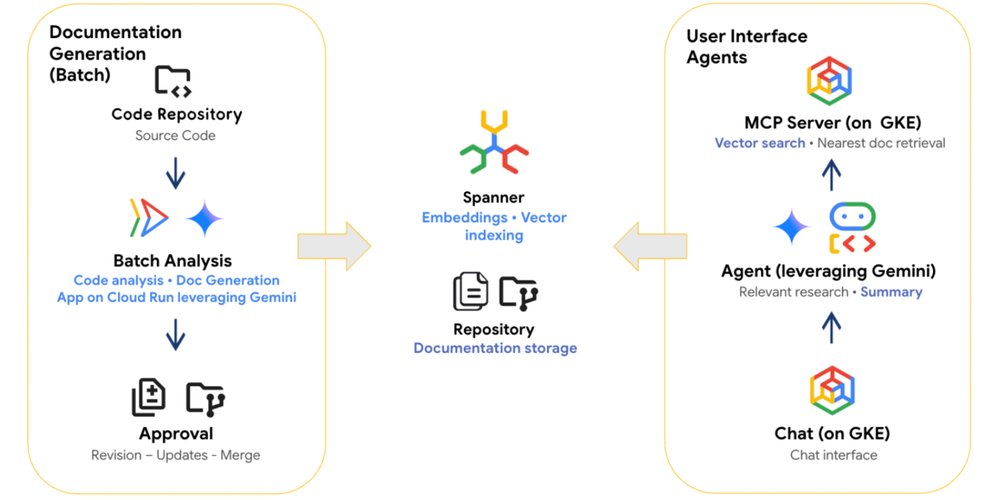
This AI-assisted workflow is now a regular part of how we build. It speeds up onboarding and gives us a scalable way to improve productivity even as our systems evolve.
Engineering at the speed of business
Rebuilding our Customer 360 platform with Google Cloud services has already changed how Fastweb + Vodafone works.
Workflow monitoring is simpler, pipelines are leaner, and real-time serving is now the norm.
The gains from this work are also visible across the business: Call centers now see more complete, up-to-date customer information, digital channels can rely on consistent data without custom integrations, and partners can access what they need with low latency through Apigee. Together, it all creates a smoother, more personalized customer experience — exactly what we imagined at the start of this process.
And we’re just getting started. We are now exploring Spanner Graph capabilities to better understand customer relationships through householding and social indexing. We also see more potential for AI agents to help teams improve analysis and decision-making.
Google Cloud didn’t just simplify our engineering – it changed how our entire organization operates.
Learn more:
-
Explore Spanner, a fully managed relational database for global-scale workloads, and the power of Spanner Graph!
-
Learn how BigQuery simplifies analytics with built-in performance and scalability.
- Bring AI assistance into engineering workflows with Gemini for Google Cloud.