“How will this look on me?” It’s the question every online fashion shopper asks, and one that most retailers still can’t answer well.
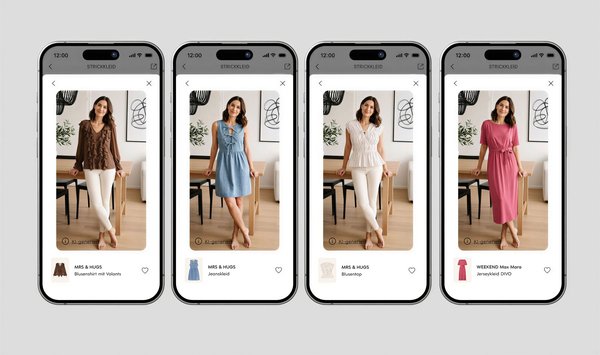
Breuninger, a fashion and lifestyle company based in Germany, thought emerging generative media models could be a good fit for this fashion conundrum. Working with Google Cloud, they built a virtual try-on experience that lets shoppers see high-end fashion on their own bodies using a simple selfie.
From trusted tester to live product
The project began when the Google Cloud team in Germany invited Breuninger to join the Trusted Tester Program for the Virtual Try-On (VTO) API. Breuninger’s data team in Germany worked directly with Google’s engineers in California, testing and refining the technology in three stages:
-
Catalog enrichment: The team first explored the VTO API to dress professional models in different outfits. This helped Breuninger to cover a greater variety in user tests without having to plan new photoshoots.
-
Body type selection: They then added a feature that let users choose from different body types to see how clothes would drape on a silhouette similar to their own.
-
The ‘Be your own model’ breakthrough: User feedback showed that customers did not just want to see a model; they wanted to see themselves.
The product owner at Breuninger noted that this close collaboration allowed the team to share user feedback with developers in real time. This speed helped them move from using pre-selected models to a user-first, selfie-based approach.

Three levels of virtual try-on
The project revealed three levels at which retails can adopt VTO, depending on how much personalization they want to offer:
|
Approach |
Interaction |
Use case |
|
Level 1: Catalog enrichment |
Offline batch processing |
Dress standard models in new collections at scale to update product pages without manual shoots. |
|
Level 2: Body type selection |
Online on-request |
Offer predefined models for users to choose from, similar to the virtual try-on feature on Google Shopping. |
|
Level 3: ‘Be your own model’ |
Online personalized |
The most personal experience where users upload a selfie to see themselves in specific items or full outfits. |
Building for scale with Flutter
Scaling a personalized experience required more than just an AI model. Selfies come in wildly different lighting and quality, so the team built preprocessing tools to make sure the final images met Breuninger’s brand standards. This project also accelerated Breuninger’s move to a Flutter-based platform. The VTO feature was the first module built by a self-sufficient product team using this new structure, which helped the team move from a vision to a live launch in only three months.
Real results during the holiday season
During a six-week A/B test over Black Week and the holiday season, the team found that shoppers who used the virtual try-on converted at a higher rate and generated a stronger contribution margin than those who didn’t. Customer surveys reinforced the numbers: shoppers responded well to the high image quality and the personalized experience. Perhaps most telling, the team found that VTO became a tool for building style confidence — helping customers feel sure about a purchase before they made it.

What’s next
The pilot’s success has set up a broader rollout and international expansion, with physical fit and sizing support on the roadmap. Breuninger continues to refine the experience based on how customers actually use it in everyday shopping — the same user-first approach that shaped the project from the start.
To explore how generative AI can help your business create similar experiences, visit Google Cloud’s Virtual Try-On solution. You can also try the feature yourself in the Breuninger app.
This work wouldn’t have been possible without the contributions from peers at both Breuninger, and Google Cloud. Thanks to Markus Peetz, Jorina Hilser, Martin Csengeri, Jay Deutinger, Sofia Widmayer, David Schowalter, Tobias Götze, Eric Karge, Abdul Mateen, Besnik Brahimi, Oliver Fesseler, and Lisa Beutner from Breuninger, and Khanh LeViet, Jorj Ismailyan, and Matt Chaban from Google Cloud.