As AI applications scale from reactive bots to autonomous agents, their reliability is bound to the speed and accuracy of the data layer beneath them.
The integrity crisis nobody is talking about
There’s a quiet assumption baked into most AI architectures today regarding data layer consistency, and it’s costing companies more than they realize. The assumption is that the data your AI agent reads is the current state of reality.
In a world of distributed systems, cross-region replication, and autonomous agents making millisecond decisions, this assumption breaks down.
I’ve spent extensive time working with enterprise teams building agentic AI, and a recurring failure pattern emerges.
The breakdown isn’t in the model or the prompts. It’s in how we manage replication consistency when an agent performs the reading.
The context window is the new database row
In a modern agentic Retrieval-Augmented Generation (RAG) architecture, the database is the active memory of your AI. When an agent performs a task, it retrieves data to build its context window, forming the foundation of the large language model’s (LLM) reasoning.
If that data is even slightly out of date, the agent’s entire reasoning chain is invalidated. We must shift from simply managing data availability to strictly verifying contextual integrity.
The silent poison of asynchronous lag
In traditional web applications, asynchronous replication scales global reads with minimal write impact. If a user sees a post 500ms late, nobody notices.
For an autonomous AI agent, a 500ms delay is silent poison. If an agent writes a decision to a primary node and immediately reads from a lagging replica, it treats stale data as ground truth. It then executes a logically coherent, multi-step plan based on factually incorrect inputs.
In the age of AI, a fast answer that is wrong is more expensive than a slightly slower answer that is right.
The anatomy of a stale-read failure: When memory betrays logic
Consider an autonomous Inventory Reconciliation Agent managing a flash sale:
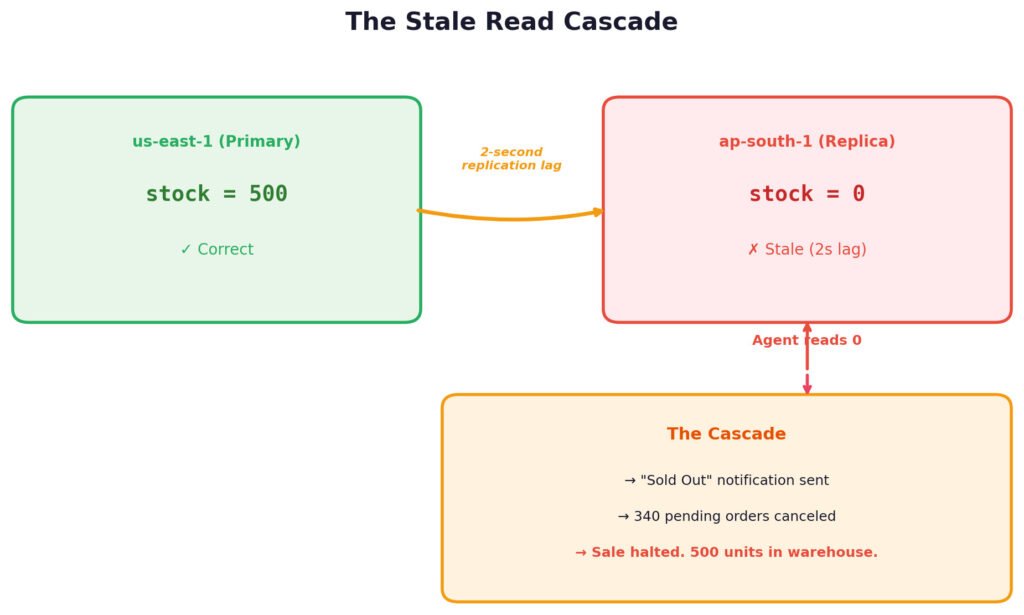
- The write: The agent updates
available_stockto 500 units on the primary database inus-east-1. - The lag: Network congestion causes a 2-second replication lag to the
ap-south-1(Mumbai) replica. - The read: A secondary agent instance in Mumbai queries the replica and retrieves the old value: 0 units.
- The failure: The agent triggers a “Sold Out” notification and halts the sale, despite having 500 units in the warehouse.
The agent didn’t make a reasoning error. It performed logical operations on poisoned context.
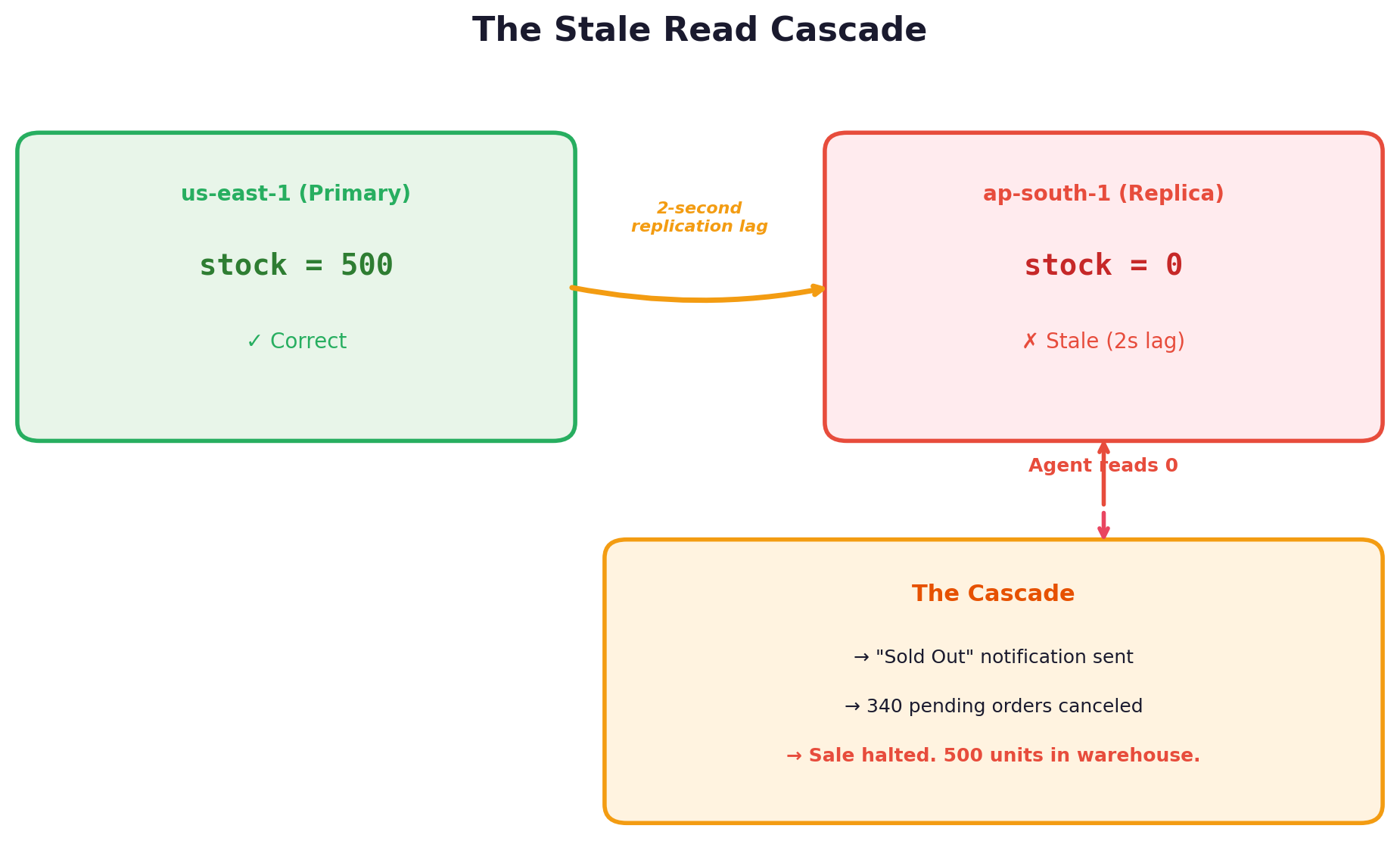
Figure 1: The stale read cascade, showing how replication lag poisons an AI agent’s context
The hallucination debt problem
When an agent writes an incorrect conclusion back to the database, that error becomes long-term memory. Future retrievals pull this poisoned history, creating a self-reinforcing cycle of “Hallucination Debt.”
LLMs amplify this because they lack a temporal compass. They cooperatively treat retrieved database results as current facts without hesitation. The burden of verifying contextual integrity falls entirely on the architecture.
The replication trinity: Choosing your truth
Not all AI tasks have the same consistency requirements. You must match your replication model to the specific “truth requirement” of the task.
Here are three architectural patterns I’ve found most effective.
Pattern A: Precision through global consistency
When an agent manages high-stakes data (user permissions, security policies, financial records, core system instructions), the cost of a stale read is unacceptable. You need strong consistency.
For many workloads, Amazon Aurora Global Database provides the necessary foundation. While its cross-region storage replication is asynchronous by default, you can close the consistency gap by turning on Global Write Forwarding with a GLOBAL consistency level.
To verify Read-Your-Own-Writes integrity, you configure the SESSION consistency level, which makes an agent wait for its own forwarded writes to replicate back before reading.
For the strongest consistency, the GLOBAL level makes a read query wait for replication to catch up to the exact point in time when the read started.
For the next generation of globally distributed AI, Amazon Aurora DSQL addresses this need. Aurora DSQL offers native synchronous strong consistency across multiple regions, so multi-agent systems can scale globally without compromising accuracy.
Every agent, regardless of location, operates on the exact same ground truth.
Best for: Identity metadata, financial ledgers, immutable system prompts.
Why it matters: Eliminates “mid-thought” state changes that cause contradictory behavior between agent instances.
Pattern B: Global availability at scale
For global AI agents that need ultra-low latency at massive scale, Amazon DynamoDB Global Tables offer a multi-leader architecture where data replicates across regions. For replication details, refer to the DynamoDB documentation.
The key technique here is Conditional Writes. By using a ConditionExpression that checks a version timestamp or whether an attribute exists, an agent updates a record only if the data hasn’t changed since it was last retrieved.
If the condition fails, DynamoDB returns a ConditionalCheckFailedException. This is a critical signal: it tells the agent to re-read the current state and reconsider its decision, rather than blindly overwriting another agent’s work.
This pattern prevents the “Lost Update” anomaly (where two agents running in parallel overwrite each other’s reasoning) without requiring synchronous global coordination.
Best for: Conversational history, user session state, personalized agent memory.
Why it matters: Handles concurrent updates from distributed agents while maintaining a shared memory that’s resilient to race conditions.
Pattern C: High-velocity intake
Some AI agents perform real-time anomaly detection or trend analysis on massive streams of telemetry data. In these cases, you need unthrottled ingestion above all else.
A leaderless architecture like Amazon Keyspaces (for Apache Cassandra) is designed for this workload.
Keyspaces provides highly available, predictable performance by automatically replicating data across three Availability Zones.
Every write is durably committed using LOCAL_QUORUM.
To make sure your AI agent doesn’t miss a critical spike in telemetry, you enforce strong consistency by setting its read operations to LOCAL_QUORUM rather than the eventually consistent LOCAL_ONE.
This quorum overlap means the agent retrieves the latest data without slowing down the high-speed ingestion pipeline.
It transforms a noisy, high-frequency data stream into a reliable foundation for real-time AI decision-making.
Best for: Internet of Things (IoT) telemetry, real-time log analysis, high-frequency sensor data.
Why it matters: Throughput is the priority, but you still need a safety valve to confirm the agent doesn’t miss critical spike data.
Conclusion: Becoming a context architect
Our role as architects has evolved.
We can no longer treat database replication as a background infrastructure concern, something to configure once and forget. In the era of autonomous agents, the stability of the data layer is the direct prerequisite for the trustworthiness of the AI. The two are inseparable.
By matching your replication model to your agent’s reasoning requirements, you move beyond simply managing data. You become a Context Architect, someone who works to confirm that every decision your AI makes is grounded in a synchronized version of the truth.
Because in the end, an AI is only as good as the context it operates in. And context is only as good as the data it’s built on.
Get the database layer right, and everything else follows.
References: