The integration of AI into real-world applications has long been hindered by a fundamental challenge: the disconnect between systems that can see, systems that can think, and systems that can act. Developers have struggled with complex integrations, managing multiple APIs, and creating custom solutions to bridge these gaps, resulting in inefficient, costly, and often fragile implementations.
We are converging the three key technologies: Computer Vision, Strands Agents, and the Model Context Protocol (MCP). Together, they create a pipeline where visual information can be captured, understood, and acted upon within a unified framework. This integration reduces the traditional barriers between perception, decision-making, and action, letting AI systems operate more like human intelligence by seeing, understanding, and responding in a coordinated way.
In this post, we walk you through the Computer Vision MCP Server, which illustrates this approach, representing how AI systems can process visual information and make intelligent decisions through a single, standardized interface. This convergence transforms what was once a complex integration challenge into a streamlined process, making AI capabilities accessible to a broader range of applications and developers.
Solution overview
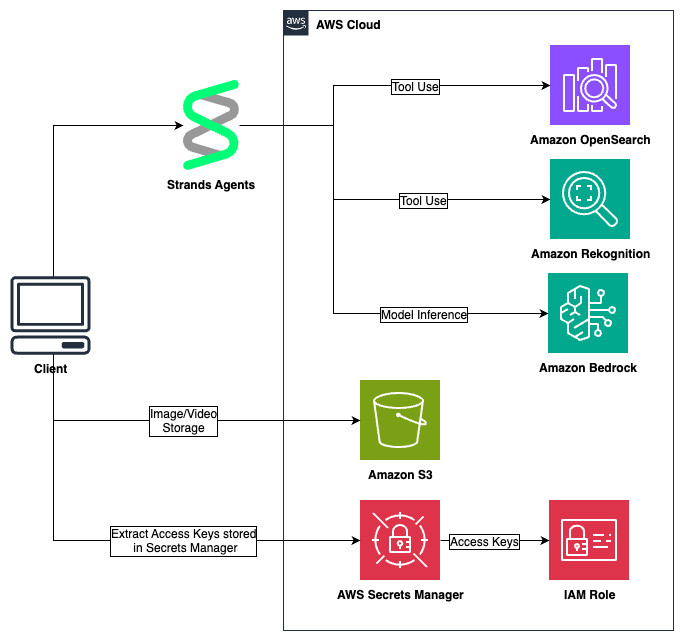
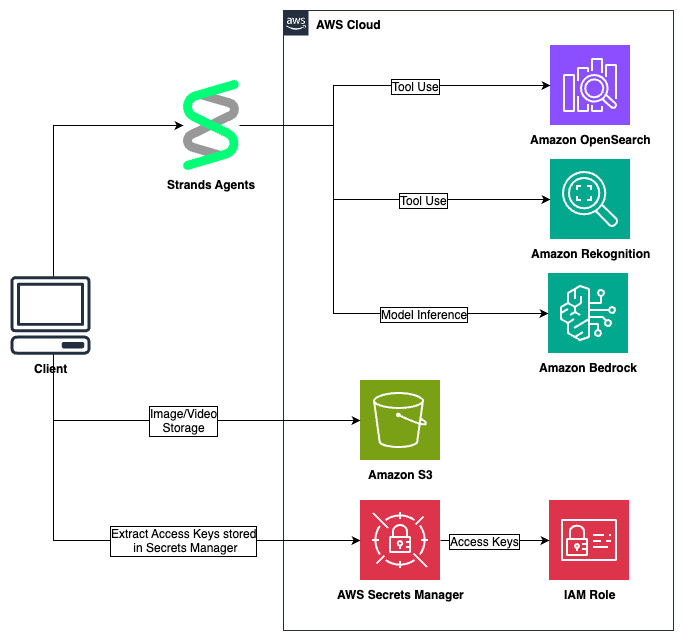
In our architecture, the client interacts with multiple Amazon Web Services (AWS) through a centralized AWS Identity and Access Management (IAM) role, which serves as the security gateway for managing permissions. Amazon Simple Storage Service (Amazon S3) handles object storage to retrieve and manage data. Amazon OpenSearch provides search capabilities for querying the indexed data. Amazon Bedrock offers generative AI models, granting the client access to AI tools for tasks like text generation for the agent. Finally, Amazon Rekognition specializes in image analysis, performing functions such as object detection. The architecture emphasizes a unified security model, where the IAM role centralizes permission management, which removes the need for embedded credentials in the client and streamlines controlled access across multiple AWS services.
Computer vision, Strands Agents, and MCP servers
The solution uses three main technologies. Computer vision focuses on processing visual information such as photos and videos. Strands Agents is a framework for building AI agents that supports multiple model providers and deployment targets, offering a customizable agent loop with production capabilities including observability, tracing, and scalable deployment. Lastly, the Model Context Protocol (MCP) is a standard designed to simplify how AI systems integrate with tools and data sources, replacing the process of building separate connections for each AI model and data source pair.
User interface (MCP client)
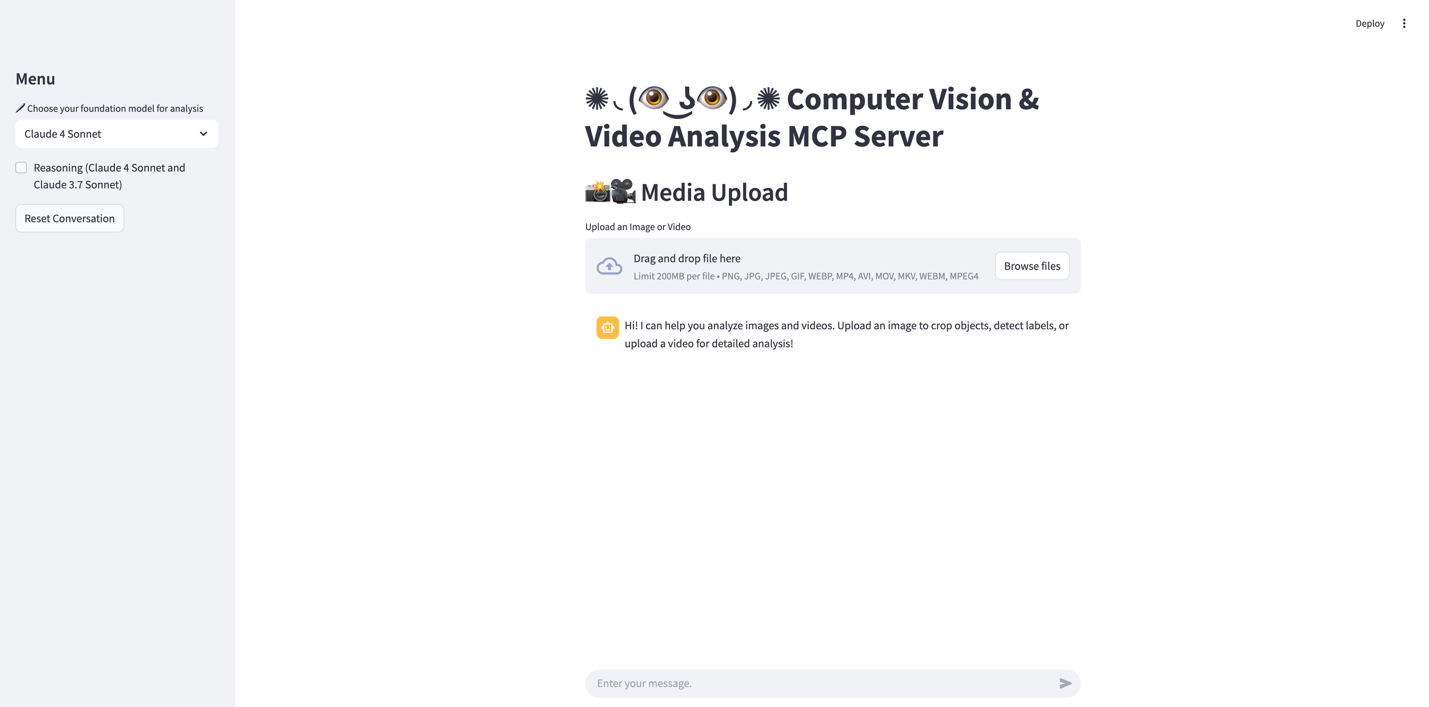
The interface features a Streamlit chat UI. On the left side, there’s a menu panel where users can select their preferred foundation model for analysis, defaulted to Claude 4 Sonnet with reasoning capabilities that include both Claude 4 Sonnet and Claude 3.7 Sonnet options. Users also can reset their conversation history through a dedicated button in this sidebar.
To use this application, users can upload their visual content through the prominent Media Upload section in the center of the interface. The system accepts both images and videos, supporting a wide range of formats including PNG, JPG, JPEG, GIF, WEBP for images, and MP4, AVI, MOV, MKV, WEBM, MPEG4 for videos, with a maximum file size limit of 200 MB. Users can either drag and drop their files directly into the designated upload area or select Browse files to manually select files from their device. After the media is uploaded, the AI system can perform various analysis tasks such as object cropping, label detection, and detailed content analysis. Users can then interact with the system through the message input field at the bottom of the interface, asking specific questions about their uploaded media or requesting types of analysis.
The following is the system prompt used by the agent:
Computer vision MCP servers
Our implementation is composed of two servers namely the CV server and the OpenSearch server. Each handles different types of requests as described in the following section.
CV server
The AWS Computer Vision MCP server provides a unified interface for image and video analysis by consolidating three Amazon AI services into a standardized protocol. This integration lets AI agents access and process visual content through a consistent API, which streamlines the development of computer vision applications. The following tools are available in the MCP server:
- The
describe_imagetool uses the Claude model in Amazon Bedrock to provide image analysis based on specific monitoring instructions. This function retrieves images from Amazon S3 storage and processes them through Claude’s multimodal capabilities to support AI-powered interpretation of visual content. It’s useful for scenarios requiring descriptions, or specific attribute identification within images, returning analysis results along with status information.
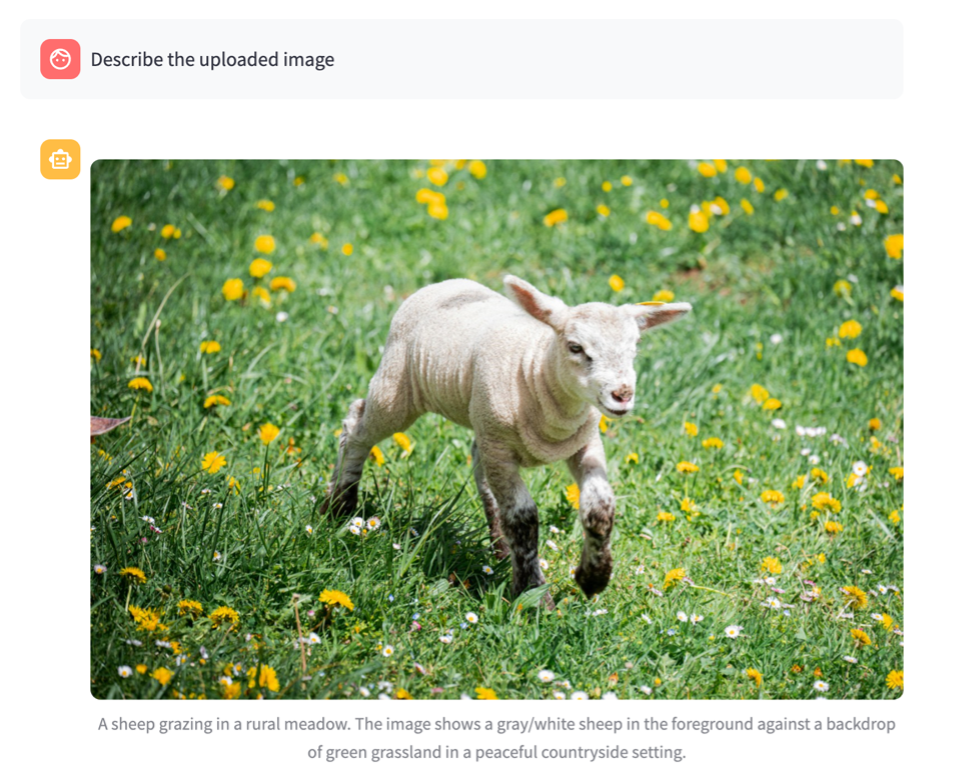
Agent Response: I’ll help you describe the uploaded image. Let me analyze it first using the computer vision agent. Now I’ll display the image with the description:
Image Description
The uploaded image shows a rural outdoor scene featuring:
- A sheep in the foreground (detected with 99.07% confidence)
- The sheep appears to be grazing in a meadow or pasture
- The sheep has predominantly gray/white coloring
- The setting is a grassland/meadow environment
- The background consists of green fields typical of countryside or pastoral landscapes
- The scene has natural outdoor lighting
The image captures a peaceful rural scene with the sheep positioned in the center of the frame against the backdrop of green meadows. The dominant colors are various shades of green in the background (representing the grassland) and gray/white tones of the sheep in the foreground.
This is a nature photograph capturing livestock in its natural pastoral environment, showing the sheep grazing in an open field.
The following code snippet from the describe_image tool represents the overall structure of a tool:
- The
analyze_videotool uses Amazon Nova video analysis capabilities to process video content. This function handles video files stored in S3 and can analyze them according to specific instructions.
Uploaded Video:

User: Analyze the uploaded video
Agent Response: I’ll help you analyze the uploaded video. Let me delegate this task to the computer vision specialist.
l’ve analyzed your uploaded video (15dc6b31_19642406-uhd_3840_2160_30fps.mp4) and here’s what I found:
Content Description
- The video features a close-up view of a plant (likely a type of grass) covered in snow
- It’s set in a field on what appears to be a sunny winter day
- The background is intentionally blurry, creating a natural depth of field effect that draws attention to the main subject
Visual Elements
- There’s a striking visual contrast between the white snow and the natural green elements of the plant
- The snow is distributed unevenly across the plant’s long, thin leaves
- The snow appears to be melting slightly, suggesting mild temperatures
- The
detect_labelstool integrates with Amazon Rekognition to provide label detection and image property analysis. It offers control over detection parameters, including confidence thresholds, maximum label counts, and custom label filters. The tool can identify objects, scenes, and activities within images while providing detailed bounding box information for spatial localization.
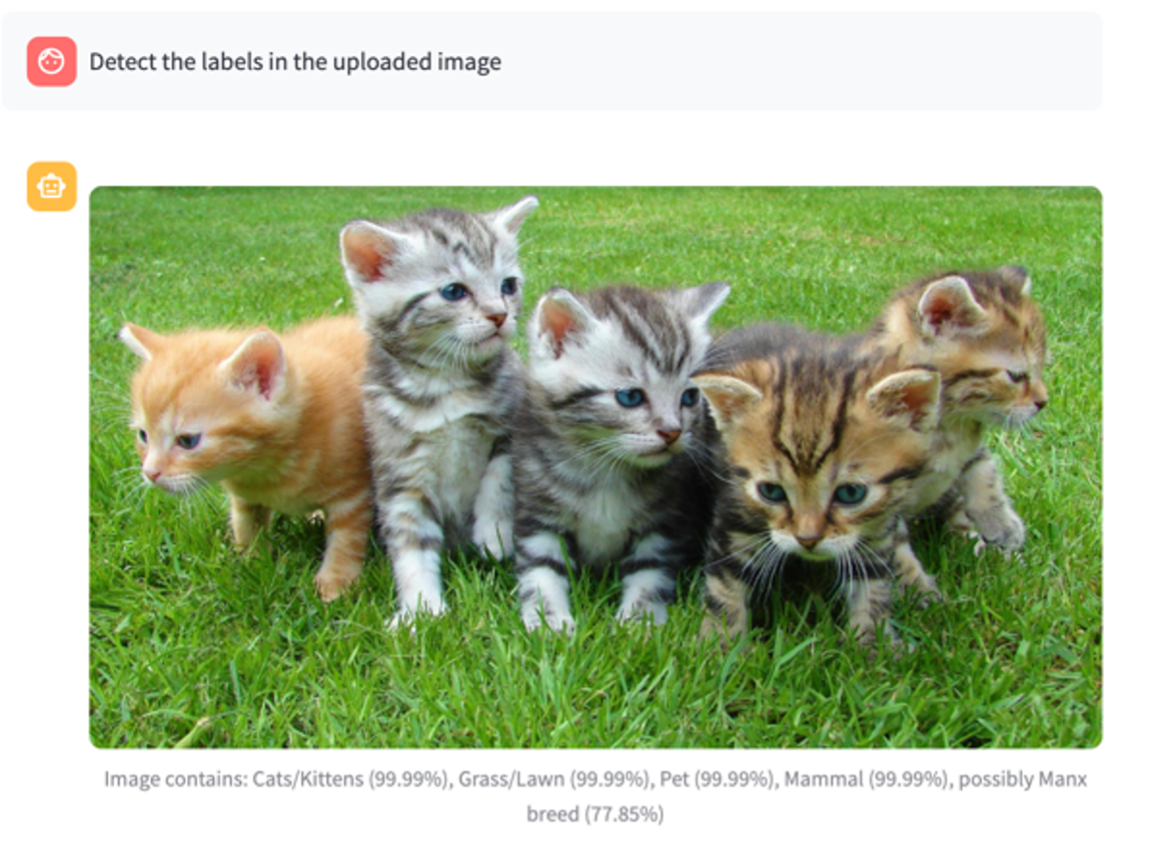
Agent Response: I’ll help you detect labels in your uploaded image. Let me analyze it using the computer vision specialist.Now that I’ve analyzed the image, let me display it with the detected labels:## Image Label Detection Results
The computer vision analysis detected the following labels in your image:
Main Labels (with confidence scores):
- Animal (99.99%)
- Cat (99.99%)
- Kitten (99.99%)
- Mammal (99.99%)
- Pet (99.99%)|
- Grass (99.99%)
- Plant (99.99%)|
- Lawn (95.56%)
- Manx (77.85%)
Details:
- The image contains 5 cats/kittens (detected with individual bounding boxes)
- The cats appear to be on grass/lawn
- One of the cats may be a Manx breed (77.85% confidence)
- The dominant colors include various shades of gray, green, and brown
The image primarily shows multiple kittens or cats relaxing on a grassy lawn area.
- The
crop_bounding_boxutilizes Amazon Rekognition for its object detection features. When using Amazon Rekognition for cropping, the service first analyzes the image to identify key elements such as faces, objects, or text, then provides precise bounding box coordinates that can be used to intelligently crop the image.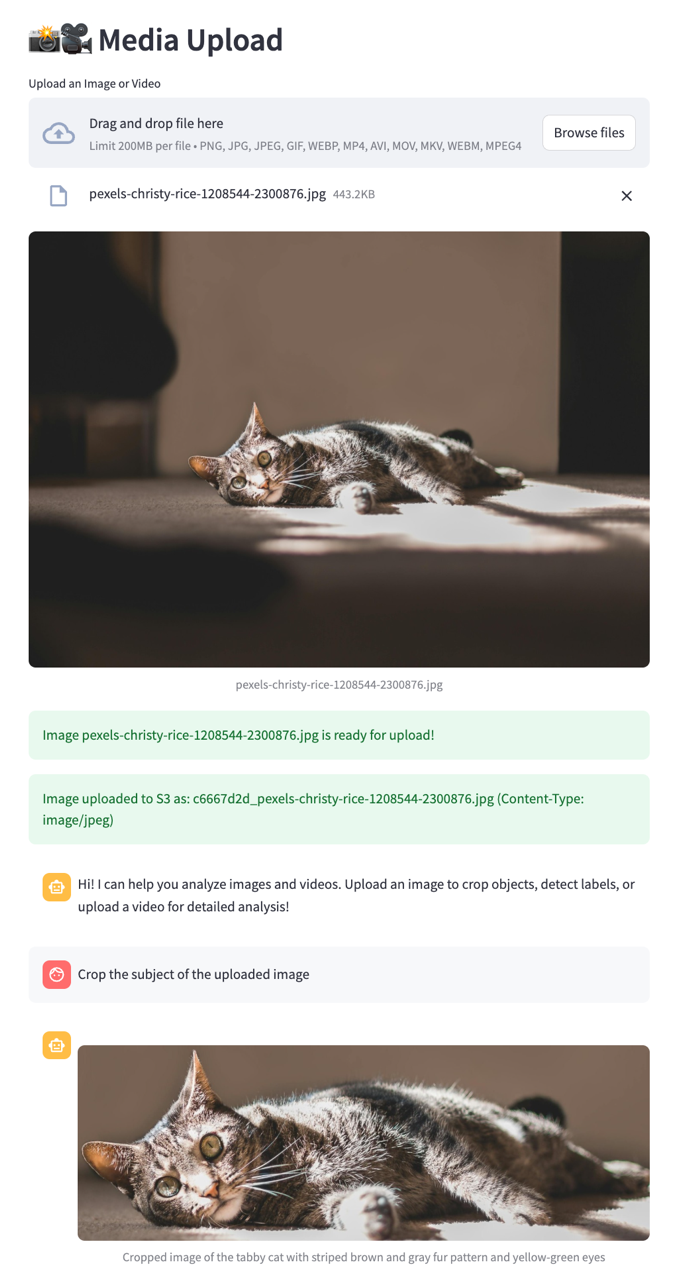
- The
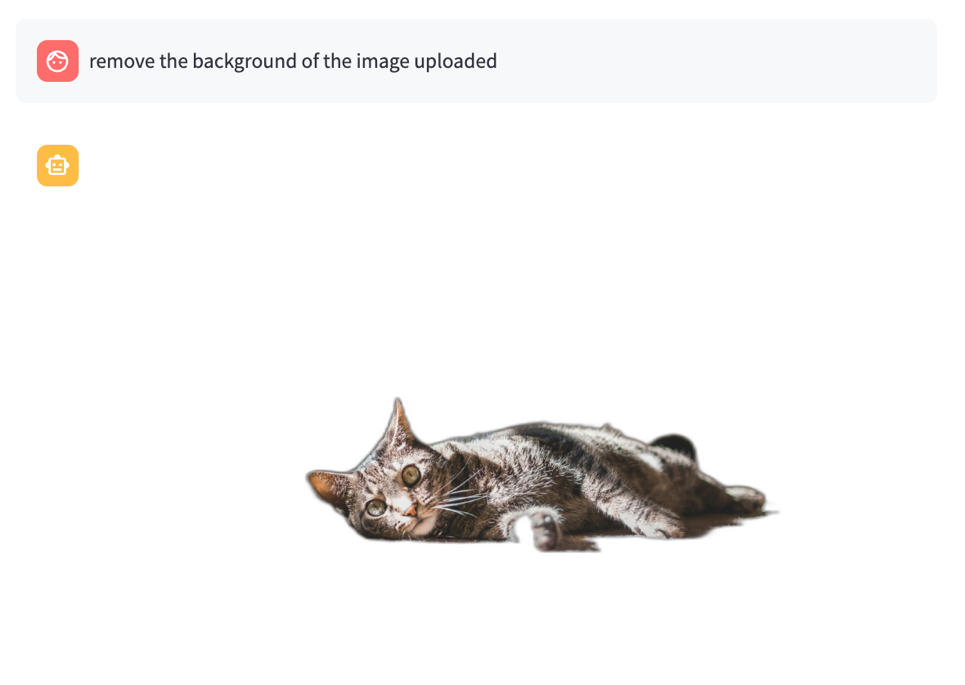
remove_backgroundtool uses the rembg library which is a solution for background removal from images without requiring complex setup or extensive machine learning (ML) expertise.
OpenSearch server
The OpenSearch MCP server provides a unified interface for the ingestion and retrieval of images. The following tools are available in the MCP server:
- The
generate_image_descriptiontool uses the Amazon Bedrock Claude models to analyze images and generate natural language descriptions. It processes images by first converting them into a format compatible with Claude’s multimodal capabilities, then generates detailed, contextual descriptions based on the visual content. - The
generate_multimodal_embeddingtool uses the Amazon Titan multimodal models to create high-dimensional vector representations (embeddings) that capture both visual and textual information. These embeddings encode semantic relationships between images and text in a shared vector space, which supports similarity comparisons and cross-modal retrieval tasks. - The
ingest_image_to_opensearchtool provides an end-to-end pipeline for processing and storing images in OpenSearch. It combines the capabilities of image description generation and multimodal embedding creation, then indexes this information in OpenSearch with appropriate metadata. - The
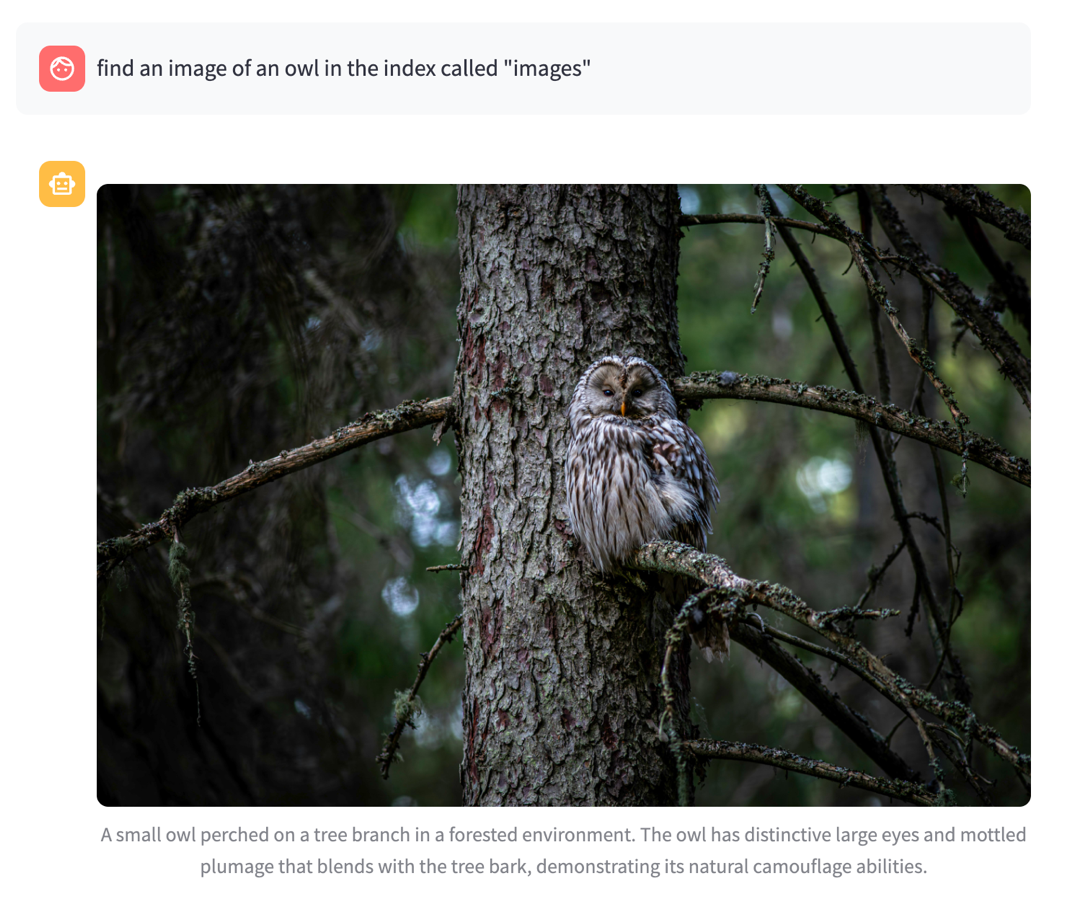
query_images_by_texttool supports natural language search across image collections by using the multimodal embeddings stored in OpenSearch. Users can search for images using text queries, which are converted into embeddings and compared against the stored image embeddings to find the most semantically similar matches.
- The
query_images_by_imagetool implements image-based search functionality, allowing users to find similar images by using an image as the query input. It processes the query image to generate its embedding and then performs similarity searches against the stored image embeddings in OpenSearch.
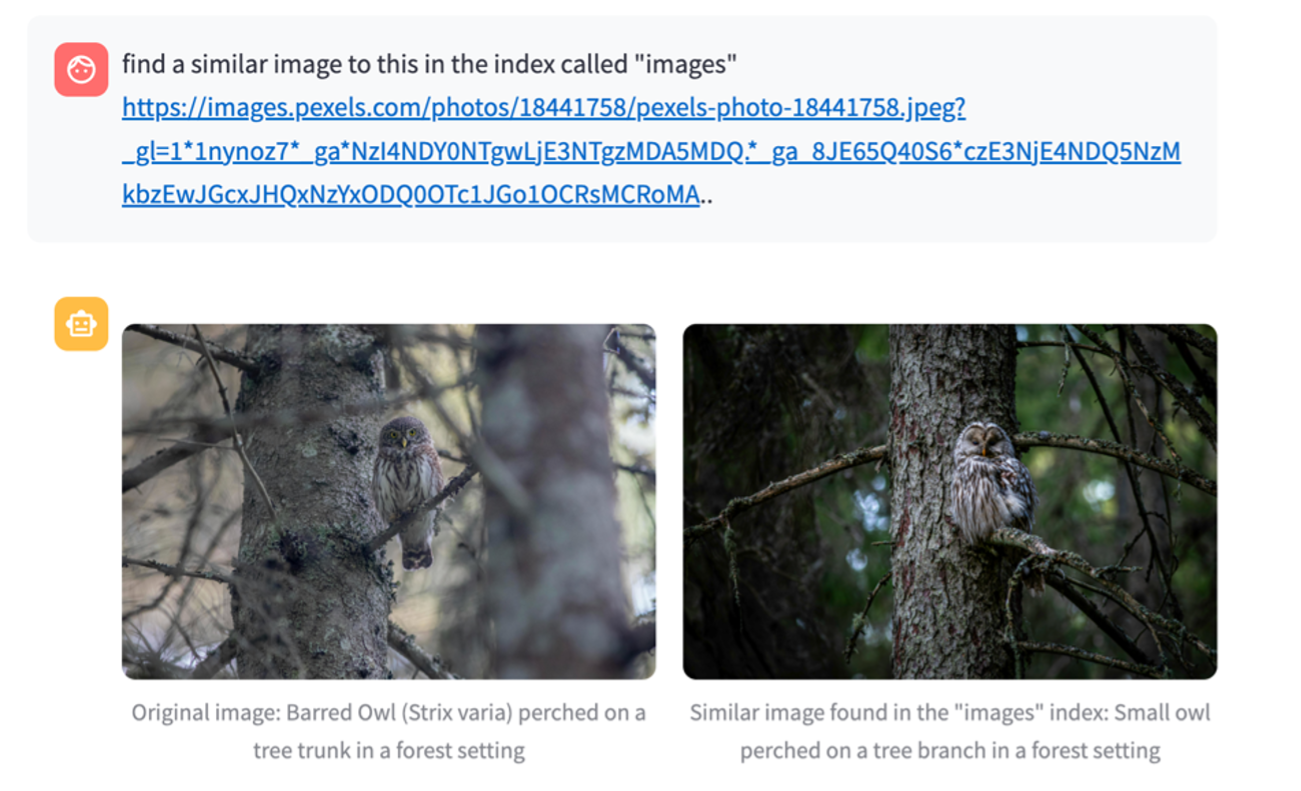
Agent Response: I’ll help you find similar images to the one you provided in the “images” index. Let me analyze this image first and then search for similar ones. Based on the search results, I found one similar image in the “images index that matches your query. Let me show you both the original image and the similar one I found:l’ve found a similar image to the one you provided in the”images” index.
Here’s what I found:
- Original Image: A Barred Owl (Strix varia) perched on a tree trunk in a forest setting. The owl has distinctive large eyes and mottled plumage that creates effective camouflage against the tree bark.
- Similar Image Found: Another owl image showing a small owl perched on a tree branch in a forest environment. This owl also has large, alert eyes and fluffy feathers that help it blend with its woodland surroundings.
The similarity score between these images is 0.65 (on a scale where higher is more similar), indicating a good match based on the visual elements and context of both images. Both photos capture owls in their natural forest habitat with similar composition and subject matter.
Would you like me to search for more similar images using different keywords, or would you like more information about either of these owl images?
- The
bulk_ingest_imagestool provides batch processing capabilities for large-scale image ingestion. It optimizes the process of generating descriptions and embeddings for multiple images simultaneously, managing parallel processing and resource utilization.
Setup and dependencies
Now that we’ve gone through the different features of the application, we will now walk through the deployment process. To get started, make sure you have the following installed:
- AWS Command Line Interface (AWS CLI)
- Active AWS account
- Python
To deploy the solution please follow the README found in the GitHub repository.
Click here to open the AWS console and follow along.
Use case extensions
The Computer Vision MCP servers have many applications including but not limited to the ones mentioned below:
Use case 1: Computer vision pipeline
The Infrastructure-less Computer Vision Pipeline offers an approach to implementing visual analysis capabilities without the traditional complexities of setting up and maintaining extensive infrastructure. This setup lets developers perform tasks such as generating bounding boxes for detected objects, creating detailed image descriptions, and analyzing video content, all without the need for dedicated servers or complex management systems. The Inline Agent serves as the orchestrator, efficiently coordinating with the MCP Server to access a suite of computer vision tools. This streamlined approach removes the need for server management and infrastructure maintenance. It also offers the advantages of a pay-per-use model and rapid deployment. As a result, developers can quickly implement robust computer vision pipelines with minimal overhead, focusing their efforts on using the technology rather than managing its underlying infrastructure.
Use case 2: Intelligent image cataloging with embeddings
The Intelligent Image Cataloging system improves traditional image search by implementing embedding-based similarity algorithms that support semantic understanding of visual content. By generating and storing image embeddings in a vector database, this solution transcends the limitations of conventional keyword-based searches, allowing for context-aware image retrieval. The system uses AI models to create rich embeddings that capture the semantic essence of images, letting users find visually similar content even when exact keyword matches aren’t available. This approach creates a scalable cataloging system that understands visual relationships and context, making it particularly valuable for large image collections where traditional search methods fall short. The resulting application offers intuitive similarity searches that can identify related images based on visual characteristics, compositional elements, and semantic meaning, providing a more natural and effective way to organize and retrieve visual content.
Use case 3: Visual memory database for contextual reasoning
The Visual Memory Database for Contextual Reasoning represents a fusion of computer vision and semantic understanding, combining the strengths of infrastructure-less CV pipelines with embedding-based similarity search. This system processes scenes to extract objects and their bounding boxes, generates embeddings for each element, and stores them with rich metadata including temporal and spatial information. This approach supports contextual reasoning across multiple cameras and time periods, allowing for complex queries and insights. The system excels in applications such as security monitoring, people tracking, and comprehensive scene understanding, offering temporal reasoning capabilities that can identify patterns and anomalies. It can answer nuanced questions about individuals, their associations, and object presence in specific areas, while also integrating with video monitoring agents to build a contextual visual memory. This integration facilitates features like suspicious activity detection and historical pattern analysis, creating a dynamic and intelligent visual understanding system that goes beyond simple object recognition to provide deep, context-aware insights.
Clean up
To avoid ongoing charges, complete the following cleanup steps:
- Empty the S3 Bucket.
- Delete the AWS CloudFormation stack.
Conclusion
By integrating the powerful AI capabilities of Amazon Bedrock with standardized MCP protocols, we’ve demonstrated how modern computer vision applications can be both sophisticated and accessible. The three use cases demonstrate the practical applications of this unified approach. This integration addresses challenges in the field by reducing infrastructure complexity through serverless architectures, semantic understanding, contextual reasoning capabilities, and offering standardized interfaces that simplify development and deployment.
The combination of standardized protocols, powerful AI models, and flexible deployment options positions this solution as a foundation for the next generation of visual intelligence applications. As AI continues to evolve, the principles demonstrated here, namely standardization, accessibility, and integration, will become increasingly important in building practical, scalable solutions that bridge the gap between visual perception and intelligent action. This marks not just a technical achievement, but a fundamental shift in how we approach the development of AI-powered visual systems.
We’d love to hear how you’re using the Computer Vision MCP servers. Share your use cases and questions in the comments.