Organizations running on-premises workloads often face a difficult choice when moving to the cloud: how to modernize without losing the architectural consistency their business depends on. If you use Red Hat OpenShift, you have a way to bridge these environments without the risk of a forced re-platforming. Google Cloud provides a secure, reliable, and high-performance home for OpenShift, offering global scale and unique cost-optimization integrations. Building on this strong foundation, today, we are announcing several updates to our work with Red Hat—including Google Cloud Cluster Services for Red Hat OpenShift, a new console experience, and the general availability of OpenShift Virtualization on OpenShift Dedicated—to help you run containerized and virtualized workloads on Google Cloud’s high-performance infrastructure.
Optimizing costs with Google Cloud infrastructure
Google Cloud’s global infrastructure is built for performance, scale, and efficiency, providing a world-class foundation for your most critical applications. This same innovative infrastructure offers significant advantages when deploying Red Hat OpenShift. Hundreds of enterprise customers such as Deutsche Börse, Kohl’s, Salling Group, Amadeus or UPS run production workloads on Red Hat OpenShift on Google Cloud to take advantage of our reliability and security. By moving to Google Cloud, you can use built-in technology to reduce your total cost of ownership (TCO) and match your infrastructure precisely to your workload needs:
-
Custom machine types: You can tailor CPU and memory to your specific requirements, which helps you avoid paying for unused resources in pre-packaged instances.
-
Hyperdisk storage pools: You can scale performance and capacity separately, allowing you to optimize costs across many volumes at once.
-
Axion processors: You can use Google’s custom ARM-based processors to achieve improved price/ performance and better energy efficiency.
The financial impact of these tools is clear. A recent IDC study on the business value of migrating Red Hat OpenShift to Google Cloud found that organizations achieved an average annual benefit of $26.3 million. The majority of this benefit comes from infrastructure savings gained by using tools like custom machine types and Hyperdisk.
Introducing Google Cloud Cluster Services for Red Hat OpenShift
Cluster Services for OpenShift provides OpenShift-native integrations with core Google Cloud services to simplify your operations. We want to make it easier for you to adopt a cloud-native operating model while maintaining consistency with your existing architectures. For many customers with on-premises OpenShift footprints, moving workloads to the cloud is a balancing act; you need to satisfy deep application or corporate policy dependencies while trying to gain cloud efficiency.
Google Cloud Cluster Services for OpenShift allows for the selective adoption of managed services, meaning you don’t have to choose an “all or nothing” approach. Critically, these services are supported with all editions of OpenShift available on Google Cloud. This is especially important for migrations where a self-managed OpenShift edition is the required target architecture, allowing you to leverage a cloud-native operating model even in complex scenarios.
These integrations are jointly engineered and supported by Red Hat and Google Cloud, providing a single point of accountability. The offering includes:
-
Managed service integrations: Right from the OpenShift interfaces that you are familiar with, you can use deep hooks into services like Hyperdisk, Filestore, Cloud Monitoring, Managed Prometheus, Secret Manager, Workload Identity Federation, Certificate Authority Service and Google Identity; which we have customized for OpenShift use cases, for example by enabling <1TB Filestore instance sizes or providing support in Managed Prometheus for ingesting OpenTelemetry metrics.
-
Middleware and integration layer: We provide a robust stack including plugins and extensions for industry standards like CSI drivers, OpenTelemetry, cert-manager and Secret Store CSI to ensure an OpenShift-native integration between your platform and the underlying cloud services.
To keep your environment healthy, we are also introducing configuration validation through Google Cloud Workload Manager. This offering automatically checks that your integrations with managed services follow best practices and alerts you to any issues. It also highlights opportunities for your clusters to modernize with usage of managed services.
Creating clusters in the Google Cloud Console
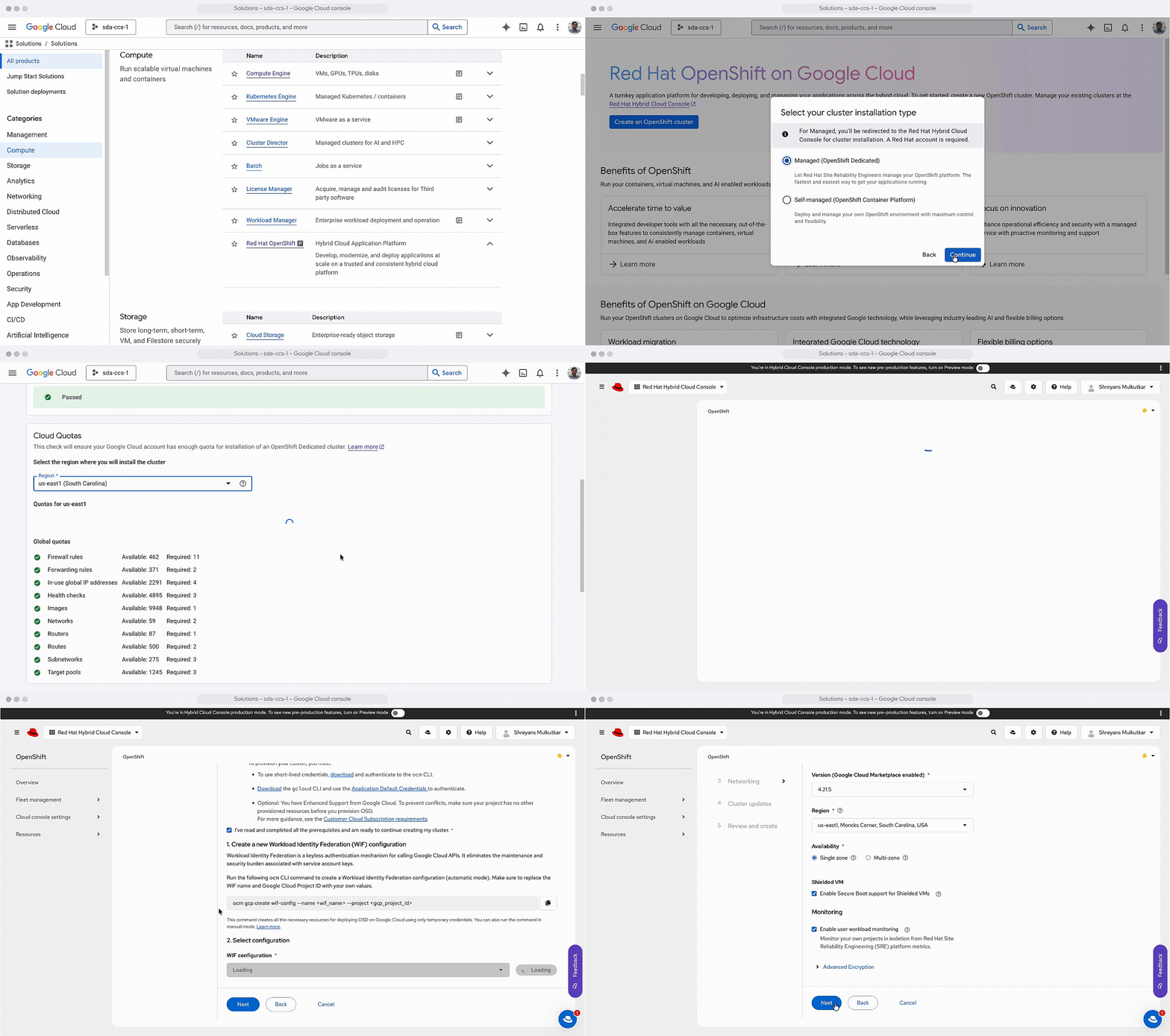
Getting started with OpenShift should be intuitive. We have integrated OpenShift directly into the Google Cloud Console to provide a guided experience. You can now create new clusters through a simplified interface, making it faster to deploy your environment on our platform.
OpenShift experience on Google Cloud Console eases cluster deployment by checking for cluster creation prerequisites and redirecting to Red Hat Hybrid Console to complete cluster creation:
Running VMs and containers together with Red Hat OpenShift Virtualization
We are also announcing the general availability of Red Hat OpenShift Virtualization on Red Hat OpenShift Dedicated on Google Cloud. A capability of OpenShift, this feature allows you to run and manage virtual machines (VMs) alongside containers on the same platform. By using Google Cloud bare metal instances and Hyperdisk, you can migrate your VMs from legacy virtualization solutions into a modern Kubernetes-based control plane. Additionally, OpenShift Virtualization on Google Cloud provides the utmost level of flexibility with bare metal access, and hypervisor-level configurability, including ability to set custom overcommit settings that are just right for your workloads to help optimize your costs. With OpenShift Virtualization on Google Cloud you unify your infrastructure management and move toward the cloud at your own pace.
Get started
-
Read the Google Cloud Cluster Services for OpenShift documentation to learn more about its different components, and their availability.
-
Visit OpenShift on Google Cloud Console to explore the new cluster creation experience.
- Read the OpenShift Virtualization documentation to learn how it can help you modernize your VM workloads.